- Streamline workflows
- Reduce waste and costs
- Allocate resources more effectively
- Improve productivity across departments
How Data Analytics Drives Smarter Business Decisions
 28 Feb
How Data Analytics Drives Smarter Business Decisions
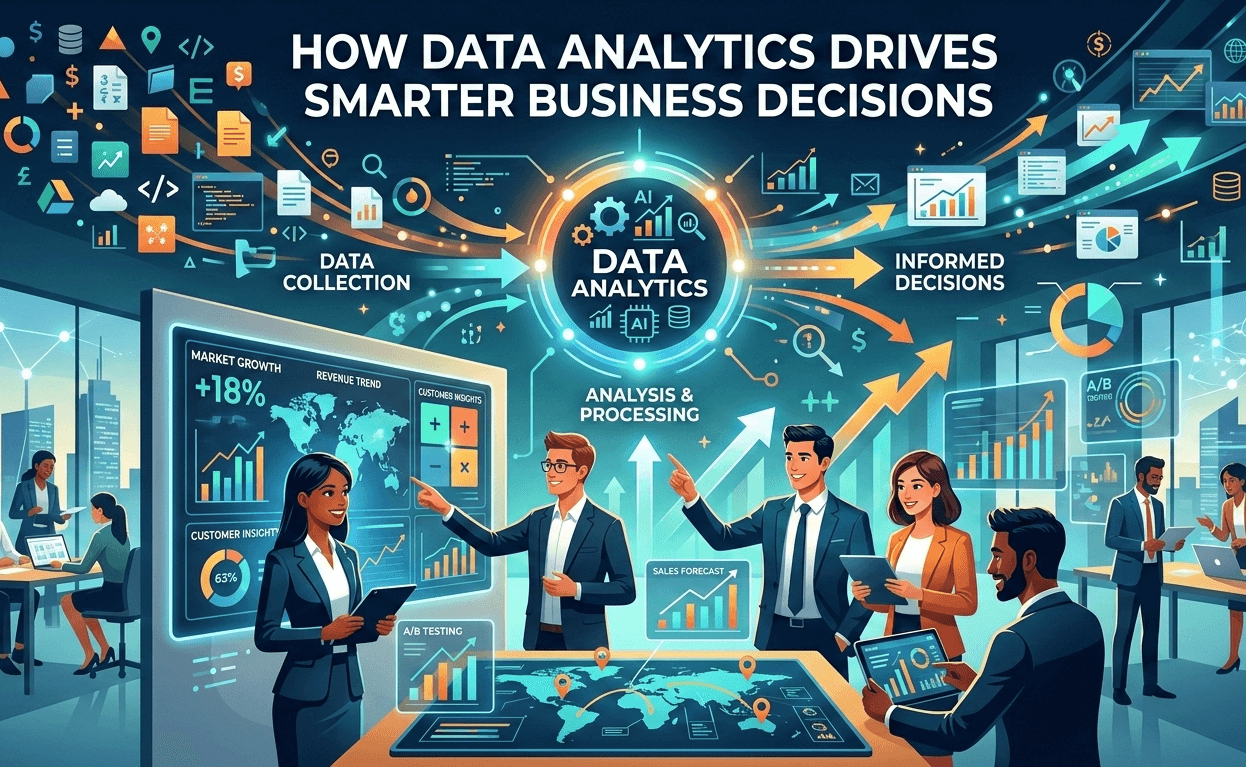
In today’s competitive business landscape, making informed decisions is crucial for success. Companies that rely on intuition alone often miss opportunities, mismanage resources, or fail to anticipate market trends. This is where data analytics comes in. By transforming raw data into actionable insights, businesses can make smarter, faster, and more accurate decisions. From marketing strategies to operational efficiency, data analytics is now the backbone of successful business decision-making.
What Is Data Analytics?
Data analytics is the process of collecting, processing, and analyzing data to identify patterns, trends, and actionable insights. It involves using statistical methods, predictive models, and visualization tools to make sense of complex information. Businesses can use data analytics to:
- Understand customer behavior
- Optimize processes and operations
- Predict market trends
- Measure performance and ROI
- Make data-driven strategic decisions
How Data Analytics Drives Smarter Business Decisions
1. Improved Customer Understanding
Data analytics helps businesses understand who their customers are, what they want, and how they behave. By analyzing purchasing patterns, online interactions, and feedback, companies can:
- Personalize marketing campaigns
- Enhance customer experience
- Predict future needs and preferences
This leads to higher engagement, retention, and sales.
2. Optimized Operational Efficiency
Analytics identifies inefficiencies and bottlenecks in business processes. Companies can:
Smarter operations mean higher profitability and faster response to market changes.
3. Data-Driven Strategic Planning
Data analytics allows businesses to forecast trends and plan strategically. By analyzing historical data, companies can:
- Predict market demand
- Identify growth opportunities
- Make informed investment decisions
- Avoid risky ventures
This minimizes guesswork and increases confidence in decision-making.
4. Enhanced Marketing Strategies
Analytics tools track campaign performance in real time. Businesses can:
- Identify high-performing channels
- Understand audience engagement
- Adjust strategies based on real data
This ensures marketing budgets are used efficiently and campaigns generate maximum ROI.
5. Risk Management and Compliance
Data analytics can detect patterns that indicate potential risks, such as financial fraud or operational failures. Companies can:
- Monitor compliance requirements
- Identify vulnerabilities
- Respond proactively to threats
This reduces financial losses and protects brand reputation.
Tools Commonly Used in Business Data Analytics
- Tableau : Data visualization and reporting
- Power BI : Interactive dashboards for business intelligence
- Google Analytics : Web traffic and user behavior analysis
- SAS : Advanced predictive analytics and modeling
- Python & R : Statistical analysis and machine learning
Best Practices for Leveraging Data Analytics
- Define Clear Goals : Know what you want to achieve with analytics.
- Collect Quality Data : Accurate, relevant, and timely data is essential.
- Use the Right Tools : Choose analytics platforms that fit your business needs.
- Train Your Team : Ensure staff can interpret and act on insights.
- Monitor and Iterate : Continuously refine analytics processes based on results.
Frequently Asked Questions
1. What is the role of data analytics in business decision-making?
Data analytics turns raw data into actionable insights, helping companies make informed, strategic decisions.
2.How can data analytics improve customer experience?
By analyzing customer behavior and preferences, businesses can personalize interactions, improve services, and increase retention.
3.Which industries benefit most from data analytics?
All industries can benefit, including retail, finance, healthcare, marketing, and logistics.
4.Do I need a large company to implement data analytics?
No. Businesses of all sizes can leverage data analytics using scalable tools and strategies.
5.What tools are commonly used for business data analytics?
Popular tools include Tableau, Power BI, Google Analytics, SAS, and programming languages like Python and R.
Want to make smarter business decisions using data?
Our team of experts specializes in data analytics solutions that help businesses gain actionable insights, optimize operations, and increase profitability. Contact StepToMedia to unlock the full potential of your data.

No next post available