Custom Internal Tools for Lebanon SMEs: Portals, Dashboards, and Workflows
 22 Sep
Custom Internal Tools for Lebanon SMEs: Portals, Dashboards, and Workflows
Custom internal tools Lebanon SMEs actually use are rarely glamorous. They are staff portals, partner dashboards, approval queues, and small workflow systems that remove spreadsheet chaos without forcing the company into a rigid global SaaS mold. In 2026, Lebanese and GCC mid-market teams face the same tension: off-the-shelf tools are fast to buy, but local payment realities, bilingual operations, WhatsApp-heavy communication, and legacy ERPs often break the “just subscribe” story.
This guide is a practical buyer map—when Excel or SaaS fails, what to build instead, how portals and workflows should be scoped, and how to decide build vs buy without inventing vanity ROI numbers.
Step to Media is a software development agency in Mkalles, Lebanon. We deliver website development (including web portals), mobile app development, custom software solutions, and TV apps for web, iOS, and Android when the product needs them. Start from our software development agency in Lebanon hub, or contact us at info@steptomedia.com · +961 03 510 646.
When Excel and SaaS stop being enough
Spreadsheets and generic SaaS are not “wrong.” They fail at predictable breakpoints.
Excel / shared-drive symptoms
- Multiple “final_v7” files and conflicting numbers in management meetings
- Manual copy-paste between sales, ops, and finance
- No audit trail for who approved what
- Access control that is either too open or painfully locked
- Mobile staff updating status over WhatsApp while the “system of record” lags by days
SaaS symptoms
- Your process needs fields and steps the vendor will not customize
- Seat pricing balloons as partners, agents, or seasonal staff join
- Critical integrations (local payments, ERP, WhatsApp templates) are shallow or missing
- Arabic/English UI and reports are second-class
- Data residency, export, or offline contingency requirements do not fit the vendor’s model
When two or more symptoms recur monthly, you are paying a tax in people-time. That is usually when a focused internal tool outperforms another subscription.
For the broader subscribe-vs-build frame, see custom software vs SaaS. For deeper web-app patterns, read the custom web application development ultimate guide.
What “custom internal tools” usually means for SMEs
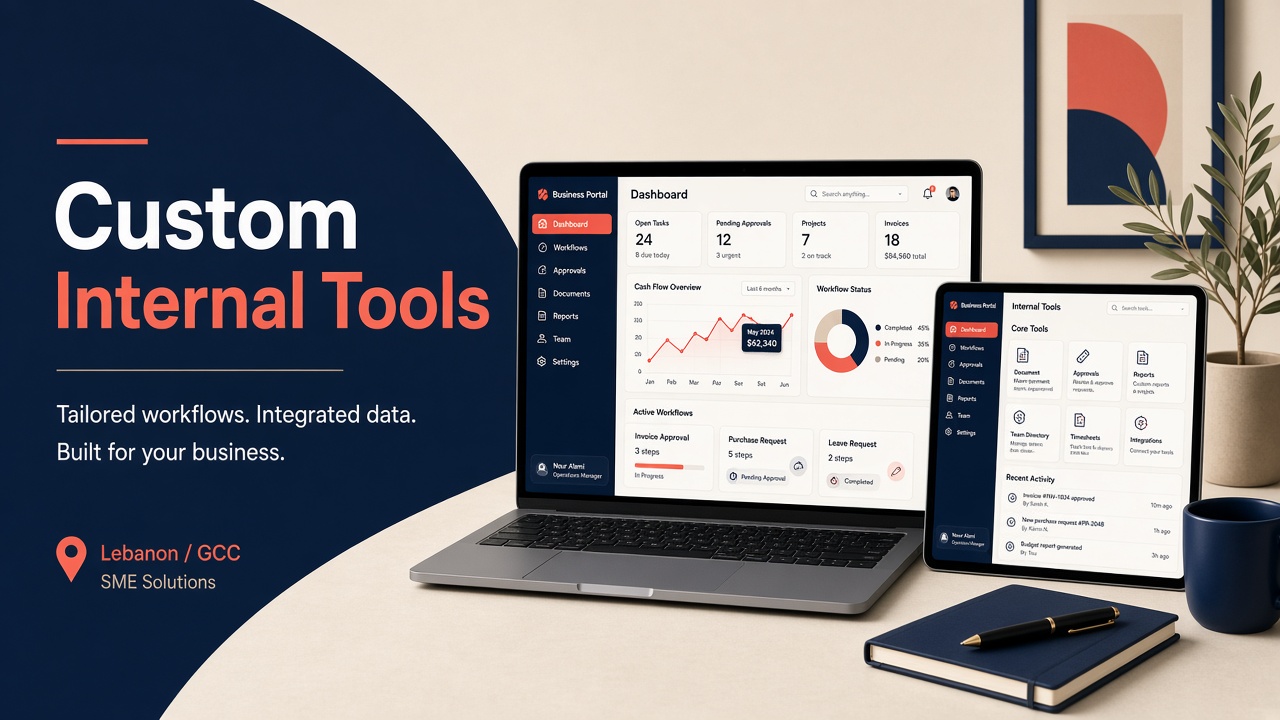
Keep the vocabulary concrete. Most Lebanon SME briefs fall into four building blocks.
| Building block | Who uses it | Typical outcomes |
|---|---|---|
| Staff portal | Employees, field teams | Tasks, leave/requests, document access, internal announcements |
| Partner / agent portal | Distributors, freelancers, franchisees | Orders, commissions, stock visibility, shared files |
| Operational dashboard | Managers, founders | KPIs from connected systems—sales, delivery, support, cash collection |
| Approval workflows | Multi-role teams | Purchase requests, discounts, content publishing, onboarding checklists |
You do not need all four on day one. The best first release usually automates one painful handoff—for example, quote → approval → invoice handoff—then expands.
Portals for staff and partners
A portal is a secure web application with role-based access. For Lebanon SMEs, successful portals share a few traits:
- Role clarity — staff, manager, partner, finance—not a single shared password.
- Mobile-friendly web — many users will never install a native app for internal work.
- Bilingual where it matters — labels and notifications in Arabic and English when mixed teams collaborate.
- Lightweight notifications — email plus WhatsApp or SMS where urgency is real; avoid notification spam.
- Document hygiene — versioned files beat endless chat attachments.
Web portals sit naturally inside website development when they share hosting, design system, and authentication with customer-facing sites—or they can be standalone apps on a subdomain. Either way, treat them as products with owners, not “small IT side projects.”
Dashboards that managers will actually open
Dashboards fail when they are vanity charts. They work when they answer weekly decisions.
Design rules that keep dashboards honest
- Start from decisions, not available data (“Which deliveries are at risk today?” beats “pretty pie charts”).
- Show freshness — timestamp every tile; stale data destroys trust.
- Prefer exceptions — overdue approvals, failed payments, low stock—over walls of green metrics.
- Connect to source systems via APIs; avoid nightly CSV rituals when possible.
- Gate access — executives, ops, and partners should not see the same cuts of data.
A first dashboard MVP often pulls from two or three sources only (CRM + accounting export + delivery sheet). Depth beats breadth.
Approval workflows without bureaucracy theater
Workflows encode who can request, who must approve, and what happens next. Useful patterns for regional SMEs:
- Purchase / expense requests with amount-based routing
- Discount or credit approval before sales can confirm
- Vendor onboarding checklists with document uploads
- Content or price-list publishing for marketing and ops
- HR-lite flows — leave, equipment, access provisioning
Implementation tips
- Keep steps few; every extra approver adds delay.
- Allow delegation for travel and leave.
- Log decisions for audit—especially finance-related flows.
- Surface status in the portal; do not make people chase updates on WhatsApp threads.
- Define SLAs (“approve within one business day”) in the product, not only in a policy PDF.
Integrations: payments, ERP, and WhatsApp
Internal tools earn their keep when they connect to systems you already run.
Common integration targets in Lebanon and the GCC:
- Payments — local gateways, card processors, or reconciliation feeds into finance tools
- ERP / accounting — customers, invoices, inventory, chart of accounts
- CRM — leads and deal stages that should not be retyped
- WhatsApp Business API — order status, approval links, OTP-style confirmations (used carefully and compliantly)
- Identity — Google Workspace / Microsoft 365 SSO for staff portals
Integration work is often the critical path. Budget discovery for API quality, sandbox access, and edge cases (partial payments, multi-currency, cash-on-delivery notes). For a focused technical overview, see API integration for Lebanon: payments, ERP, WhatsApp.
Build vs buy: a decision table for SMEs
Use this as a working session with your leadership team—not as dogma.
| Question | Lean buy (SaaS) | Lean build (custom) |
|---|---|---|
| Is the process standard globally? | Yes | No—local twists dominate |
| Will differentiation come from this workflow? | Unlikely | Yes—it is how you operate |
| Do you need deep ERP/payment/WhatsApp links? | Native connectors exist | APIs are messy or unique |
| Seat count and partner access volatile? | Pricing still OK | Per-seat model hurts |
| Must you own data model and roadmap? | Vendor roadmap fine | You need control |
| Timeline to first relief | Days–weeks | Weeks–months, phased |
Hybrid is common: keep SaaS for HR or email, build the operational spine that SaaS cannot express. Revisit the choice annually as volume and integrations change.
Cost conversations should stay scenario-based. For framing ranges and scope drivers (without treating any figure as a quote), see custom software development cost in Lebanon.
A sensible delivery sequence
Agencies and internal champions succeed with thin vertical slices:
- Map the painful handoff — who waits on whom, which spreadsheet is sacred.
- Define roles and permissions — before UI polish.
- Ship a portal MVP — create/read/update the core records + one approval path.
- Add one high-value integration — usually ERP or payments, not five at once.
- Dashboard the exceptions — managers see queues and risks.
- Harden — audit logs, backups, SSO, training, and a named product owner.
Avoid big-bang “digital transformation” programs that try to replace every tool in one quarter.
Lebanon / GCC operating realities to design for
- Connectivity variance — optimistic UI caching and clear offline messaging for field staff.
- Multi-entity groups — sister companies sharing a portal with strict data boundaries.
- Cash and transfer mix — status fields that reflect how money actually moves, not only card capture.
- WhatsApp as default ops channel — integrate deliberately; do not rebuild chat inside the portal unless needed.
- Bilingual leadership packs — exportable reports for boards and partners.
These are product requirements, not afterthoughts.
How to brief an agency (without wasting a week)
Bring:
- Current spreadsheet or SaaS screenshots of the broken flow
- User roles and approximate monthly volume
- Systems of record (ERP, payments, CRM) and whether API access exists
- Languages and device mix (desktop vs phone)
- Definition of done for phase 1 (one sentence)
- Who will own the tool after launch
Step to Media scopes custom internal software as part of our agency practice—often as secure web portals under website development, sometimes with companion mobile views when field teams need them. Explore the agency hub for positioning across web, mobile, custom solutions, and TV apps.
FAQ
Should we build a native mobile app for internal tools?
Often no for v1. A responsive web portal covers most staff and partner needs. Consider native or lightweight mobile apps when offline field work, camera-heavy workflows, or push-critical ops demand them.
How do we avoid rebuilding Excel inside a browser?
Model statuses, roles, and validations—not infinite free-form grids. Use structured forms and queues. Spreadsheets can remain for ad-hoc analysis after the system of record is solid.
What is a realistic phase-1 scope?
One portal audience (staff or partners), one core object (orders, tickets, requests), and one approval chain—plus login and audit basics. Integrations beyond a single critical system usually belong in phase 2.
Can custom tools replace our ERP?
Rarely as a first goal. Better pattern: keep ERP as financial backbone; build portals and workflows that feed it clean data and reduce shadow spreadsheets.
How do we measure success without fake ROI claims?
Pick operational metrics you already feel: cycle time for approvals, error rate in orders, hours spent reconciling, or number of WhatsApp chases per week. Compare qualitatively after 30–60 days of real use, then tighten instrumentation.
Soft next step
If Excel and SaaS are straining under your real Lebanon or GCC workflows, a focused portal or approval tool may be the highest-leverage software investment you make this year. Contact Step to Media (info@steptomedia.com · +961 03 510 646, Mkalles) with a short description of the handoff that hurts most—we will help you decide what to buy, what to build, and what to leave alone.