Web Application Development in Lebanon: Portals, Dashboards, and Custom Web Apps
Web Application Development in Lebanon: Portals, Dashboards, and Custom Web Apps
 17 Nov
Web Application Development in Lebanon: Portals, Dashboards, and Custom Web Apps
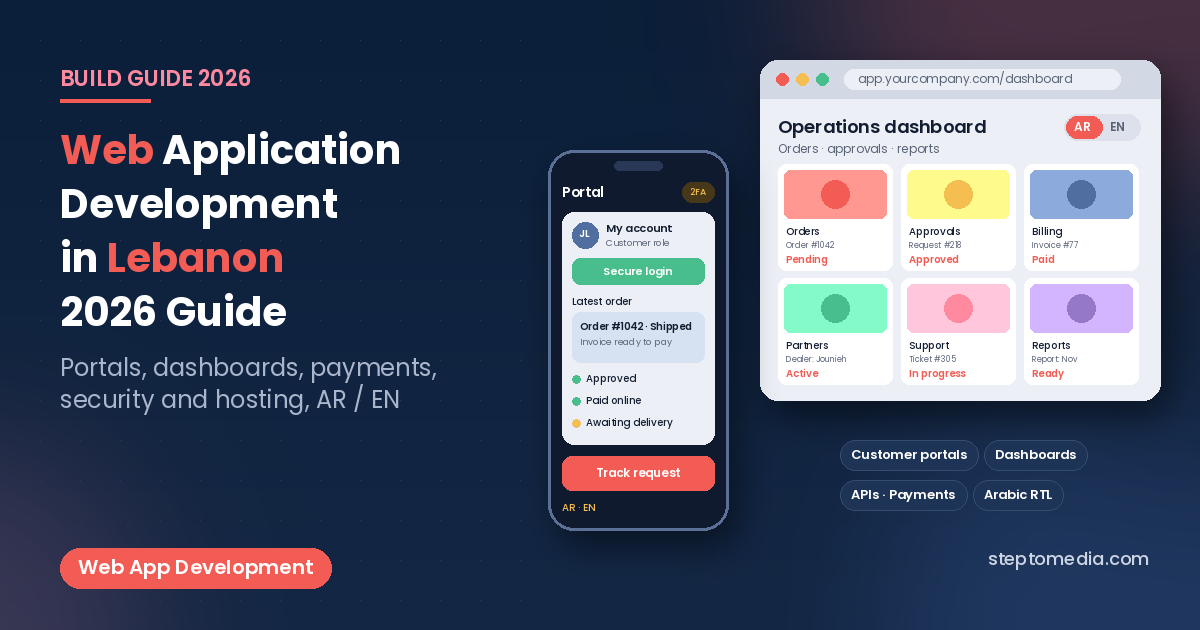
Web application development in Lebanon has moved well beyond company websites. More Lebanese and GCC businesses now run operations in the browser: customer portals, dealer dashboards, approval systems and SaaS products. A web application is software that people log into and use, not just pages they read. This guide covers what a custom web app includes in 2026, the choices that matter in Lebanon and the Gulf, how a project runs, and what to ask before you hire.
Step To Media is a software development agency in Lebanon based in Mkalles. We build websites, mobile apps and custom software.
Website vs Web Application: What Is the Difference?
A website mainly publishes information: services, projects, blog posts and a contact form. A web application lets users do things with their own data. They sign in, create and edit records, upload files, pay, track status and get notifications. The line is not always sharp, but a few signs tell you that you need a web app rather than a website development project:
- Users have accounts and see different data depending on who they are.
- There are roles and permissions, such as admin, manager, staff, customer or partner.
- Work moves through stages: requests, approvals, orders, invoices or tickets.
- The system has to talk to other systems, such as payments, accounting, an ERP, SMS or WhatsApp.
- Reports and dashboards are built from live data, not typed in by hand.
If you are still deciding between the browser and a phone app, our guide on web application vs mobile app: which to build first walks through the trade-offs.
Common Web Applications Lebanese and GCC Businesses Build
Most custom web apps we are asked about fall into a few families:
- Customer portals: clients log in to see orders, invoices, documents, appointments or project progress instead of asking on WhatsApp.
- Partner and dealer portals: distributors, agents or branches place orders, check stock and download price lists.
- Internal operations tools: request and approval workflows, job tracking, inventory, field reports and management dashboards. See custom internal tools for Lebanon SMEs for examples.
- SaaS products: a startup’s own software sold on subscription to many customers, which needs multi-tenant data separation and billing.
Key Decisions in Web Application Development in Lebanon
A few early decisions shape cost, speed and how easily the app can grow.
Arabic and English from day one
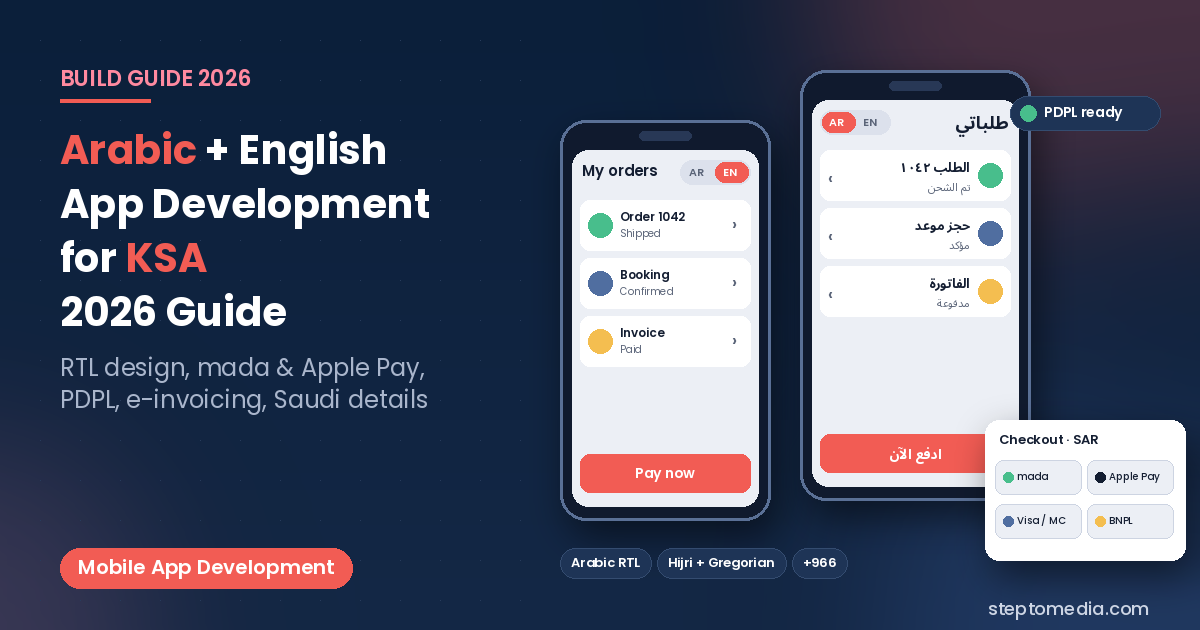
Many apps in Lebanon and the GCC need both languages. Right-to-left support is far cheaper to build in from the start than to add later: layouts built with CSS logical properties, a proper dir="rtl" switch, Arabic fonts, translated validation messages and emails, and dates and numbers formatted per language.
Real-world connectivity and devices
Users often open business apps on phones over mobile data. A responsive interface, light pages, clear loading states and forms that do not lose input when the connection drops make a real difference. For field staff, a progressive web app (PWA) adds an installable icon and limited offline use without a separate native app.
Payments and integrations
Payment options in Lebanon depend on your bank and on which gateways support your business, and many B2B apps still record cash, cheque or transfer payments alongside cards. GCC apps often need local gateways and wallets. Integrations with accounting software, an ERP, SMS providers or the WhatsApp Business Platform should be listed in the brief, because each one adds design and testing work. Our article on API integration for payments, ERP and WhatsApp covers this in more detail.
Hosting, data location and privacy
Major cloud providers run data centers in the Gulf, including AWS regions in Bahrain and the UAE and Microsoft Azure regions in the UAE. Some Saudi and UAE clients, especially in regulated sectors, ask for data to stay in the region, and both countries have personal data protection laws. In Lebanon, Law No. 81 of 2018 covers electronic transactions and personal data. Confirm hosting and data requirements before development starts, because moving later is expensive.
Typical Technology Stack for a Custom Web App
There is no single best stack; pick mature, widely used tools you can hire for and maintain for years. A typical setup:
- Front end: React, Next.js, Vue or Angular for the interface users see.
- Back end and API: Laravel (PHP), Node.js, Django (Python) or .NET for business logic and an API that a mobile app can reuse later.
- Database: PostgreSQL or MySQL for structured business data, plus file storage for documents and images.
- Infrastructure: cloud hosting, automated backups, staging and production environments, monitoring and SSL.
Ask the team why each piece fits your project.
Security Basics Every Web App Needs
Business apps hold customer, financial and employee data, so security is part of the build, not an add-on. At minimum, expect secure login with strong password rules and optional two-factor authentication, role-based permissions checked on the server, encrypted connections, protection against the common risks in the OWASP Top 10 such as injection and broken access control, audit logs, regular updates and tested backups.
How a Web Application Project Usually Runs
- Discovery: users, roles, workflows, integrations and what success looks like.
- Scope and MVP: agree on the smallest version that solves the main problem, and park the nice-to-haves.
- UX and UI design: clickable prototypes of the key screens in both languages.
- Development in sprints: working features shown every one to two weeks on a staging site.
- Testing: functional, permission, browser and mobile checks, plus user acceptance testing.
- Launch and data migration: importing records from spreadsheets or the old system.
- Support and iteration: monitoring, updates, bug fixes and the next round of features.
For a deeper look at the general process, see our custom web application development guide.
What Drives the Cost of a Web App
We do not publish fixed prices for web applications because two apps with the same name can differ in size many times over. The main cost drivers are the number of user roles and screens, how complex the workflows and rules are, the number of integrations, bilingual and RTL requirements, reporting needs, security and compliance requirements, and how much existing data has to be migrated. A clear brief and an MVP-first plan keep the budget under control.
Questions to Ask Before You Hire a Web App Team
- Who owns the source code, the domain and the cloud accounts?
- How will you handle Arabic and English, roles and permissions?
- How often will we see working software, and how are changes priced?
- What happens after launch: support, updates and response times?
- Can the same back end serve a mobile app later?
If your project mixes a portal, integrations and automation, it usually falls under custom software development rather than a standard website. You can also read how we work as a software and web development company in Lebanon, or contact us to talk through your idea.
Frequently Asked Questions
What is the difference between a website and a web application?
A website mainly presents information to visitors. A web application lets signed-in users work with data, such as placing orders, approving requests, booking appointments or viewing reports, often with different permissions for each role.
Can a web application work in Arabic and English?
Yes. A web app can support Arabic right-to-left and English left-to-right layouts, translated content, emails and notifications, and correct date and number formats. It is much easier and cheaper to plan this from the start than to add it later.
Should I build a web app or a mobile app first?
Many businesses start with a web app because it works on any device through the browser and is easier to update. A mobile app makes sense when users need push notifications, the camera or offline use daily. A well-built API lets you add one later.
Who owns the code of a custom web application?
Ownership is set by your contract. Make sure the agreement transfers the source code and intellectual property to your company, and that hosting and domain accounts are in your company’s name.
Where is Step To Media located?
Step To Media is a software development agency at 2001 Bldg, Bloc A, 3rd floor, Main road, Mkalles, Lebanon. We build websites, web applications, mobile apps and custom software for clients in Lebanon and the GCC.