Telemedicine App Development in Lebanon and the GCC: Video Consultations, E-Prescriptions and Payments (2026)
Telemedicine App Development in Lebanon and the GCC: Video Consultations, E-Prescriptions and Payments (2026)
 28 Nov
Telemedicine App Development in Lebanon and the GCC: Video Consultations, E-Prescriptions and Payments (2026)
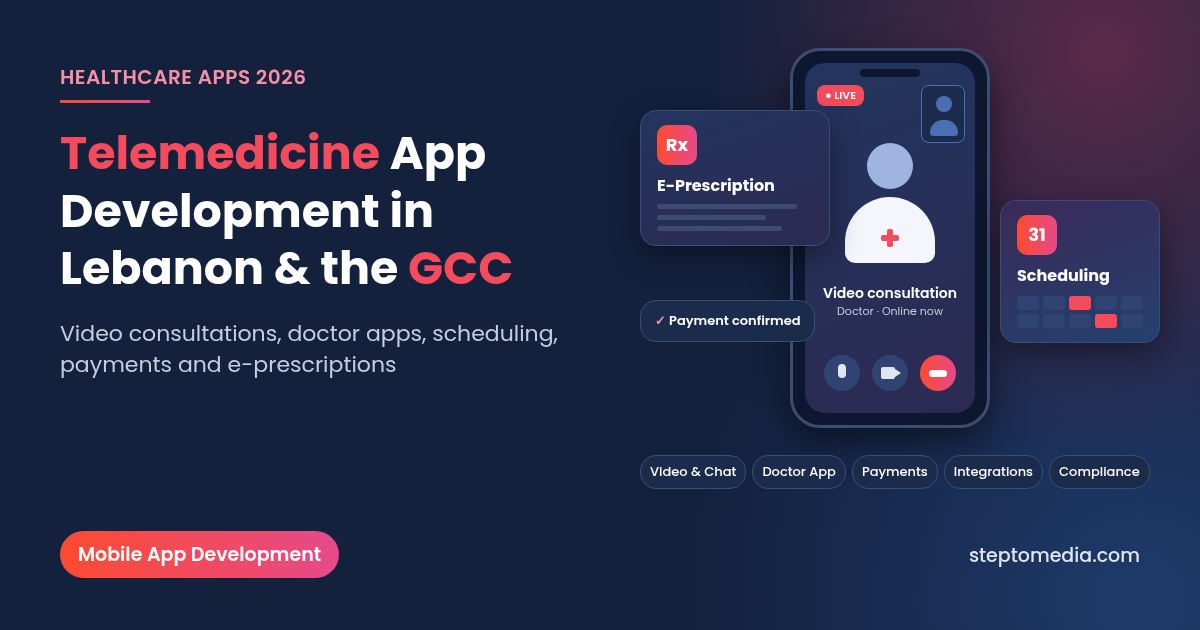
Clinics, medical centers and individual doctors in Lebanon and the Gulf increasingly want to see some patients without asking them to drive across town. Follow-ups, result reviews and chronic care check-ins often work well over a screen. Telemedicine app development is how a practice gets its own platform for this: a patient app, a doctor app and a back office that handle live video or chat consultations, scheduling, payments and e-prescriptions. This 2026 guide explains what a telemedicine app needs, which integrations matter, and what to check in Lebanon, Saudi Arabia and the UAE before you build.
Step To Media is a software development agency in Lebanon, based in Mkalles. This guide focuses on the consultation itself. If you are planning a patient records portal, a pharmacy ordering app or a simple appointment system, see the related guides linked further down.
What Telemedicine App Development Covers
A telemedicine platform is usually three connected products:
- Patient app (iOS, Android and often web): find a doctor, book a slot, pay, join the video call, chat, upload reports and receive prescriptions.
- Doctor app (mobile and web): manage availability, see the day’s queue, run the consultation, write notes and prescriptions, and follow up.
- Admin panel: manage doctors and specialties, prices, payments, refunds, support tickets and reports for the clinic or network.
Behind them sits a back end and API that handles accounts, scheduling, notifications, payments and secure storage. This is a typical custom software development project, with the apps built through mobile app development.
Core Features of a Telemedicine App
| Feature | What it does | Notes |
|---|---|---|
| Live video consultation | One-to-one video between doctor and patient inside the app | Usually built on a real-time video service (WebRTC-based) rather than from scratch; needs a fallback for weak connections |
| Chat and audio calls | Text consultations, voice calls and file sharing | Useful when video quality is poor or for quick follow-ups |
| Scheduling | Doctor availability, time slots, time zones, reminders | Instant “see a doctor now” queues and booked appointments work differently |
| Payments | Pay before the call, refunds, packages or subscriptions | Local payment gateways differ by country |
| E-prescriptions | Doctor issues a digital prescription the patient can view or share | Rules on what can be prescribed remotely vary by country |
| Consultation notes | Doctor notes, attachments, visit history | Access must be limited to the people treating the patient |
| Notifications | Push, SMS, email or WhatsApp reminders | Reduce missed appointments |
| Arabic and English | Full right-to-left support in both apps | Including prescriptions and invoices |
Video and Chat Consultations: Getting the Call Right
The video call is the heart of the product, and it is where most users judge the app. A few practical points:
- Use a proven real-time video provider or a well-supported open-source media server. Building a video stack from zero is rarely worth it.
- Plan for weak connections. Mobile data and home internet quality vary, especially in Lebanon. The app should lower video quality automatically, allow switching to audio, and let the doctor continue in chat.
- Waiting room and reconnection. Patients should wait in a virtual waiting room until the doctor admits them, and both sides should be able to rejoin a dropped call.
- Recording only if justified. Recording raises consent and storage questions, so many platforms do not record by default.
Scheduling and Payments
Telemedicine scheduling is more than a calendar. Doctors work across clinics and online hours, patients may book from another country, and instant consultations need a live queue of available doctors. The app should handle time zones, buffers between calls, cancellations and no-show rules.
Payment is usually taken before the consultation, with clear refund rules if the doctor cancels or the call fails. In the GCC, card payments, Apple Pay and local schemes are common through regional gateways. In Lebanon, many practices still mix online card payments with cash or transfer for some patients, so the admin panel should record payments made outside the app too. If you also need a public booking page on your clinic’s site, our website development team can connect it to the same back end.
E-Prescriptions and Integrations
An e-prescription feature can be as simple as a signed PDF the patient shows at a pharmacy, or as advanced as a direct connection to a national e-prescription system or a pharmacy network. Which one is possible depends on the country and the regulator, so confirm this early.
Other integrations to plan for:
- Clinic or hospital systems (EMR/HIS) to sync appointments and visit notes, often through APIs or HL7 FHIR where supported.
- Labs and imaging so patients can share results during the call.
- Insurance eligibility or claims, where the insurer offers an API.
- Identity verification for doctors (license checks) and, where required, patients.
Compliance in Lebanon, Saudi Arabia and the UAE
Health data is among the most sensitive data an app can hold, and telehealth is regulated differently in each market. Always check the current rules of the relevant health regulator and get legal advice before launch. In general terms:
- Saudi Arabia: the Ministry of Health runs its own virtual care through Seha Virtual Hospital and instant consultations in the Sehhaty app, so patients already expect video, audio and text consultations. The Personal Data Protection Law (PDPL), overseen by SDAIA, classifies health data as sensitive data, with stricter controls on access and processing.
- UAE: Federal Law No. 2 of 2019 on the use of ICT in health fields generally restricts storing or processing health data related to UAE health services outside the country, except in cases allowed by the health authorities. Emirate-level regulators set their own telehealth rules; for example, the Dubai Health Authority’s Standards for Telehealth Services apply to DHA-licensed facilities and exclude prescribing narcotic and controlled medicines remotely.
- Lebanon: there is no dedicated, comprehensive telemedicine law yet. During COVID-19, the Lebanese Order of Physicians stated that remote consultations should be between a doctor and patients they already follow. Check the Order’s and the Ministry of Public Health’s current position for your use case.
In practice, this affects where you host data, how you verify doctors, what can be prescribed online and how consent is collected.
Related Reading: Portals, Pharmacy Apps and Booking Systems
Telemedicine often sits next to other healthcare software. If your main need is giving patients access to records and results, read our guide to patient portal development. For medicine ordering and delivery, see pharmacy app development. And if you only need in-person appointments, a booking system for clinics may be enough.
Working With Step To Media
Step To Media is a software and web development company in Lebanon. We build web and mobile apps, custom platforms and admin panels for clients in Lebanon, the GCC and beyond, with bilingual Arabic and English interfaces, clear written scopes and support after launch. We handle the software; your clinic or legal advisor confirms the medical licensing side for each market.
Frequently Asked Questions
What is the difference between a telemedicine app and a patient portal?
A telemedicine app is built around live consultations: video, audio or chat with a doctor, plus scheduling, payment and prescriptions. A patient portal focuses on access to records, results and appointments. Many healthcare providers eventually connect both.
Can a telemedicine app work on weak internet connections?
Yes, if it is designed for it. The app can lower video quality automatically, switch to audio, and keep chat available so the consultation can continue when the connection drops.
Can doctors issue e-prescriptions through the app?
Technically yes, but what can be prescribed remotely and how prescriptions reach pharmacies depends on each country’s regulator. Some medicines, such as controlled drugs, are commonly excluded from remote prescribing. Check the rules in each market before launch.
Where should telemedicine data be hosted?
It depends on the market. The UAE, for example, generally restricts storing health data related to UAE health services outside the country, and Saudi Arabia treats health data as sensitive personal data. Plan hosting per country with your legal advisor.
Should we build native apps or use a cross-platform framework?
Cross-platform frameworks such as Flutter or React Native work well for most telemedicine apps and let one team ship iOS and Android together. Native development can make sense for very specific device or performance needs.
Planning a telemedicine platform for your clinic or medical network? Contact Step To Media and tell us what you want to build.
No next post available