OTT App Development in Lebanon and the GCC: Streaming Apps for Web, Mobile and Smart TV (2026)
OTT App Development in Lebanon and the GCC: Streaming Apps for Web, Mobile and Smart TV (2026)
 26 Nov
OTT App Development in Lebanon and the GCC: Streaming Apps for Web, Mobile and Smart TV (2026)
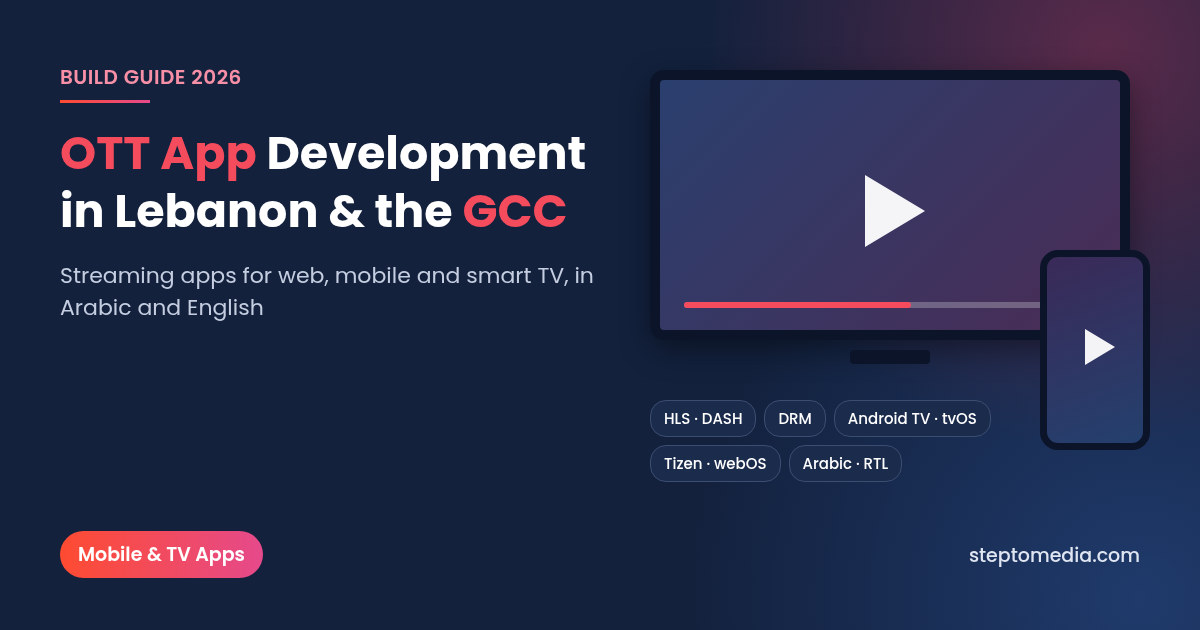
Local TV channels, sports clubs, churches, schools, fitness coaches and media startups across Lebanon and the Gulf are moving their video online. Viewers expect to press play on a phone, a laptop or a smart TV and get a smooth picture in Arabic or English. OTT app development is how that happens: building the streaming back end and the player apps that deliver video over the internet, without a cable or satellite operator in between. This 2026 guide explains how an OTT platform works, which devices to target, and what matters specifically in Lebanon and the GCC.
Step To Media is a software development agency in Lebanon, based in Mkalles. We build websites, mobile apps, custom software and TV apps for web, iOS and Android. Below is the checklist we would walk through with a client planning a streaming service.
What Is an OTT Platform?
“Over-the-top” (OTT) means content delivered straight to viewers over the internet. Well-known examples include global and regional subscription services, but the same model works at a much smaller scale: a channel’s catch-up library, a paid course library, a church’s live services or a club’s match replays. Every OTT platform, large or small, is made of the same building blocks:
- Content management (CMS): where your team uploads videos, writes titles and descriptions in Arabic and English, sets thumbnails, categories, release dates and regional availability.
- Encoding and storage: each video is converted into several quality levels so it can adapt to the viewer’s connection.
- Delivery: a content delivery network (CDN) serves video from servers close to the viewer.
- Users, plans and payments: sign-up, login, subscriptions, coupons, rentals and device limits.
- Player apps: web, iOS, Android and smart TV apps that browse the catalog and play the video.
- Analytics: what people watch, where they stop, and which devices they use.
Streaming Technology: The Parts That Matter
Adaptive bitrate streaming
Modern OTT apps use adaptive bitrate (ABR) streaming formats, mainly HLS (created by Apple and supported almost everywhere) and MPEG-DASH. The player switches quality automatically as the connection changes. This is important in Lebanon, where mobile data and home connections can vary during the day, and it keeps playback smooth instead of buffering.
Video on demand and live streaming
Video on demand (VOD) is the library: films, episodes, lessons and replays. Live streaming adds an ingest step, usually RTMP or SRT from the studio or encoder, plus live-to-VOD recording so the broadcast is available later. Live sports and events need extra attention to latency, scaling for peak audiences and a backup stream.
Build or integrate the video pipeline
Few businesses need to build encoding and DRM from scratch. A common approach is to integrate a cloud video platform for encoding, storage, DRM and CDN, and invest custom development in the parts viewers see and the business logic: the apps, the CMS workflows, payments and reports. This is the same custom vs SaaS decision that applies to most software projects.
Devices: Web, Mobile and Smart TV Apps
An OTT service usually lives on several screens, each with its own technology:
- Web: a fast, responsive web app where many users first sign up and pay. See our website development service.
- iOS and Android: native or cross-platform apps with downloads for offline viewing, casting to TVs and push notifications for new episodes. Our Flutter vs React Native comparison explains the cross-platform options.
- Android TV and Google TV: built with Android tools and designed for remote-control navigation.
- Apple TV: a tvOS app, usually built with Swift.
- Samsung and LG smart TVs: Tizen and webOS apps, built with web technologies and published through each manufacturer’s store. Our guide to Samsung and LG smart TV app development covers these in detail.
TV apps are a different design problem from phones: large text, focus states, simple rows and a “10-foot” interface driven by a remote. For an overview of every TV platform, read our TV app development guide.
Arabic, Rights and Regional Requirements
Bilingual experience
For audiences in Lebanon and the GCC, the app should switch cleanly between Arabic (right-to-left) and English, with metadata in both languages, Arabic and English subtitles (for example WebVTT files) and, where available, dubbed audio tracks. Search should tolerate different Arabic spellings of the same title. We cover the interface side in our post on bilingual Arabic and English websites.
Content rights and geo-restrictions
Licensed content is often sold per territory, so the platform may need to show a title in Lebanon but hide it in Saudi Arabia, or the reverse. Geo-restriction, release windows and expiry dates should be managed in the CMS, not hard-coded in the apps.
DRM and content protection
Rights holders usually require digital rights management. The main systems are Google Widevine (Android, Chrome, many TVs), Apple FairPlay (Apple devices and Safari) and Microsoft PlayReady (many smart TVs and Windows). Most platforms use a multi-DRM service, combined with tokenized URLs, device limits and concurrent-stream limits to reduce account sharing. Our secure app development guide covers the wider security checklist.
Monetization and Payments
OTT services usually choose one model or combine several:
- SVOD: monthly or yearly subscriptions.
- AVOD: free viewing with video ads.
- TVOD: pay-per-view, rentals or one-off purchases, common for events and matches.
- Hybrid: a free tier with ads and a paid tier without them.
Payments depend on the market and the device. Card payments on the web need a gateway that works for your country and currency; see our guide to payment gateways in Lebanon. Inside iOS, tvOS and Android apps, Apple and Google apply their own billing rules to digital subscriptions, so plan the payment flow around their current policies before you design the screens. Publishing itself has its own review steps, explained in our App Store and Google Play publishing guide.
Planning Your OTT Project
- Define the audience and content: VOD, live or both; free, paid or mixed; which countries.
- Choose the first screens: usually web plus iOS and Android, then the TV platforms your viewers actually use.
- Pick the video stack: a cloud video platform with DRM and CDN, or a more custom pipeline if you have special needs.
- Design the CMS workflow: who uploads, who approves, and how regional rights and schedules are set.
- Build a first version: catalog, player, accounts and payments on the main screens.
- Test on real devices and networks: older TVs, slow connections and both languages.
- Launch, measure and expand: add TV platforms, live events, recommendations and new plans based on real viewing data.
Budgets vary a lot with the number of platforms, live features and DRM needs, so we do not publish fixed prices here. For general market context on app budgets in the region, see our post on app development cost in Dubai and Saudi Arabia; those figures are public market ranges, not Step To Media’s official prices.
Why Work With a Lebanon-Based Team
A streaming service touches web, mobile, TV and back-end work at the same time, and it needs one team that understands Arabic interfaces and Gulf audiences. As a software and web development company in Lebanon, we work with clients in Lebanon, Saudi Arabia, the UAE, Qatar and Kuwait. If your platform also needs admin dashboards, reporting or integrations, our custom software development service covers that side.
Frequently Asked Questions
What is OTT app development?
OTT app development means building the apps and back end that deliver video or audio over the internet directly to viewers, without a cable or satellite operator. A typical OTT platform includes a content management system, video encoding and streaming, user accounts and payments, and player apps for web, mobile and smart TVs.
Which platforms should an OTT service launch on first?
Most services start with a responsive web app plus iOS and Android, because that is where sign-ups and payments usually happen. Living-room apps follow: Android TV and Google TV, Apple TV (tvOS), Samsung Tizen and LG webOS. The right order depends on where your audience watches, so check your own analytics or survey data.
Do we need DRM for a streaming app?
If you stream licensed films, series or sports, rights holders usually require DRM. The common systems are Google Widevine, Apple FairPlay and Microsoft PlayReady, often delivered through a multi-DRM service. For your own free content, signed URLs and token authentication may be enough.
Can an OTT app support Arabic and English?
Yes. A bilingual OTT app needs a right-to-left interface for Arabic, Arabic and English metadata in the CMS, subtitle tracks such as WebVTT, and optional dubbed audio tracks. Search should handle Arabic spelling variations so viewers can find titles easily.
How do OTT apps make money?
The main models are subscriptions (SVOD), advertising (AVOD), pay-per-view or rentals (TVOD), or a mix. Note that Apple and Google have their own billing rules for digital subscriptions sold inside their apps, so check their current policies when you plan payments.
How long does it take to build an OTT platform?
It depends on scope and on how much you build versus integrate. A first version using a ready video platform for encoding and DRM, with web and mobile apps, is usually planned in a few months. Each additional TV platform, live streaming, and custom recommendation features add time. A written scope gives a reliable estimate.
Planning a streaming app or video platform in Lebanon or the GCC? Contact Step To Media and tell us what you want to stream and to whom.
No next post available