Patient Portal Development in Lebanon and the GCC: Results, Prescriptions, and Secure Access
Patient Portal Development in Lebanon and the GCC: Results, Prescriptions, and Secure Access
 11 Nov
Patient Portal Development in Lebanon and the GCC: Results, Prescriptions, and Secure Access
Patient portal development gives clinics, medical centres, labs, and hospitals in Lebanon and the GCC a secure place where patients can see their own information without calling reception. Instead of lab results sent as photos on WhatsApp, prescriptions lost in a bag, and invoices requested again and again, patients log in to a web portal or app, and your team works from one system. This guide explains what a patient portal includes, how it differs from a booking system, and how to plan the first version.
Patient Portal vs Booking System
A booking system for clinics solves one problem: getting the right patient into the right slot with the right doctor. A patient portal starts where the appointment ends. Its job is ongoing access to the patient’s own record and to the clinic:
- Before the visit: registration forms, insurance details, and consent forms filled in online.
- After the visit: visit summaries, lab and imaging results, prescriptions, and follow-up instructions.
- Between visits: secure messages, document uploads, invoices, and reminders.
Many clinics need both, and they can share one patient account: book an appointment, then see the results of that appointment in the same place.
Who Needs a Patient Portal in Lebanon and the GCC
- Multi-doctor clinics and medical centres that want fewer reception calls and paper files.
- Diagnostic labs and imaging centres whose main daily task is delivering results.
- Dental, dermatology, and physiotherapy practices with treatment plans that run over many sessions.
- Hospitals and clinic groups serving patients across Beirut, Dubai, Riyadh, Doha, or Kuwait, often with patients living abroad who follow up remotely.
Core Features of Patient Portal Development
- Patient account and family profiles: one login that can manage a child’s or a parent’s records with permission.
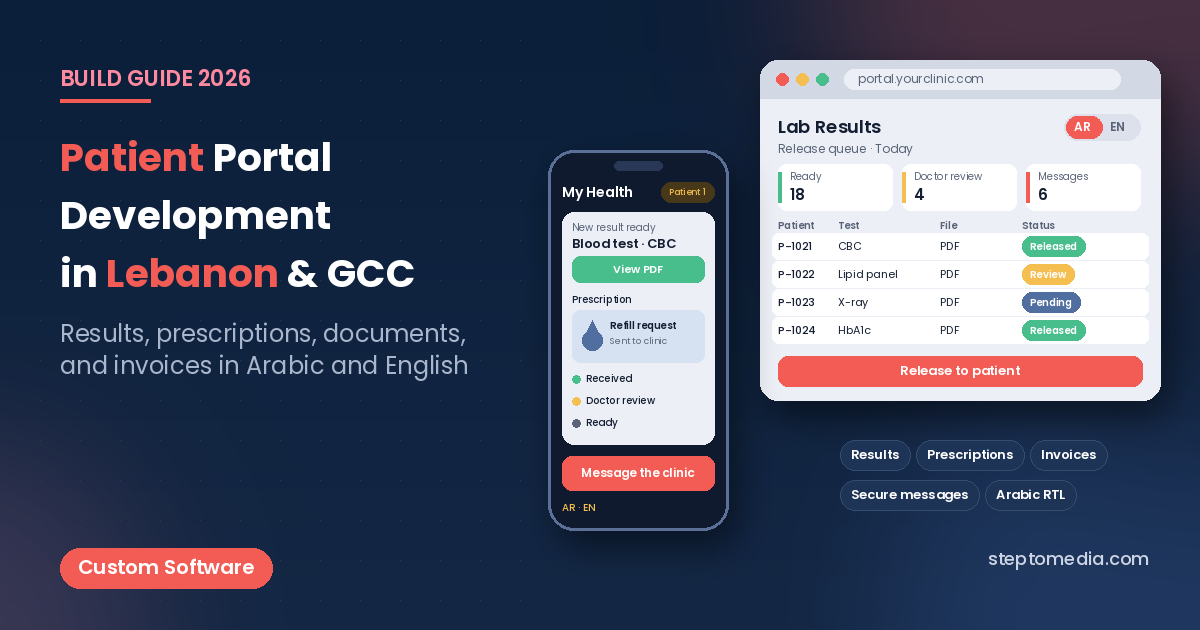
- Results: lab and imaging results released by staff, with PDF reports and clear status (pending, ready, reviewed by doctor).
- Prescriptions and medication lists: current medications, dosage instructions, and refill requests.
- Visit history: past appointments, doctor notes approved for sharing, and follow-up tasks.
- Documents: referral letters, sick leave notes, medical reports, and patient uploads such as previous test results.
- Billing: invoices, payments, insurance coverage notes, and receipts.
- Secure messaging: non-urgent questions to the clinic, routed to the right team, with response time expectations shown.
- Notifications: SMS, email, push, or WhatsApp alerts that say “a new result is ready” without exposing the result itself.
Staff Side: The Part Patients Never See
A portal is only as good as the back office behind it. Staff need to decide what gets published, when, and to whom:
- Release rules: some results can be released automatically, others only after a doctor has reviewed them and added a note.
- Roles: reception, nurses, doctors, lab staff, billing, and administrators each see only what their work requires.
- Audit trail: a log of who viewed, changed, or released each record and when.
- Message inbox: assignment, templates, and closing rules so patient messages do not sit unanswered.
Integrating With Your Clinic or Lab System
Most clinics already have software: a clinic management system, a lab information system, an imaging system, or an accounting tool. The portal should read from these systems rather than become a second place where staff type data. Common options are:
- Direct API integration when the existing vendor offers one. Our guide to API integration in Lebanon explains how this usually works.
- Healthcare data standards such as HL7 or FHIR, where the current system supports them.
- Scheduled file exports, such as PDF reports matched to patient IDs, when no API exists.
What is possible depends on your current vendor, so confirm it during scoping before you commit to features. If your current system is too limited, a broader custom software vs SaaS decision may come first.
Privacy and Security Basics
Health information is among the most sensitive data a business can hold. Rules differ between Lebanon, the UAE, Saudi Arabia, and other GCC countries, including where health data may be stored, so confirm the requirements for your country with a legal adviser before you choose hosting. On the technical side, a well-built portal should include:
- Strong login with one-time codes by SMS or email, and session timeouts on shared devices.
- Encryption in transit (HTTPS) and at rest for stored files and records.
- Role-based access for staff and explicit permission for family or caregiver access.
- Audit logs, backups, and a tested restore process.
- Notifications that never include diagnoses or result values in the message text.
Arabic, English, and French
Patients in Lebanon and the GCC often prefer Arabic, while doctors may write reports in English or French. Plan for a full Arabic and English RTL interface, and decide early which content is translated (menus, instructions, forms) and which stays in the original language (doctor reports). Dates, phone numbers, and names in Arabic and Latin script should display and search correctly.
Web Portal or Mobile App?
A responsive web portal is usually the right first step: patients open a link from an SMS, log in with a one-time code, and download their result. A mobile app adds value when patients come back often, for example for chronic care, physiotherapy plans, or medication reminders, and when push notifications matter. Our comparison of web application vs mobile app covers the trade-off, and simple, readable mobile app UX is essential for older patients.
Online Payments for Clinic Invoices
Paying an invoice or a deposit online removes queues at the cashier. Use a payment gateway’s hosted or tokenised checkout so card data never touches your servers, and record cash, card terminal, and insurance payments in the same ledger. Our guide to payment gateways in Lebanon covers the options and constraints.
A Practical Build Plan
- Discovery: map how results, prescriptions, invoices, and messages flow today, and which system holds each. A clear custom software brief saves weeks later.
- First version: patient login, results delivery, documents, and notifications. Results are the main reason patients log in, so they are a sensible place to start.
- Second phase: payments, secure messaging, prescriptions, and family profiles.
- Integrations: connect the clinic or lab system as early as the vendor allows.
- Testing and launch: test with real staff and a small patient group, then roll out gradually.
- Support: security updates, monitoring, and backups through ongoing website and app maintenance.
Patient Portal Development: Cost and Timeline
Cost depends on the number of user roles, the integrations required, whether you need a web portal only or also iOS and Android apps, languages, and hosting requirements. Integration with an existing clinic or lab system is often the biggest unknown. We don’t quote fixed prices without a scope; our custom software development cost guide and MVP development guide explain how scope drives budget and timeline.
How Step To Media Can Help
Step To Media is a software and web development company in Lebanon working with clients in Lebanon and the GCC. As a software development agency in Lebanon, we build custom software, secure web portals, and mobile apps for iOS and Android, in Arabic and English. If you are planning a patient portal, contact us with your clinic size, current systems, and the problems you want to solve first, and we will help you define a realistic first version.
Frequently Asked Questions
What is patient portal development?
Patient portal development is building a secure web portal or mobile app where patients can log in to see their own results, prescriptions, visit history, documents, and invoices, and contact their clinic, connected to a back office where staff control what is shared.
Is a patient portal the same as an online booking system?
No. A booking system handles appointments and schedules. A patient portal gives ongoing access to the patient’s record after the visit. Both can share one patient account.
Can a patient portal connect to our existing clinic or lab software?
Often yes, through the vendor’s API, healthcare standards such as HL7 or FHIR, or scheduled file exports. What is possible depends on your current system and should be confirmed during scoping.
Should the patient portal be in Arabic?
For most clinics in Lebanon and the GCC, yes. A bilingual Arabic and English interface with proper right-to-left layout makes the portal usable for more patients, while doctor reports can stay in their original language.
How much does a patient portal cost in Lebanon?
We don’t quote fixed prices without a scope. Cost depends on features, user roles, integrations, web vs mobile apps, languages, and hosting requirements.
No next post available