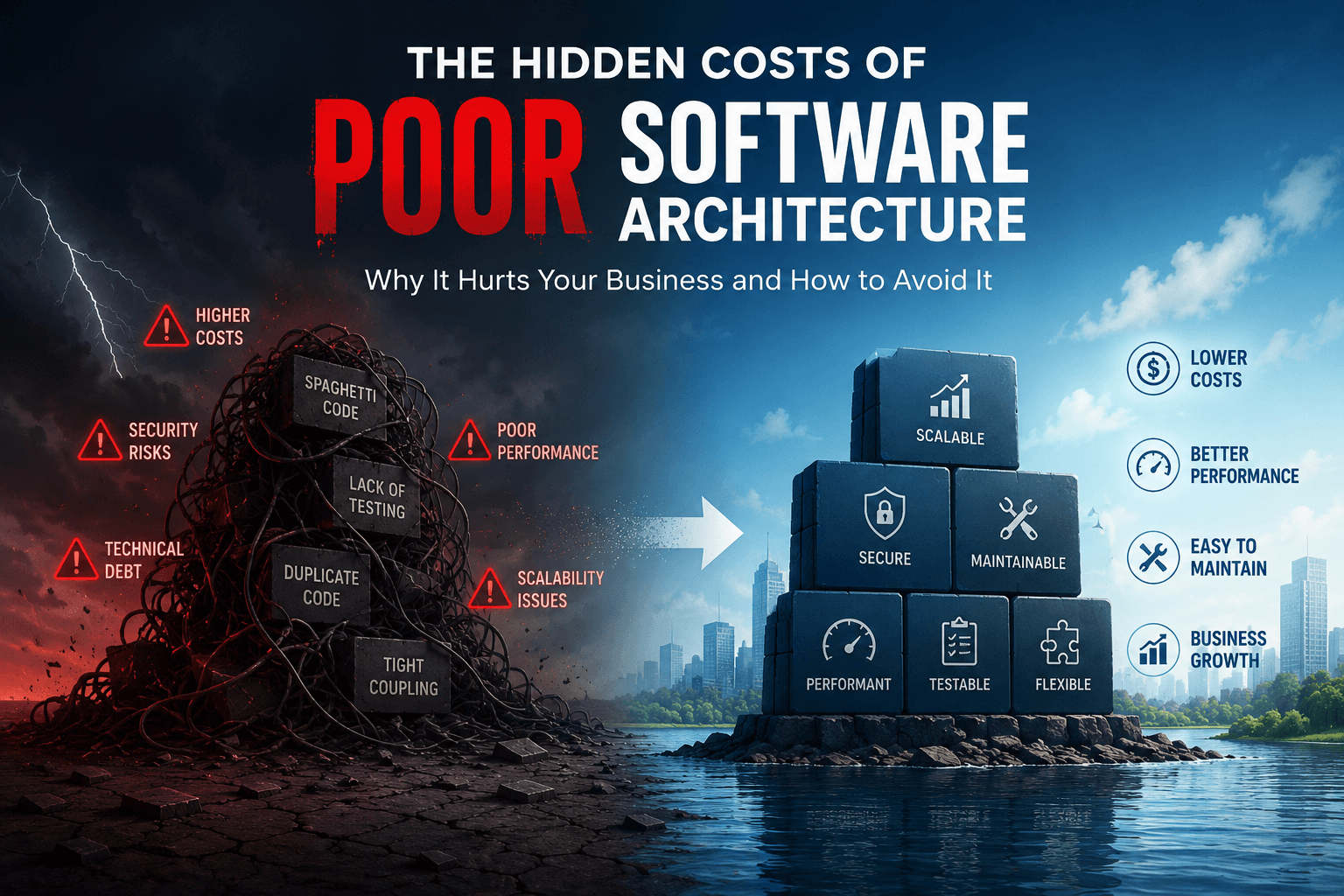
The Hidden Costs of Poor Software Architecture
 1 Jun
1 JunThe Hidden Costs of Poor Software Architecture
Why Investing in Strong Software Foundations Saves Businesses Time and Money
In today’s digital landscape, businesses rely heavily on software to manage operations, serve customers, and drive growth. While many organizations focus on features, design, and delivery speed, one critical aspect often goes unnoticed until problems arise: software architecture.
Poor software architecture can silently drain resources, increase technical debt, and limit a company’s ability to scale. Although the initial development may seem faster or less expensive, the long-term consequences can significantly impact both business performance and profitability.
In this article, we’ll explore the hidden costs of poor software architecture and why investing in a solid foundation is essential for sustainable growth.
What Is Software Architecture?
Software architecture refers to the high-level structure of a software system. It defines how different components interact, how data flows through the application, and how the system can scale, evolve, and remain secure over time.
Think of software architecture as the blueprint of a building. A beautiful building with weak foundations will eventually face structural problems. Similarly, software with poor architecture may function initially but often becomes difficult and costly to maintain.
1. Increased Development Costs
One of the most common consequences of poor architecture is rising development costs. When systems are poorly structured, developers spend more time understanding existing code, fixing bugs, and implementing new features. Tasks that should take hours may require days or even weeks due to complicated dependencies and unclear system design.
As the application grows, these inefficiencies multiply, leading to:
- Longer development cycles
- Higher labor costs
- Reduced team productivity
- Increased project delays
Over time, businesses often spend more maintaining the software than building it.
2. Reduced Scalability
As businesses grow, their software must grow with them. Applications built without scalability in mind often struggle to handle:
- Increased user traffic
- Larger databases
- Additional integrations
- New business requirements
This can result in slow performance, system outages, and frustrated users.
Eventually, organizations may be forced to rebuild significant portions of their applications—an expensive and disruptive process that could have been avoided with proper architectural planning.
3. Higher Maintenance and Technical Debt
Technical debt occurs when development teams prioritize short-term solutions over long-term quality. While quick fixes may solve immediate problems, they often create complex code that becomes harder to maintain over time.
Signs of growing technical debt include:
- Frequent bug fixes
- Repeated code duplication
- Difficulty implementing new features
- Increasing system instability
The longer technical debt remains unaddressed, the more expensive it becomes to resolve.
4. Security Vulnerabilities
Security should never be an afterthought. Poor software architecture can introduce vulnerabilities that expose sensitive business and customer data.
Common architectural weaknesses include:
- Weak authentication mechanisms
- Improper data handling
- Insecure API integrations
- Lack of access controls
Data breaches can lead to financial losses, legal consequences, and reputational damage that far exceed the cost of building secure architecture from the beginning.
5. Poor User Experience
Users expect software applications to be fast, reliable, and intuitive. Poor architecture often results in:
- Slow loading times
- Application crashes
- Inconsistent functionality
- Performance bottlenecks
Research consistently shows that users quickly abandon applications that fail to meet performance expectations. A poor user experience can lead to lower customer satisfaction, reduced engagement, and lost revenue opportunities.
6. Limited Business Agility
Modern businesses must adapt quickly to changing market conditions. When software architecture is rigid or poorly designed, introducing new features, integrating third-party services, or responding to customer feedback becomes increasingly difficult.
This lack of agility can prevent businesses from:
- Launching products faster
- Entering new markets
- Responding to competitors
- Taking advantage of emerging technologies
In competitive industries, delayed innovation often translates directly into lost market share.
7. Expensive System Rebuilds
Perhaps the most costly consequence of poor software architecture is the need for a complete system rewrite. Many organizations eventually reach a point where maintaining the existing application becomes more expensive than rebuilding it from scratch.
A full rebuild often involves:
- Significant financial investment
- Business disruption
- Data migration challenges
- Extended development timelines
With proper architectural planning from the outset, these costly rebuilds can often be avoided.
How to Avoid Poor Software Architecture
Organizations can minimize risks by adopting best practices such as:
Plan for Scalability
Design systems that can handle future growth without major structural changes.
Prioritize Code Quality
Implement coding standards, reviews, and automated testing.
Invest in Experienced Architects
Experienced software architects can identify potential issues before they become expensive problems.
Follow Modern Development Practices
Leverage proven architectural patterns, cloud infrastructure, and DevOps methodologies.
Regularly Review and Refactor
Continuous improvement helps prevent technical debt from accumulating.
Ready to Build Software That Scales?
Whether you’re launching a new digital product, modernizing an existing platform, or planning your next technology initiative, the right software architecture can make all the difference.
Contact StepToMedia today for a free consultation and discover how we can help you build secure, scalable, and future-ready software solutions tailored to your business goals.
Frequently Asked Questions
What is software architecture?
Software architecture is the high-level structure of a system that defines how components interact, how data flows, and how the application is organized for scalability and maintenance.
Why is good software architecture important?
Good architecture helps businesses build scalable, secure, and maintainable systems while reducing long-term costs and technical debt.
What are the signs of poor software architecture?
Common signs include frequent bugs, slow performance, difficulty adding new features, system instability, and increasing maintenance costs.
What is technical debt?
Technical debt refers to the extra work created when quick or poor development decisions lead to inefficient or hard-to-maintain code.
How can companies improve their software architecture?
By following best practices, using scalable design patterns, investing in experienced developers, and regularly refactoring and reviewing the system.

01 Jun, 2026
Behind the Scenes: Our Software Development Process