AI Development in Lebanon: How to Add AI Features to Your App or Software in 2026
 21 Oct
AI Development in Lebanon: How to Add AI Features to Your App or Software in 2026
Most businesses in Lebanon and the Gulf don’t need their own AI model. They need AI features inside software they already use or plan to build: a support assistant that answers from their own policies, a form that reads invoices, a search box that understands Arabic. Good AI development in Lebanon is mostly sound software engineering around a model API, with the same care for data, security, and testing that any custom build needs.
This guide explains which AI features are practical, how they are built, and the rules to plan for in 2026. For a broader view, see how AI is changing web and mobile app development.
AI Development in Lebanon: What Businesses Actually Build
Useful projects tend to follow a few patterns:
- Answers from your own content: an assistant on your website, app, or staff portal that replies using your FAQs, product data, or internal procedures, and says when it doesn’t know.
- Document and data extraction: turning invoices, IDs, delivery notes, or emails into structured fields that your system can save and check.
- Smarter search: letting users search a catalogue or knowledge base in their own words, in Arabic or English.
- Drafting and summarizing: suggested replies or ticket summaries that a person reviews before sending.
- Workflow actions: the model proposes an action, such as creating a booking, and your code checks and performs it.
The AI part is one component; screens, permissions, database, and integrations are still regular software. That is why many AI features fit naturally into custom internal tools like portals and dashboards.
Can You Use Major AI APIs From Lebanon and the GCC?
Yes. As of October 2026, the official supported-country lists for the OpenAI API, the Google Gemini API, and Anthropic’s API all include Lebanon, Saudi Arabia, the United Arab Emirates, Qatar, Kuwait, Bahrain, and Oman. Lists can change, so recheck before committing, and keep your code able to switch providers.
These providers publish prices per million tokens (pieces of text going in and out). Running cost depends on request size, user numbers, and the model you pick, so estimate it from real usage.
How an AI Feature Is Built
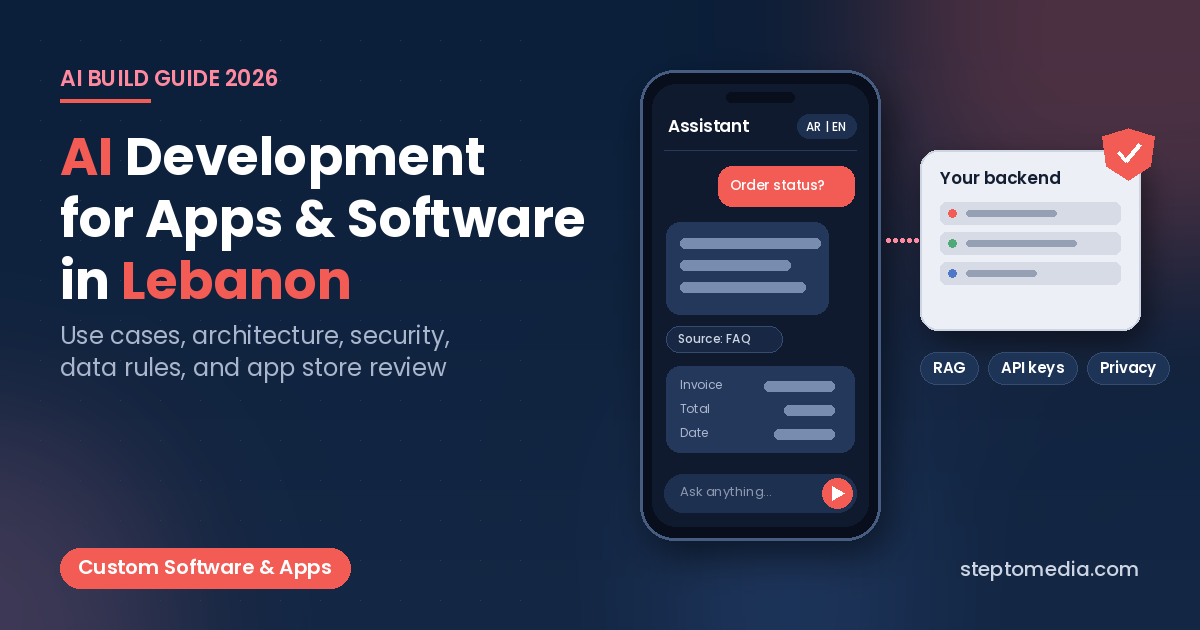
A typical architecture looks like this:
- Your app or website sends the question to your own backend, never directly to the AI provider.
- Your backend checks who the user is and what they may see.
- Retrieval: the backend finds the relevant pieces of your content, such as policy pages or product records, and adds them to the request. This is often called retrieval-augmented generation (RAG).
- The model answers using that context. For extraction or actions, it returns structured data. OpenAI and Gemini both document structured outputs that follow a JSON schema, and function (tool) calling, where the model asks your code to run a specific function.
- Your code validates the result, saves it, and decides what the user sees.
Keeping the provider behind your backend matters. OpenAI’s own guidance is to never deploy an API key in client-side environments like browsers or mobile apps, because anyone could copy it and make requests on your account. Requests should go through your server, where the key stays secret, whichever provider you use.
Most AI features also need your existing systems, such as your ERP or CRM. Our guide to API integration for payments, ERP, and WhatsApp covers how those connections are usually built.
Security Risks That Are Specific to AI
The OWASP Top 10 for LLM and generative AI applications (2025 edition) lists the main risks. Prompt injection is number one: text from a user, web page, or file can try to override the model’s instructions. OWASP notes that it is unclear whether fool-proof prevention exists, so the design has to limit the damage. In practice:
- Give the model only the data and functions the current user is allowed to use.
- Treat the model’s output as untrusted input: validate formats in code before saving or displaying anything.
- Require human approval for high-risk actions, such as refunds, deletions, or messages to customers.
- Set per-user usage limits to prevent runaway costs (“unbounded consumption” in OWASP’s list).
- Test with deliberate attack attempts before launch.
Personal Data: Lebanon and GCC Rules
Sending customer data to an AI provider means sharing it with a third party, often abroad. Plan for local rules early:
- Lebanon: Law No. 81 of 2018 on Electronic Transactions and Personal Data includes a section on personal data protection that applies to processing of personal data.
- Saudi Arabia: the Personal Data Protection Law, overseen by SDAIA, has a separate regulation on transferring personal data outside the Kingdom, including safeguards and risk assessments in some cases.
- UAE: Federal Decree-Law No. 45 of 2021 on the Protection of Personal Data, in force since 2 January 2022, covers processing and cross-border transfer of personal data.
On the provider side, OpenAI states that data sent to its API has not been used to train its models since 1 March 2023 unless you opt in, and that abuse-monitoring logs are kept for up to 30 days by default. Read your provider’s data terms, send only the fields a feature needs, and get legal advice for sensitive sectors such as health or finance. This article is not legal advice.
App Store and Google Play Rules for AI Features
If the AI feature lives in a mobile app, store rules apply too:
- Apple: App Review Guideline 5.1.2(i) requires apps to clearly disclose where personal data will be shared with third parties, including third-party AI, and to get explicit permission before doing so.
- Google Play: apps that generate content with AI must include in-app reporting or flagging so users can report offensive content without leaving the app.
Design the consent screen and report button from the start. Our guide to publishing on the App Store and Google Play from Lebanon covers the rest of the review process.
Arabic, English, and Testing
Test with real questions in Arabic, English, and the mix people actually type, including Arabic written in Latin letters, and check right-to-left display of answers. Before launch, build a test set of real questions with expected answers, and re-run it whenever the model, prompt, or content changes. AI output varies, so measure it instead of trusting a demo.
A Sensible First AI Project
- Pick one narrow, valuable task, such as order-status answers or invoice extraction.
- Start with content and data you own and keep up to date.
- Show sources, or hand over to a person when the answer isn’t certain.
- Plan who maintains the prompts, content, and tests after launch.
How Step To Media Can Help
Step To Media builds websites, web apps, mobile apps, and custom software from Mkalles for businesses in Lebanon and the Gulf, including AI features connected to your own data. Explore our custom software development, mobile app development, and website development services. You can also learn more about us as a software and web development company in Lebanon, or see how we work as a software development agency in Lebanon. If you have an AI feature in mind, contact us with the task, the data it needs, and where your users are.
Frequently Asked Questions
Do I need to train my own AI model?
Usually not. Most business features use an existing model through an API, combined with your own content and data at request time.
Are the OpenAI, Gemini, and Anthropic APIs available in Lebanon?
Yes. As of October 2026, all three official supported-country lists include Lebanon, as well as Saudi Arabia, the UAE, Qatar, Kuwait, Bahrain, and Oman.
Can I call an AI API directly from my mobile app?
It isn’t recommended. OpenAI advises never putting API keys in browsers or mobile apps. Route requests through your own backend so the key stays secret.
Will an AI provider train on my business data?
It depends on the provider. OpenAI states that API data has not been used for training since March 2023 unless you opt in. Check your provider’s terms.
Do AI features change App Store or Google Play review?
Yes. Apple requires clear disclosure and explicit permission before sharing personal data with third-party AI. Google Play requires in-app reporting for apps that generate AI content.
What is the biggest security risk in an AI feature?
OWASP ranks prompt injection first. Limit the model’s access, validate its output in code, and require human approval for high-risk actions.
No next post available