Website and App Maintenance in Lebanon: What a Support Plan Should Cover in 2026
 19 Oct
Website and App Maintenance in Lebanon: What a Support Plan Should Cover in 2026
Launch day feels like the finish line, but for a website, web app, or mobile app it is the start of a second phase. Software keeps changing around you: CMS and plugin updates, PHP versions reaching end of life, shorter SSL certificates, new iOS and Android releases, and app store rules that can block your next update. Good website maintenance in Lebanon and the GCC is the plan that keeps all of this under control after the build team moves on.
Here is what a maintenance and support plan should cover in 2026 and which dates to watch. It picks up where our website launch checklist for Lebanon ends.
Maintenance, Redesign, or Modernization?
These are three different jobs. Maintenance keeps a working product secure, fast, and compliant month after month. A website redesign changes structure, content, and design when the site no longer fits the business. Legacy website modernization replaces an outdated stack that can no longer be maintained safely. A solid maintenance plan delays the need for the other two, and it tells you early when one of them is due.
What Website Maintenance in Lebanon Should Cover
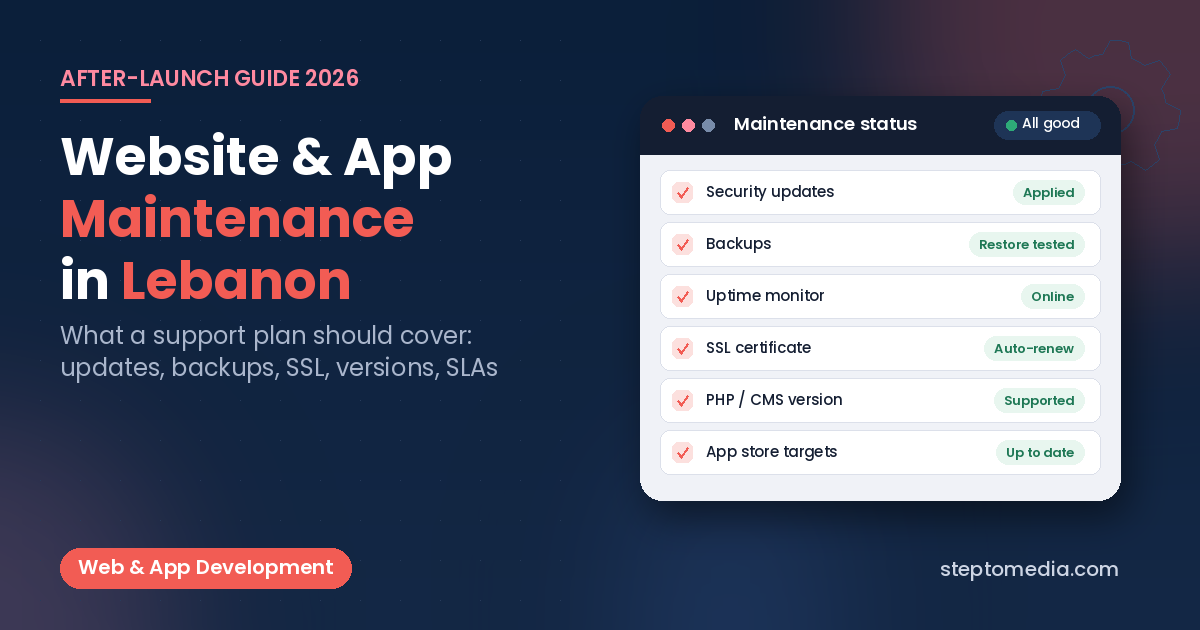
Whatever the stack, a complete plan should name who is responsible for each of these:
- Updates and security patches for the CMS, plugins, frameworks, and libraries.
- Off-server backups with tested restores.
- Uptime and error monitoring.
- Automated SSL/TLS certificate renewal.
- Server versions such as PHP, Node.js, and the database.
- Mobile OS and app store compliance.
- Performance checks.
- Bug fixes with agreed response times.
- Hosting, domains, and access owned by your company.
Updates and Security Patches
On WordPress, minor core releases (maintenance and security fixes) install automatically by default. Sites created on WordPress 5.6 or later also get major core updates automatically, unless that is turned off. Plugins and themes are different: since WordPress 5.5, administrators opt in to auto-updates one plugin or theme at a time. Otherwise, they only update automatically in special cases decided by the WordPress security team.
So someone still has to apply plugin and theme updates and check key pages and forms afterwards. Custom web apps and mobile apps need the same for their frameworks and packages. Test updates on a staging copy first, then release them live.
Backups You Have Actually Restored
A backup only counts if you can restore it. WordPress’s own upgrade guide says to verify that your backups exist and are usable, and calls this essential. For any site or app, agree on:
- What is backed up: database, uploaded files, code, and configuration.
- How often, and how many copies are kept.
- Where copies are stored: off the main server, with access you control.
- When restores are tested, for example on a staging server.
Uptime Monitoring and Alerts
Do not rely on customers to tell you the site is down. Monitor the homepage and the flows that bring leads or sales: forms, checkout, login, and the APIs your mobile app depends on. Alerts should reach a named person on your side and the agency’s.
SSL/TLS Certificates Are Getting Shorter
The CA/Browser Forum, the industry body that sets rules for public TLS certificates, adopted ballot SC-081 in 2025. The maximum certificate lifetime drops in stages:
- 200 days for certificates issued from March 15, 2026.
- 100 days from March 15, 2027.
- 47 days from March 15, 2029.
Renewing by hand is no longer realistic. Automate renewals and get alerts before any certificate expires, including subdomains and API endpoints.
PHP and Platform End of Life
Each PHP branch gets two years of active support and then two years of security fixes only. After that, it reaches end of life. According to php.net, PHP 8.2 gets security fixes until December 31, 2026, PHP 8.3 until December 31, 2027, and PHP 8.4 until December 31, 2028. WordPress currently recommends PHP 8.3 or greater.
If your site still runs PHP 8.2 or older, plan the upgrade now: test the theme, plugins, and custom code on the new version before switching the live server. The same applies to Node.js, databases, and frameworks in custom web applications. Our comparison of WordPress vs a custom website explains how each option changes your long-term maintenance work.
Mobile Apps: OS Releases and Store Rules
Mobile apps need maintenance even if you never add a feature, because Apple and Google raise their requirements every year:
- Google Play: since August 31, 2026, new apps and app updates must target Android 16 (API level 36) or higher. Existing apps must target at least Android 15 (API level 35) to stay available to new users on newer Android versions. Android TV apps must target at least Android 14 (API level 34).
- Apple: since April 28, 2026, apps uploaded to App Store Connect must be built with Xcode 26 or later using the iOS 26 SDK (or the matching iPadOS, tvOS, visionOS, or watchOS SDK).
If an app has not been rebuilt in a year, the next urgent fix may first need SDK upgrades and retesting. Regular maintenance keeps fixes quick. Our guide to publishing on the App Store and Google Play from Lebanon covers the store accounts these updates go through.
Performance Does Not Stay Fixed
New images, tracking scripts, plugins, and features slowly make a site heavier. Include regular speed checks on key templates, especially on mobile, and fix regressions before they hurt sales. Our article on why slow websites hurt online sales explains what to watch.
Bug Fixes and Response Times
A support plan should define severity levels in writing. For example: “critical” when the site, checkout, or app is down; “high” when a key feature is broken; “normal” for smaller issues and content changes. For each level, agree on a response time, a target fix time, support hours, and the reporting channel. Also agree on what counts as maintenance versus new work.
Hosting, Access, Ownership, and Handover
Your company should own the key accounts: domain registrar, DNS, hosting or cloud account, code repository, analytics, and App Store Connect and Play Console. Give your agency its own user accounts with the access it needs, turn on two-factor authentication, and keep credentials in a shared password manager instead of email or chat. When someone leaves, remove their access.
Ask for handover documentation too: where everything is hosted, how to deploy, the dependency list, where backups live, and how to restore. That way you can change agency without losing control.
How Step To Media Can Help
Step To Media builds and maintains websites, web apps, mobile apps, and TV apps from Mkalles for businesses in Lebanon and the Gulf. Explore our website development, mobile app development, and custom software development services. You can also learn more about us as a software and web development company in Lebanon, or see how we work as a software development agency in Lebanon. If your site or app needs a maintenance plan, contact us with its stack, hosting, and current versions.
Frequently Asked Questions
What does website maintenance include?
Updates and security patches, tested backups, uptime monitoring, SSL renewal, server and PHP version upgrades, performance checks, and bug fixes with agreed response times. For apps, it also covers new OS versions and store requirements.
Does WordPress update itself automatically?
Minor core releases update automatically by default, and sites created on WordPress 5.6 or later also get major core updates. Plugins and themes only auto-update if you enable it for each one, or in special security cases.
How often should backups be tested?
Agree on a schedule in your plan, and always test after major changes. WordPress’s own guide calls verifying that backups are usable essential.
Why do SSL certificates need renewing more often now?
CA/Browser Forum ballot SC-081 reduces the maximum certificate lifetime to 200 days from March 15, 2026, 100 days from March 15, 2027, and 47 days from March 15, 2029. Automated renewal is the practical answer.
Do mobile apps need maintenance if nothing changes?
Yes. Google Play requires new apps and updates to target Android 16 (API level 36) since August 31, 2026, and Apple requires uploads to be built with Xcode 26 since April 28, 2026.
Who should own the hosting and domain accounts?
Your company. Give your agency its own user access with two-factor authentication, so you keep control if people or providers change.
No next post available