What to Lock in a Custom Software Brief in Lebanon Before You Ask for a Quote
 1 Oct
1 OctWhat to Lock in a Custom Software Brief in Lebanon Before You Ask for a Quote
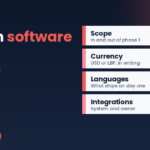
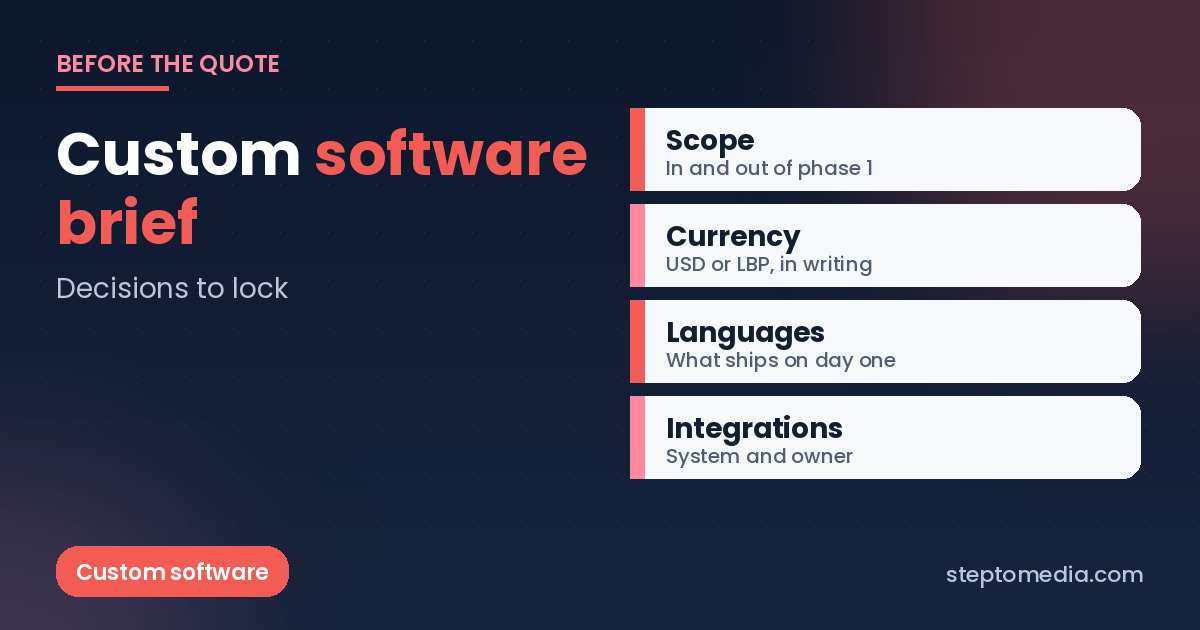
A custom software project brief Lebanon companies can send before a quote is a short lock on scope, currency, languages, and integrations. Without it, two vendors price two different products and both numbers look sure. The brief is not a 40-page specification, and it is not a tour of who sells software. It is the decisions that make a first phase estimable.
Step To Media builds this work from Mkalles as a software development agency in Lebanon. The custom software development page describes the engagement. Finish the brief before you ask us, or anyone else, for a figure. This article is not legal, accounting, or procurement advice.
The problem, then the feature list
Name the job the software replaces, who does that job today, and what “better” means in 90 days. Better might mean fewer spreadsheet handoffs, a customer who can see status, or a manager who can approve a request without a phone call. If you cannot describe the job, the feature list will grow until the quote is fiction.
Say whether you are replacing a tool, extending one, or covering a gap. If a standard product already does the job, read custom software versus SaaS before you commission a build. Custom work fits when your rules or your integrations do not. It does not fit because a template feels plain.
Scope you freeze for phase one
Phase one is the smallest release on which a real user can finish one important task. Write the rest down so it does not leak into the price.
- In scope: the screens, roles, and single workflow you will accept the software against.
- Out of scope: native mobile apps, extra branches, extra brands, and reports nobody uses yet.
- Users: how many people on day one, and the roles (staff, manager, accountant, customer).
- Data: what must be imported, roughly how many rows, and who cleans it.
- Acceptance: three to five sentences a non-developer can test. Example: a manager approves a request and the requester sees the new status without calling.
Many Lebanese SMEs start with an internal tool shaped like that. See custom internal tools for SMEs in Lebanon. If the work is mostly connecting systems you already pay for, say so. That may be API integration or process automation rather than a new product.
Currency: USD or LBP, written down
Proposals in Lebanon are often in US dollars because salaries, hosting, and licenses move with the exchange rate. Some approvals still need Lebanese pounds. Either can be valid. Silence is what causes disputes.
- The invoice currency is USD or LBP, not “whichever is easier on the day.”
- Say whether figures are exclusive of VAT, and confirm the tax treatment with your accountant. This is not tax advice.
- If you need pounds, state what happens if the rate moves between signature and the last invoice.
- Tie payment to milestones, such as an approved scope, a staging review, and launch.
- Say who pays third parties: hosting, SMS, email delivery, and payment processing.
Published market bands, for orientation only, are in custom software development cost in Lebanon. Those figures are not Step To Media’s official prices. A brief like this one is what turns a band into a phase-one quote.
Languages
State what must ship in version one. Arabic, English, and sometimes French appear in Lebanese companies. Do not assume all three are included.
- Which language is the default, and whether the layout must be right-to-left.
- Who translates, and whether records (not only menus) are translated.
- Date and number formats your staff already use.
- Whether SMS or email is in a different language from the admin screens.
Adding Arabic after screens are built costs more than designing for it. An internal tool used by one team can stay in a single language for phase one if you write that limit down.
Integrations
“Connect our ERP” is not estimable. A named product, a direction of data, and a person who can open a sandbox is. Use one row per system.
| What to write down | Why a quote needs it |
|---|---|
| Product name, and whether you already have a contract | You cannot test an API for a product you have not bought |
| What moves, and which way | A one-way export is a different build from two-way sync |
| Who can issue test keys | Waiting on a supplier is calendar time |
| What happens if the other system is down | Retries and a manual fallback are scope |
| Whether payments are in phase one | Checkout is its own work. Start with payment gateways in Lebanon |
WhatsApp, SMS, and email count even when they feel like “just a notification.” The field notes are in API integration for payments, ERP, and WhatsApp.
Ownership and change control
Say where the code and the cloud accounts will live, and in whose name. The company should be able to reach the repository, the host, and an admin user after launch. Also state how a change is requested after signature, so a new report does not appear as a free extra in week six.
Add only the security rules you already know you must meet: who may export data, and how a leaver’s account is closed. If you have no written rule, say so, and ask which defaults the vendor will use for access and backups. Do not paste a policy nobody has read.
One page you can send
- The process you are fixing, and who feels it today.
- Phase-one workflow, in scope and out of scope.
- Roles, rough user counts, and data to import.
- Invoice currency (USD or LBP), tax assumption, and milestones.
- Languages on day one, and who translates.
- Each integration: system, direction, account owner, sandbox yes or no.
- Where code and hosting will sit, and how changes are approved.
- Three to five acceptance sentences, plus a date to start discovery, not a fantasy launch day.
That is enough for a serious first conversation. Vendors may still quote different figures. They will at least be quoting the same project.
Questions before you ask for a number
What is a custom software project brief in Lebanon?
It is the short document you lock before quotes: the phase-one workflow, what is out of scope, invoice currency, languages, integrations, data to import, and how you will accept the work. It describes your project. It is not a directory of companies.
Should the quote be in USD or LBP?
Pick one and write it down. Many software proposals in Lebanon use US dollars because delivery costs move with the exchange rate. If you need Lebanese pounds for an internal approval, say what happens when the rate moves before the last invoice. A published market band is not a vendor’s price.
Do we need Arabic in version one?
Only if the people using that version need it. Customer-facing products often need Arabic and English, with right-to-left layout from the start. An internal tool for one team can ship in a single language if that limit is explicit.
How detailed must integrations be?
Name the product, the data, the direction, who can create test access, and whether payments or messaging are included. “Connect to our system” cannot be priced properly.
Can a slide deck produce a fixed quote?
It can produce a range. A fixed phase-one quote needs the scope, currency, languages, and integrations above. If those are still open, pay for a short discovery instead of pretending the price is fixed.
What should stay out of the first quote?
Later phases: extra offices, native mobile apps, new brands, and reports you have not used. List them as out of scope so they are not lost and not silently included.
Send the brief
Contact Step To Media with the one-page brief, even if some rows still say unknown. We will say what can be estimated now and what should wait for discovery. You can also email info@steptomedia.com or call +961 3 510 646.
01 Oct, 2026
Website Go-Live Checklist for Companies in Lebanon
No next post available