Multi-Vendor Marketplace Development in Lebanon and the GCC: Vendors, Commissions, and Payouts
Multi-Vendor Marketplace Development in Lebanon and the GCC: Vendors, Commissions, and Payouts
 14 Nov
Multi-Vendor Marketplace Development in Lebanon and the GCC: Vendors, Commissions, and Payouts
Marketplace development is a different project from building a normal online store. In a store, one business sells its own products. In a multi-vendor marketplace, many independent sellers list products or services, customers buy from several of them in one checkout, and the platform owner earns a commission while handling payouts, disputes and quality. This guide explains how marketplaces work, which features matter for Lebanon and the GCC, how payments and payouts are usually handled, and how to plan a build in phases without overspending.
Step To Media is a software development agency in Lebanon that builds websites, mobile apps and custom software for local and Gulf businesses. The notes below are practical scoping advice, not a sales pitch for one platform.
What Is a Multi-Vendor Marketplace?
A multi-vendor marketplace is a website or app where third-party sellers manage their own listings, stock and orders, while the platform owner controls the brand, the customer experience and the rules. Familiar examples range from large retail marketplaces to food delivery apps, rental platforms and service directories where customers book a provider.
Marketplaces in the region usually fall into one of these models:
- Product marketplaces: many shops selling physical goods, such as fashion, electronics, handmade items or groceries.
- Service marketplaces: customers book tutors, cleaners, technicians, beauty professionals or freelancers.
- Rental marketplaces: equipment, cars, venues or property listed by owners for set periods.
- B2B marketplaces: suppliers selling to shops, restaurants or contractors with bulk pricing and credit terms.
If you only sell your own products, you probably need a single-vendor store instead. Our guide to e-commerce website development in Lebanon and the GCC covers that case.
Core Features of a Marketplace
A marketplace has three sides, and each needs its own experience:
- Customer side: search and filters, vendor pages, ratings and reviews, a cart that can hold items from several sellers, order tracking and an account area.
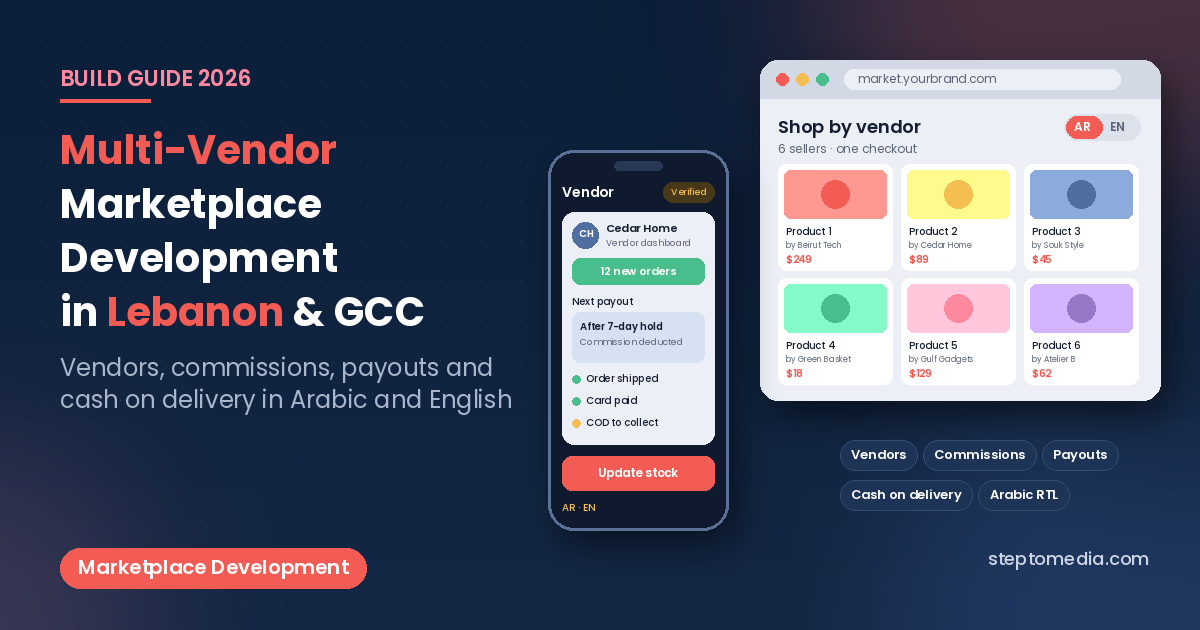
- Vendor dashboard: seller registration and verification, product or service listings, stock, order management, shipping settings, earnings and payout history.
- Admin panel: vendor approval, commission rules, categories, content moderation, refunds and disputes, promotions, and reports on sales by vendor and category.
Supporting features often include notifications by email, SMS or WhatsApp, coupons funded by the platform or the vendor, featured listings, and messaging between customers and sellers with moderation.
Commissions, Payments and Vendor Payouts
Money flow is the hardest part of marketplace development. The platform collects the customer’s payment, keeps its commission, and pays each vendor their share after the order is delivered or the return window ends. Decide early:
- Commission model: a percentage per order, a fixed fee, a monthly vendor subscription, paid featured listings, or a mix.
- Payout schedule: weekly or monthly, with a holding period to cover refunds and cancellations.
- Payment methods: cards, digital wallets and, especially in Lebanon, cash on delivery collected by the courier or the vendor.
- Split payments: some gateways can split a payment between the platform and vendors automatically, but availability depends on the gateway and the country where your company is registered.
- Taxes and invoices: GCC countries apply VAT (5% in the UAE and 15% in Saudi Arabia at the time of writing), so check with an accountant who issues invoices and who collects tax.
Our guide to payment gateways for websites and apps in Lebanon explains the local options and limits, and our API integration guide covers how payment, accounting and messaging systems connect.
Delivery and Logistics
Each vendor may ship from a different location. Common setups are vendor-managed delivery, platform-managed delivery with a courier partner, or pickup points. The system must calculate delivery fees per vendor or per order, show the customer realistic times, and track the status of each part of a split order. If delivery is central to your idea, such as groceries or meals, read our guide to on-demand delivery app development.
Arabic, English and Multi-Currency
Regional marketplaces usually need Arabic and English interfaces with proper right-to-left layouts, Arabic search that handles spelling variations, and product data that vendors can enter in both languages. Currency matters too: Lebanese marketplaces often price in USD, while Gulf platforms use local currencies. Our guide to bilingual Arabic and English websites covers RTL details that apply to vendor dashboards as well.
Ready-Made Plugin, SaaS Platform or Custom Build?
There are three common routes, each with trade-offs:
- WordPress with a marketplace plugin: WooCommerce extensions such as Dokan or WCFM turn a store into a marketplace quickly. Good for validating an idea, but heavy customization and high traffic can become hard to manage.
- Marketplace SaaS platforms: hosted products such as Sharetribe or CS-Cart Multi-Vendor offer ready features and hosting. You trade flexibility for speed and pay ongoing fees.
- Custom marketplace development: built around your exact commission rules, vendor workflows, payment providers and mobile apps. More upfront work, but full control over features, data and scaling.
Our comparison of e-commerce platforms for Lebanon and the GCC and our article on custom software vs SaaS help you choose. Many founders start with a lean version and move to a custom build once vendors and orders prove the model.
Web Platform and Mobile Apps
Most marketplaces launch with a responsive web platform built through our website development service, because it is indexed by Google and works on every device. Customer apps for iOS and Android become valuable when repeat orders, push notifications and saved payment methods drive sales. A separate vendor app helps sellers accept orders and update stock on the move. Our mobile app development team usually shares one backend between the website and the apps, so data stays consistent.
Marketplace Development Cost and Phased Plan
We don’t publish fixed prices without a scope. Cost depends on the number of user roles, payment and payout complexity, delivery logic, mobile apps and integrations. Our custom software development cost guide for Lebanon explains the main cost drivers.
A sensible phased plan looks like this:
- Phase 1 (MVP): vendor registration and approval, listings, customer checkout, one commission rule, manual payouts, and a basic admin panel.
- Phase 2: reviews, coupons, automated payout reports, delivery fee rules, WhatsApp or SMS notifications.
- Phase 3: customer and vendor mobile apps, advanced analytics, ERP or accounting sync, and subscription plans for vendors.
Our guide to MVP software development for startups explains how to keep the first release small. Through our custom software development service, each phase is released, tested with real vendors and adjusted before the next one starts.
What to Prepare Before You Start
- Your marketplace model: products, services, rentals or B2B.
- How you will attract the first vendors and how many you expect at launch.
- Your commission model and payout schedule.
- Payment methods you need, including cash on delivery.
- Who handles delivery, returns and disputes.
- Languages, currencies and countries at launch.
If you are comparing partners, our page on choosing a software and web development company in Lebanon lists what to check. When you’re ready, contact Step To Media to discuss your marketplace idea.
Frequently Asked Questions
What is multi-vendor marketplace development?
It is building a website or app where many independent sellers list and sell products or services, while the platform owner manages customers, payments, commissions, vendor payouts and quality rules.
How does a marketplace make money?
Common models are a commission on each order, a fixed fee per transaction, monthly vendor subscriptions, paid featured listings or advertising. Many marketplaces combine two or more of these.
Can a marketplace in Lebanon accept cash on delivery?
Yes. Many Lebanese marketplaces support cash on delivery alongside cards and wallets. The system then needs to track which courier or vendor collected the cash and reconcile it before vendor payouts.
Should I use Dokan, a SaaS platform or a custom build?
A plugin like Dokan or a SaaS platform is often enough to test an idea quickly. A custom build fits better when you need unusual commission rules, specific payment providers, mobile apps or full control over data and scaling.
Do I need a mobile app for my marketplace?
Not at launch in most cases. A responsive web platform can validate demand first. Customer and vendor apps add value once repeat orders, push notifications and on-the-go order management matter.
No next post available