HR and Payroll Software Development in Lebanon and the GCC: Attendance, Leave, and WPS
HR and Payroll Software Development in Lebanon and the GCC: Attendance, Leave, and WPS
 15 Nov
HR and Payroll Software Development in Lebanon and the GCC: Attendance, Leave, and WPS
HR software development is often the next system a growing company needs after its website and sales tools. Once a business passes a few dozen employees, spreadsheets for attendance, leave, payroll and documents start to break: numbers do not match, managers approve requests on WhatsApp, and nobody is sure which contract or ID copy is the latest. This guide explains what a custom HR and payroll system usually includes, what is specific to Lebanon and the GCC, when a ready-made HR platform is enough, and how to plan a build in phases.
Step To Media is a software development agency in Lebanon that builds websites, mobile apps and custom software for local and Gulf companies. The notes below are practical scoping advice. They are not legal or payroll advice, so always confirm labor and social security rules with your accountant or a local HR specialist.
What Does HR and Payroll Software Cover?
An HR system is the single place where employee data lives and where people-related workflows run. In most companies it grows from a few core modules:
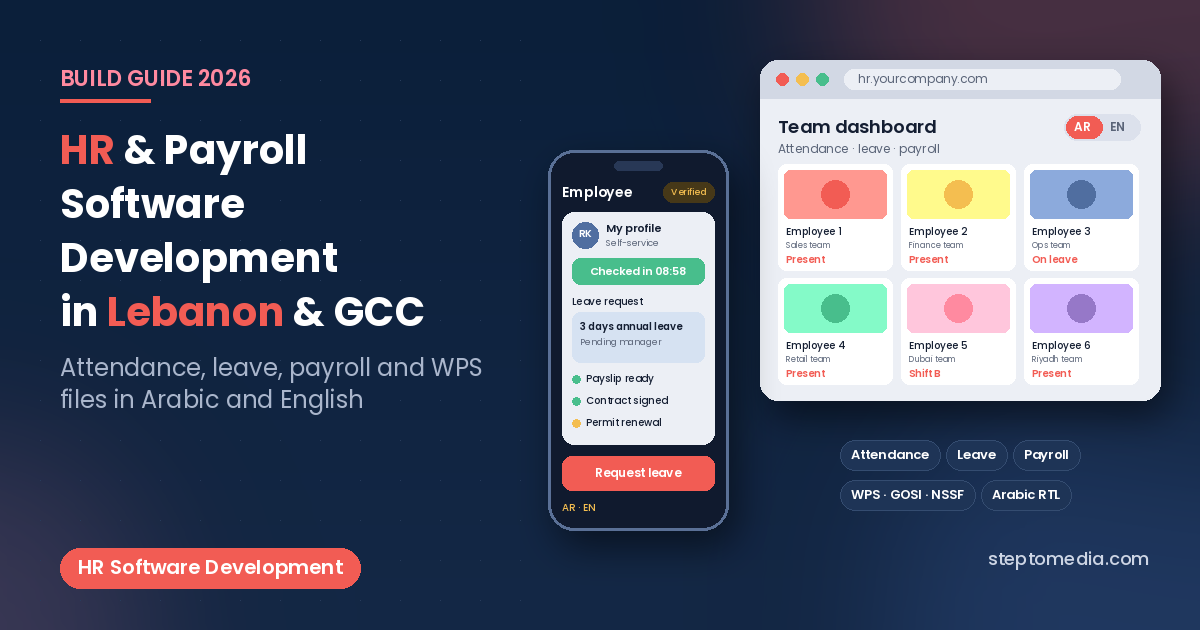
- Employee records: personal details, contracts, job titles, departments, salary history, emergency contacts and document expiry dates such as passports, residency permits or work permits.
- Attendance and time: shifts, check-in and check-out from biometric devices, a mobile app with location rules, or a web clock, plus overtime and late arrivals.
- Leave management: annual, sick and unpaid leave, balances that update automatically, and approval chains by manager or department.
- Payroll: basic salary, allowances, deductions, overtime, bonuses, loans and advances, with payslips and bank transfer files.
- Self-service: a web portal or mobile app where employees request leave, download payslips and letters, and update their own details.
- Reports: headcount, turnover, attendance trends, payroll cost per department and exports for the finance team.
Some companies add recruitment, onboarding checklists, performance reviews, training records or asset tracking later. If hiring is your main pain point, our guide to recruitment portal development covers that side in more detail.
Why Lebanon and GCC Companies Look at Custom HR Systems
Generic HR tools are built for one country’s rules and one currency. Companies operating across Lebanon and the Gulf often run into the same gaps:
- Multi-currency salaries: many Lebanese companies pay salaries in US dollars, Lebanese pounds or a mix, and need payroll and reports to handle both clearly.
- Several countries in one company: a head office in Beirut with branches in Dubai or Riyadh means different leave rules, public holidays, working weeks and end-of-service calculations per entity.
- Local compliance outputs: Lebanese employers deal with NSSF declarations, UAE employers pay salaries through the Wage Protection System (WPS), and Saudi employers work with GOSI and the Mudad wage protection platform. The system needs to produce the right files or reports for each.
- Arabic and English: employees, managers and official letters often need both languages, with proper right-to-left layouts. See our notes on bilingual Arabic and English builds.
- Field and shift teams: retail, hospitality, construction and sales teams rarely sit at a desk, so mobile check-in and approvals matter more than a desktop dashboard.
Ready-Made HR Platform or Custom Build?
Before building anything, compare existing tools. Regional platforms such as Bayzat, ZenHR and Jisr, and broader systems such as Odoo HR or Zoho People, already cover standard HR and payroll needs for many companies. A subscription is usually the faster and cheaper choice when your policies are fairly standard and you operate in a country the tool supports well.
A custom HR system makes sense when:
- Your payroll rules are unusual: commissions, piece rates, tips, multi-currency splits or complex shift premiums.
- You need deep integration with your own ERP, POS, CRM or accounting system rather than CSV exports.
- You operate across countries that one platform does not cover well.
- Per-employee subscription fees become expensive at your headcount, or you want full control of sensitive employee data.
- HR features are part of a bigger internal platform you are already building.
A hybrid is also common: keep a ready-made payroll engine and build a custom employee app, attendance layer or approval workflow around it. Our comparison of custom software vs SaaS and ERP vs custom software walks through the same decision for other systems.
Key Features to Scope Carefully
Attendance that matches reality
Decide early how people check in: biometric devices, a mobile app with geofencing, QR codes at each branch or a mix. Each option affects hardware, privacy rules and how overtime is calculated. Integrating existing fingerprint or face-recognition devices is often possible through their export files or APIs, but confirm the model before you commit.
Payroll rules written down first
The biggest risk in payroll software is unclear rules. Before development, document every allowance, deduction, overtime rate, loan policy and end-of-service rule per country, with real examples checked by your accountant. Developers turn these examples into automated tests, so every payroll run is checked against known results.
Approvals and notifications
Leave, overtime, expense and document requests should follow clear chains, with reminders by email, push notification or WhatsApp. Our guide to API integration with payments, ERP and WhatsApp explains how these connections usually work.
Security and access
Salaries, IDs and medical notes are highly sensitive. Plan role-based access (employee, manager, HR, finance, admin), audit logs for every change, encrypted backups, two-factor login for HR users and clear data retention rules.
Web Portal, Mobile App or Both?
HR and finance teams usually work in a web dashboard, because payroll runs, reports and bulk edits are easier on a large screen. Employees, especially in the field, benefit from a light mobile app for check-in, leave requests and payslips. A practical approach is a responsive web platform first, then a cross-platform app built with Flutter or React Native once the workflows are stable. Our mobile app development and website development services cover both sides.
How to Plan the Build in Phases
- Discovery: map current spreadsheets, policies, countries, headcount and integrations. Collect sample payslips and edge cases.
- Phase 1, core HR: employee records, documents with expiry alerts, leave requests and approvals, and employee self-service.
- Phase 2, attendance: device or mobile check-in, shifts, overtime and attendance reports.
- Phase 3, payroll: salary calculations, payslips, bank or WPS files, and accounting exports, run in parallel with the old method for at least one or two cycles before switching.
- Phase 4, extras: recruitment, onboarding, performance reviews, training and analytics.
Running payroll in parallel is the step most often skipped and the one that prevents costly mistakes. For a broader view of internal systems, read our guide to custom internal tools for Lebanese SMEs, and for budgeting, see what custom software costs in Lebanon.
Choosing a Development Partner
Look for a team that asks detailed questions about your payroll rules before quoting, has built secure dashboards and mobile apps, can integrate with your existing systems and offers maintenance after launch, since labor rules and tax settings change over time. Step To Media works as a software and web development company in Lebanon on custom software development projects like these. If you are weighing an HR system for your company, contact us to discuss your scope.
Frequently Asked Questions
What is HR software development?
It is building a system that manages employee records, attendance, leave, payroll, documents and self-service for a specific company, either from scratch or by extending an existing HR or ERP platform.
Can one HR system handle Lebanon, UAE and Saudi employees?
Yes, if it is designed for it. Each country or legal entity gets its own leave rules, holidays, currencies and end-of-service settings, and the system produces the payroll outputs each country needs, such as WPS salary files in the UAE.
Is a ready-made HR platform enough for a small company?
Often, yes. Platforms such as Bayzat, ZenHR, Jisr, Odoo HR or Zoho People cover standard needs well. Custom development makes more sense when payroll rules, integrations or multi-country operations go beyond what those tools support.
Can the system connect to our fingerprint attendance devices?
In many cases, yes. Most biometric devices can export logs or offer an API or SDK. The exact approach depends on the device model, so it should be confirmed during discovery.
Do employees need a mobile app?
Not always. Office teams can use a responsive web portal. A mobile app becomes useful for field, retail or shift staff who need to check in, request leave or view payslips from their phones.
No next post available