Website Go-Live Checklist for Companies in Lebanon
 1 Oct
1 OctWebsite Go-Live Checklist for Companies in Lebanon
A website launch checklist Lebanon companies can finish is a list of decisions, not a mood board. Go-live is the hour you point a domain at a new site and start taking leads or orders. If DNS, content, or forms are still “someone’s task,” the site is not ready, however polished the homepage looks.
This list is for marketing sites, corporate sites, and stores. It is not a branding rollout and it is not a social media plan. Step To Media, a software development agency in Lebanon, uses the same kind of list on website development projects. Adapt the rows. This is not legal or tax advice.
Before you name a date
Pick a window only after staging holds the real templates and one person can approve them. If you are still guessing how long the build should take, read how long website development takes in Lebanon and set the date from the phase you are in.
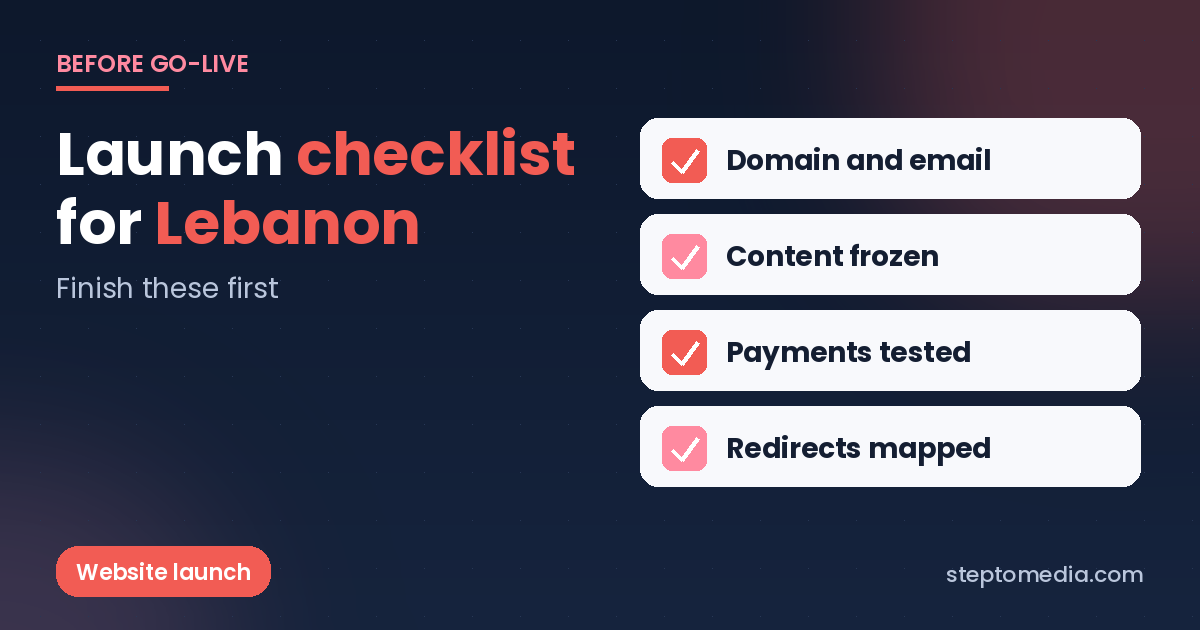
- Content freeze. After this point, wording changes are fixes, not new pages.
- Who says go. One approver, plus a backup who can be reached that day.
- Rollback. How you restore the old site, or a backup, if forms or checkout fail.
Domain, email, and hosting
Launches fail on access as often as on code. The company, not a former freelancer, should control the registrar. Write down every DNS record you must keep, especially email.
- The domain is in the company name, and you know the renewal date.
- Mail records are copied before anyone edits DNS.
- SSL will cover the live hostname, including www if you use both.
- Hosting, backups, and who receives alerts are agreed. Hosting and support describes that ongoing care. It is not a price list.
- Staging is blocked from search engines so the draft is not indexed beside the live site.
If you are replacing a site, export its URLs first. Dropping addresses without redirects throws away visits you already have. Do that mapping with the notes in legacy website modernization in Lebanon, before launch week.
Content freeze
- Every public template has real text and real images, in each language you will launch.
- Menus, footer, and the error page match the final page list. Placeholder copy is removed.
- Arabic, if you ship it, is read by someone who reads Arabic, including alignment and the language switcher. The technical side is in bilingual Arabic and English websites.
- Phone numbers, WhatsApp links, the address, and opening hours were checked this week.
- Editors have CMS accounts and have published one test update on staging.
Forms, measurement, and policies
Submit every form from a phone. Check the inbox that should receive it, including spam, and any CRM behind it.
- Success and error states are clear. Required fields are obvious.
- Analytics fires on the production domain, not only on staging. Exclude internal traffic if you can.
- If you collect names or phone numbers, publish a privacy notice your own counsel accepts. This article is not that notice.
- Any consent bar must not cover the main button on a small screen.
Payments, only if you take money
Do not launch a checkout you have not completed yourself, first in test and then with a small live payment you can refund. Merchant onboarding is a separate queue from development. Options are explained in payment gateways for websites and apps in Lebanon.
- Prices, currency, and delivery fees match what finance approved.
- A failed or cancelled payment returns the shopper to a clear page.
- The order alert reaches the person who fulfils it.
- You know who can issue a refund.
A brochure site can skip this section. A store cannot. Catalogue decisions for Lebanon and the Gulf are in e-commerce website development.
Search and redirects
- Each important URL has one title and one meta description. Canonicals do not point at staging.
- Old URLs 301 to the closest new page. Google’s guide to 301 redirects is the reference. Avoid chains.
- An XML sitemap lists live URLs only. See how to build a sitemap.
- The robots file allows the public site. A staging “disallow all” must not go live.
- Sample pages and demo products are deleted.
QA on a phone
On a phone, open the homepage, reach a service or product, and submit a form or a test order. Repeat in the other language if you have one. Then check a laptop.
Judge speed with real images. Google’s Core Web Vitals documentation is a shared language for that review. Chasing a perfect score the night before DNS changes is how launches slip.
The launch window
| Check | Owner | Ready when |
|---|---|---|
| Backup of the current site and database, if one exists | Whoever holds hosting | The backup file exists and someone knows how to restore it |
| DNS edit planned, mail records untouched | Registrar admin | The records to change are written down |
| SSL on the public hostname | Developer | The live URL shows a secure connection |
| Form or test payment on production | Business approver | A message or order arrived in the real inbox |
| Redirects from the old URL list | Developer | The important old addresses land on the right new pages |
| Rollback steps | Approver and developer | Both can revert the same day |
Make the change during a staffed hour, not before a holiday when nobody can fix a form. After DNS, open the site from a connection that is not the office network, so you are not seeing only a cached copy.
The first 14 days
- Watch form deliveries and, if you sell, failed payments each day.
- Fix broken links and wrong numbers. Do not open a new section.
- Submit the sitemap and confirm the indexed URLs are the live ones.
- Confirm backups are running on the new host.
- Park phase-two ideas so they do not become emergency edits.
A working enquiry path matters more than extra pages. After this list is done, website conversion for SMEs in Lebanon is the follow-on if leads or orders are the goal.
Questions before go-live
What is a website launch checklist in Lebanon?
It is the checks to finish before a company points its domain at a new site: DNS and email, frozen content, working forms, payment tests if you sell, redirects, analytics, a backup, and a named approver. Arabic layout and local payment providers belong on the list when they are in scope.
Who should approve the launch?
One person who can speak for the business, with a backup. A group chat is not an approver. The developer should not be the only one who has tried the form or the checkout.
Should Arabic and English launch together?
If both are part of the promise, yes. Shipping English and “adding Arabic later” often means the right-to-left layout never gets a real pass. If Arabic is phase two, hide the switcher so people are not sent to empty pages.
Do lead-only sites need a payment test?
No. Test the form, the notification, and the spam path. Use the payment checks only when money moves on the site.
When should redirects be mapped?
Before launch day, from a full export of the old URLs. Mapping them while DNS is changing is how important pages are missed.
What should stay frozen for two weeks after launch?
New page types, a different payment provider, and a rewrite of the navigation. Use those weeks to fix defects and confirm backups, tracking, and enquiries.
Apply the list to your site
Contact Step To Media and say whether you are launching a new site or replacing one. We will tell you which checks apply and what a sensible window looks like. You can also email info@steptomedia.com or call +961 3 510 646.