On-Demand Delivery App Development for Lebanon and GCC
 15 Oct
On-Demand Delivery App Development for Lebanon and GCC
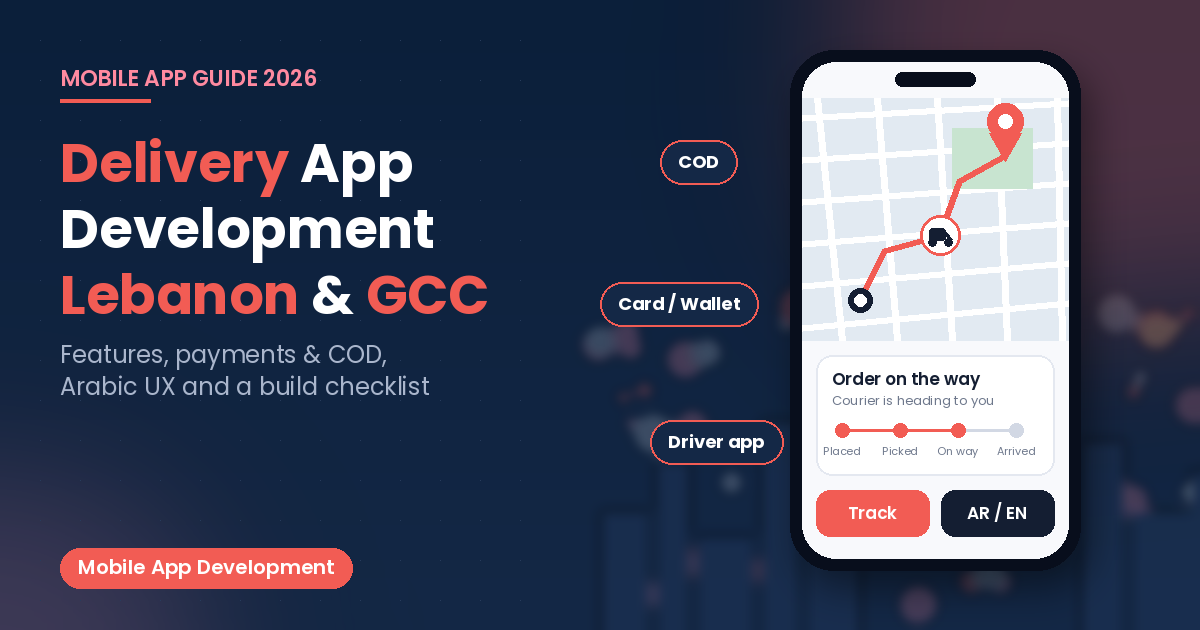
Food, groceries, pharmacy orders, laundry, and parcels—on-demand delivery is an everyday habit across Lebanon and the Gulf. The question for many businesses is whether to rely on third-party marketplaces or own the experience. A delivery app development Lebanon project gives you control over customer data, branding inside the app, pricing, and operations—but only if the scope is right from day one.
This guide is for owners and founders who want a clear picture before they brief a team: what a delivery app includes, which features matter for phase one, how payments and cash on delivery work, and when custom beats a ready-made platform.
What Counts as an On-Demand Delivery App
An on-demand delivery app is not a single app. It is usually a small system of connected products:
- Customer app (iOS and Android, sometimes a web ordering page) for browsing, ordering, paying, and tracking.
- Driver or courier app for accepting jobs, navigation, proof of delivery, and cash collection.
- Operations admin panel for menus or catalogues, zones, pricing, dispatch, refunds, and reporting.
- Backend and APIs that connect everything—orders, notifications, payments, and any ERP or POS you already use.
Multi-store businesses may also need a merchant or branch app. Knowing which pieces you need is the first step in scoping cost and timeline.
Who Needs Delivery App Development in Lebanon and the GCC
Delivery app development in Lebanon and the Gulf usually comes from one of these situations:
- Restaurants and cloud kitchens that want direct orders alongside marketplace listings.
- Supermarkets, pharmacies, and specialty retailers handling large baskets, substitutions, and scheduled slots.
- Service businesses—laundry, water and gas refills, car wash, home maintenance—where a technician or driver visits the customer.
- Logistics and courier startups building last-mile delivery for other merchants.
- Regional brands operating in Lebanon and one or more GCC markets that need multi-country pricing, currencies, and languages.
Startups testing a new delivery idea should usually start smaller. Our guide to MVP software development for startups in Lebanon explains how to launch a focused first version and learn from real orders.
Core Features to Scope
Feature lists grow fast. Separate must-haves for launch from later improvements:
Customer app
- Sign-up with phone number and OTP, saved addresses with map pin, and clear delivery zones.
- Catalogue or menu with search, options, and availability per branch.
- Cart, checkout, delivery fee logic, promo codes, and scheduled orders.
- Order status, push notifications, and live tracking once a driver is assigned.
- Order history, reorder, ratings, and in-app support or WhatsApp handoff.
Driver or courier app
- Online/offline status, job offers, and accept/decline flow.
- Navigation hand-off to map apps, pickup and drop-off steps, and photo or signature proof.
- Cash collected tracking and end-of-shift reconciliation.
Operations admin
- Catalogue, pricing, zones, and opening hours management.
- Manual and automatic dispatch, order reassignment, and refunds.
- Reports on orders, delivery times, and driver performance, plus role-based access.
Good ordering flows depend on UX as much as features. Our post on mobile app user experience for Lebanon and GCC businesses covers checkout, onboarding, and bilingual design in more depth.
Payments, COD, and Local Integrations
Payments shape the whole architecture. In Lebanon, cash on delivery remains common, while GCC customers increasingly expect cards and digital wallets. Plan for:
- Cash on delivery with driver cash tracking, reconciliation, and clear change or rounding rules.
- Card and wallet payments through a gateway that supports your markets and currencies. See our guide to payment gateways in Lebanon for websites and apps.
- Multi-currency pricing where needed, with one clear currency shown at checkout.
- Integrations with POS, ERP, inventory, SMS/OTP providers, maps, and WhatsApp notifications. Our article on API integration for payments, ERP, and WhatsApp explains how these connections are usually planned.
If your app adds stored balances, loyalty wallets, or payouts to merchants, compliance becomes more involved—our fintech app development guide outlines what changes when money stays inside the platform.
Arabic/English UX and Mobile Network Realities
Customers in Lebanon and the GCC switch between Arabic and English, and drivers may prefer a different language from customers. Build for:
- Proper RTL layouts for Arabic across customer, driver, and admin screens.
- Address input that matches reality—map pins, landmarks, building and floor notes—since formal street addresses are often incomplete.
- Resilience on weak connections: retry logic, saved carts, clear error states, and lightweight screens for mid-range Android phones.
- Driver apps that tolerate signal drops and sync status once the connection returns.
Choosing the right cross-platform framework affects all of this. Compare options in Flutter vs React Native for Lebanon and GCC apps.
Build vs Buy vs White-Label
There are three common paths, each with trade-offs:
- Marketplaces only. Fastest to start and no build cost, but commissions, limited customer data, and little control over the experience.
- White-label or SaaS platforms. Quicker launch with standard features; customisation, local payment options, Arabic quality, and long-term fees can become limits.
- Custom development. Higher upfront effort, but you own the product, data, and roadmap, and can integrate deeply with your operations through custom software development.
Many businesses combine approaches: keep marketplace listings for reach while a custom app builds direct, repeat ordering. A companion ordering website through website development can also capture customers who will not install an app.
Timeline and Briefing Checklist
Timelines depend on how many apps and integrations you need. A focused MVP with one customer app and a basic admin is a much smaller project than a multi-merchant platform with live tracking and wallets. For phase-by-phase expectations, read our mobile app development timeline for Lebanon.
Before your first meeting with a development team, prepare:
- Business model—own deliveries, merchant marketplace, or courier service.
- Apps needed for phase one (customer, driver, merchant, admin).
- Markets, cities, and languages at launch.
- Payment methods, including COD rules and currencies.
- Existing systems to connect: POS, ERP, inventory, CRM.
- Must-have versus later features, plus a target launch window and budget band.
Our custom software brief guide gives a template you can adapt so quotes are easier to compare.
Working With a Lebanon Development Partner
A capable partner will challenge an oversized phase one and design for COD and bilingual users from the start. Step To Media builds mobile apps, websites, and custom software from Mkalles for businesses across Lebanon and the region.
If you are planning delivery app development in Lebanon or the GCC, learn more about our mobile app development services, our approach as a software and web development company in Lebanon, and how we work as a software development agency in Lebanon. When you are ready, contact us with your business model, target markets, and must-have features.
Frequently Asked Questions
What apps does an on-demand delivery platform need?
Most platforms need a customer app, a driver or courier app, and an operations admin panel connected by a backend. Multi-store setups often add a merchant app so branches can accept and prepare orders.
Should a delivery app in Lebanon support cash on delivery?
Yes for most Lebanon businesses. Cash on delivery is still widely used, so plan driver cash tracking and reconciliation, while also offering card or wallet payments where customers expect them.
Is it better to build a custom delivery app or use a white-label platform?
White-label platforms launch faster with standard features. Custom development suits businesses that need ownership of data, deeper integrations, strong Arabic UX, or unique operations. Many start with a focused custom MVP.
How long does it take to build a delivery app?
It depends on scope. A focused MVP with one customer app and a basic admin is much faster than a multi-merchant platform with live tracking, wallets, and several integrations. A phased plan keeps launch realistic.
Do delivery apps need Arabic and English?
For Lebanon and the GCC, usually yes. Plan proper RTL layouts, translated notifications, and address inputs that support landmarks and map pins for both customers and drivers.
What should I prepare before briefing a delivery app agency?
Your business model, apps needed for phase one, launch markets and languages, payment methods, systems to integrate, and a must-have feature list with a target timeline and budget band.
No next post available