Website Redesign for Lebanon Businesses: When to Rebuild
 14 Oct
Website Redesign for Lebanon Businesses: When to Rebuild
Many Lebanon business sites look fine until you try to use them: pages load slowly on mobile data, Arabic text wraps badly, WhatsApp is buried, and the design no longer matches the brand you present in person. A website redesign Lebanon project can mean a light refresh, a structured rebuild on the same platform, or a full rebuild with a new stack. The right choice depends on what is broken, what SEO equity you already have, and how bilingual and mobile your customers really are.
This guide is for owners and managers who need a clear decision framework before they brief an agency—when to polish versus rebuild, what to keep for search rankings, Arabic and English realities, and a practical checklist for kickoff.
Redesign, Refresh, or Full Rebuild?
These words get mixed up in quotes, so separate them clearly:
- Refresh (visual polish). New colours, typography, imagery, and layout tweaks on the same CMS and URL structure. Content and SEO foundations stay largely intact.
- Redesign (structured rebuild). New information architecture and templates, often with better conversion paths, still on a fitting platform (for example WordPress) with careful redirects and content migration.
- Full rebuild. New platform, templates, and often new integrations. Highest cost and risk—best when the current stack cannot meet speed, security, or product needs.
If you are still choosing a CMS, see our comparison of WordPress versus custom websites in Lebanon before you redesign.
Signs Your Lebanon Business Site Needs a Redesign
Not every aging site needs a rebuild. Watch for patterns that hurt trust and leads:
- Mobile friction. Hard-to-tap buttons, broken forms on phones, or heavy pages on typical Lebanese mobile networks.
- Weak conversion paths. Contact, WhatsApp, quote, or booking are hard to find. Our post on website conversion UX for Lebanon SMEs covers owner-level fixes.
- Broken bilingual experience. Arabic feels bolted on, RTL is incomplete, or language versions contradict each other.
- Outdated brand and content. Services, locations, and proof no longer match how you sell today.
- Maintenance pain. Editors fear updates, plugins conflict, or security patches wait because the theme is fragile.
- SEO plateau with clear UX issues. You still rank, but bounce and engagement suggest the page experience is holding you back.
Refresh vs Rebuild: Decision Criteria
Use these criteria in a short workshop with your team (and later with your agency):
- Can the current platform deliver speed and security? If hosting, theme, and plugins are the bottleneck, a cleaner rebuild may cost less long term than endless patches.
- Is the information architecture wrong? Buried or duplicated services and blog content usually need a redesign with clearer structure, not only a paint job.
- How much SEO equity do you have? Indexed URLs, backlinks, and Search Console history favour preserving URLs or mapping them carefully. Thin sites have less to lose.
- Do you need new capabilities? Catalogues, portals, multilanguage workflows, or ties to internal tools often push toward a structured redesign or custom software development on top of the site.
- What is the downtime risk? Lead-critical sites need phased migration, staging, and a launch plan—not a weekend cutover.
For effort and phases, see our website development timeline for Lebanon. Pair it with a written brief; our custom software brief guide helps even when the main deliverable is a redesign.
What to Keep: URLs, Content Equity, Analytics, Redirects
Redesigns fail SEO when teams treat the old site as disposable. Protect these assets:
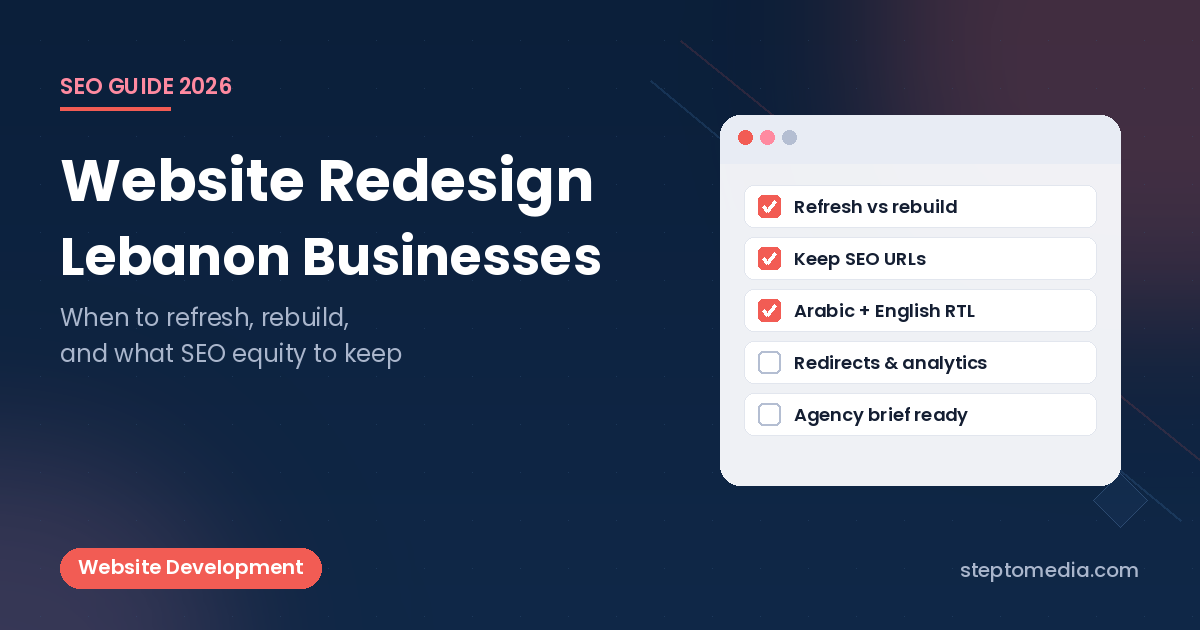
- URL inventory. Export indexed URLs from Search Console and your CMS. Decide keep, merge, or retire before design starts.
- Content that ranks or converts. Service, location, and proven blog pages should be rewritten in place when possible—not deleted for a “cleaner” sitemap.
- 301 redirects. Every retired URL needs a clear redirect to the closest live page. Avoid dumping everything to the homepage.
- Analytics and tags. Preserve GA4 (or equivalent) and conversion events so you can compare before and after.
- Metadata and structured data. Titles, meta descriptions, and FAQ schema on important pages should migrate deliberately.
Before public cutover, use our website launch checklist for Lebanon for DNS, HTTPS, forms, redirects, and indexing checks.
Bilingual Arabic/English and Mobile Network Realities
Lebanon audiences switch between Arabic and English (and often French). A redesign that only works in English will feel unfinished. Plan for:
- True RTL layouts for Arabic—including navigation, forms, and icons.
- Content parity on critical services and contact paths, with someone accountable for updates.
- Performance on mobile data—compress images, limit heavy scripts, and test on mid-range Android devices.
- Local contact patterns—visible phone and WhatsApp, clear location details if you serve walk-ins, and forms that retry after a drop.
For deeper RTL guidance, read our guide to bilingual Arabic and English websites in Lebanon. If a companion app follows the redesign, align language and UX early with mobile app development.
Checklist Before You Brief an Agency
Bring this to the first meeting so quotes are comparable:
- Goals. More qualified leads, faster publishing, bilingual parity, ecommerce, or brand refresh—pick primary and secondary.
- Audience and languages for day one.
- Must-keep URLs and content from your inventory.
- Integrations (CRM, WhatsApp, payments, booking, internal tools).
- Owners and approvers for Arabic copy, design, and form testing.
- Constraints—launch date, hosting, budget band, and phase-one out-of-scope items.
- Success measures—form completions, call clicks, Search Console on key queries, or speed thresholds.
A clear brief shortens discovery and helps you compare a simple refresh against a fuller website development engagement.
Working With a Lebanon Development Partner
A good partner will push back on a full rebuild when a refresh would protect SEO, and will insist on redirects, staging, and content ownership when a rebuild is justified. Step To Media works from Mkalles on websites, mobile apps, and custom software for businesses across Lebanon and the region.
If you are planning a website redesign for your Lebanon business, start with our overview as a software and web development company in Lebanon, explore how we work as a software development agency in Lebanon, or contact us with your goals, current site URL, and language requirements. We can help you decide refresh versus rebuild before you commit budget.
Frequently Asked Questions
When should a Lebanon business redesign its website?
When mobile use is painful, conversion paths are unclear, bilingual pages feel incomplete, the brand no longer matches the business, or maintenance and security have become risky. Rankings alone are not enough reason to rebuild if the experience still converts.
What is the difference between a website refresh and a full rebuild?
A refresh updates visuals and light layout on the same platform and URLs. A redesign restructures pages and templates with careful migration. A full rebuild changes platform and often many integrations, which needs stronger redirect and content planning.
How do I protect SEO during a website redesign?
Keep important URLs where you can, map every retired URL with a 301 redirect, migrate titles and strong content, preserve analytics, and verify indexing after launch with Search Console and a crawl of the new site.
Should our redesigned site support Arabic and English?
Yes for most Lebanon businesses that serve local clients. Plan proper RTL layout, content parity on key pages, and clear ownership for updates in each language—not a one-time machine translation pass.
How long does a website redesign take in Lebanon?
It depends on scope: a visual refresh can be weeks; a structured redesign with content migration and bilingual work often takes longer. Use a phase-by-phase timeline and a launch checklist so discovery, design, build, and go-live stay realistic.
What should I bring to an agency briefing for a redesign?
Goals, language requirements, must-keep URLs, integrations, approvers, constraints, and how you will measure success. A short written brief makes quotes comparable and reduces mid-project scope changes.
No next post available