School Management Software in Lebanon & GCC: A 2026 Guide
 31 Oct
School Management Software in Lebanon & GCC: A 2026 Guide
Most schools in Lebanon and the Gulf still run on a patchwork: attendance on paper or in a spreadsheet, grades in another file, fees tracked by the accountant, and parent communication spread across WhatsApp groups. A well-built school management software pulls those pieces into one system that teachers, administrators, parents and students can actually use, in Arabic, English and often French. This guide explains what to build, when custom development beats an off-the-shelf package, and how to plan the project without wasting a school year.
What School Management Software Should Cover
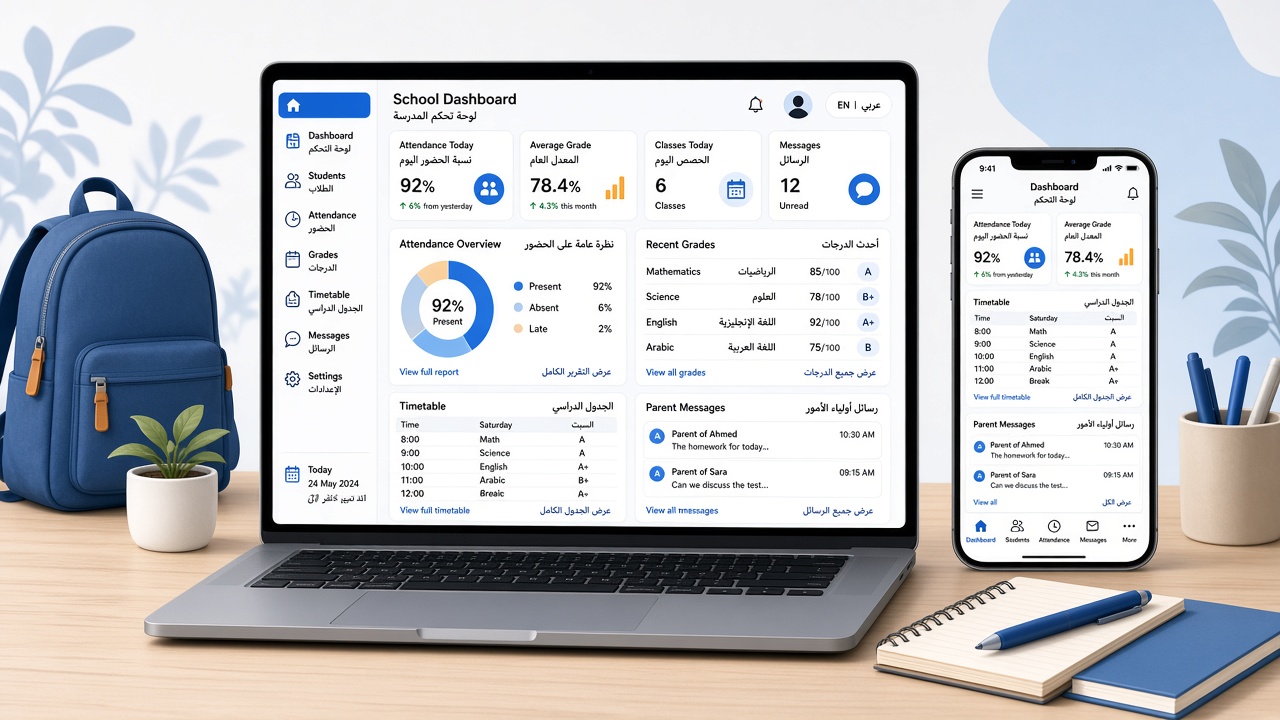
A school management system (sometimes called a student information system or school ERP) is the operational backbone of a school. The core modules are fairly consistent across K-12 schools in Lebanon, Saudi Arabia, the UAE and Qatar:
- Student records and admissions: enrollment forms, documents, sibling links, medical notes and class placement.
- Attendance: daily or per-period attendance with automatic alerts to parents for absences and late arrivals.
- Grades and report cards: gradebooks that follow your curriculum (Lebanese official program, French Baccalaureate, IB, American or British systems) and generate printable bilingual report cards.
- Timetables and staff: class schedules, substitutions and teacher workloads.
- Fees and finance: installments, discounts, receipts, multi-currency handling and exports to your accounting system.
- Parent communication: announcements, homework, circulars and direct messages through a parent app instead of scattered chat groups.
- Transport and canteen (optional): bus routes, pickup lists and prepaid meal balances.
You rarely need everything on day one. The best projects start with the two or three modules that cause the most daily friction, usually attendance, grades and parent communication.
Off-the-Shelf vs Custom School Software
There are many ready-made school platforms on the market, and for a small school with a standard workflow they can be a sensible starting point. Problems tend to appear when a school’s reality doesn’t match the package:
- Curriculum mismatch: grading scales, coefficients and report card layouts for Lebanese official exams or French programs are often not supported out of the box.
- Weak Arabic support: right-to-left layouts that break, untranslated screens, or report cards that can’t print Arabic names properly.
- Fees and currency: Lebanese schools in particular deal with split payments, fresh-dollar and lira amounts, and installment plans that generic billing modules handle poorly.
- Per-student licensing: subscription costs grow with enrollment every year, and you don’t own the data model.
- Integrations: connecting to your accounting software, SMS provider, WhatsApp Business API or payment gateway may be impossible or extra-cost.
Custom development makes sense when these gaps affect daily operations, when you run a group of schools with shared reporting, or when the school wants its own branded parent app. For a broader comparison of the two approaches, see our guide on ERP vs custom software.
The Parent App Is What Families Judge You On
Administrators use the back office, but parents experience the school through the mobile app. A good parent app shows today’s attendance, upcoming homework and exams, grades as soon as they’re published, fee balances and a clear inbox for school messages. Push notifications should be targeted (one class, one bus route, one student) rather than broadcast to everyone.
For Lebanon and the GCC, build the app in Arabic and English from the start, with French where your community expects it. Retrofitting RTL support later is far more expensive than designing for it upfront. Cross-platform frameworks such as Flutter or React Native let one team ship iOS and Android apps from a shared codebase, which suits most school budgets. Our mobile app development team typically recommends this route unless the app needs heavy device-specific features.
Data Privacy and Security for Student Information
Student data is sensitive: names, photos, health notes, family details and payment records. Whatever you build should include:
- Role-based access, so a teacher sees only their classes and a parent sees only their own children.
- Encrypted connections (HTTPS) and encrypted backups stored off-site.
- Audit logs showing who changed a grade or a fee record, and when.
- Clear data retention rules for students who leave the school.
Schools serving the Gulf should also check local requirements. Saudi Arabia’s Personal Data Protection Law and the UAE’s federal data protection law both set rules on how personal data is processed and where it may be stored, so hosting choices should be confirmed with the school’s legal advisor before launch.
How a School Software Project Is Usually Phased
Timing matters more in education than in most sectors, because nobody wants to switch systems in the middle of term. A practical sequence looks like this:
- Discovery (spring): map current workflows, collect sample report cards, fee structures and timetables, and agree on the first-phase scope.
- Design and build (late spring to summer): admin dashboard, teacher web app and parent app, with weekly demos to the school team.
- Data migration (summer): import student records, classes and opening fee balances from existing spreadsheets or the old system.
- Training and pilot (before term): train administrators and teachers, then pilot with a few classes.
- Launch and support (first term): roll out to all parents, monitor issues closely and plan phase two.
If you’re starting from scratch, writing a clear brief speeds up every quote you receive. Our custom software brief guide walks through what to include.
What Affects the Cost
Step To Media doesn’t publish fixed prices for school systems, because scope varies widely. The main cost drivers are the number of modules, the number of user roles, how complex your grading and fee rules are, how many languages you support, native mobile apps versus a web-only portal, integrations (accounting, payments, SMS, WhatsApp) and the volume of data to migrate. A web portal covering attendance, grades and announcements is a much smaller project than a multi-campus platform with transport, canteen and online fee payments. For general market context, our article on custom software development costs in Lebanon explains how agencies typically estimate projects.
Choosing a Development Partner
Look for a team that has shipped bilingual web platforms and mobile apps, can show how they handle RTL layouts, and will sit with your administrators before writing code. Ask who owns the source code and data, how hosting and backups work, and what support looks like during the first term. As a software development agency in Lebanon serving clients across the region, Step To Media builds custom software, web portals through our website development service, and companion mobile apps. If you’re comparing vendors, our overview of choosing a software and web development company in Lebanon is a useful checklist.
Frequently Asked Questions
What is school management software?
It is a system that manages a school’s daily operations in one place, including student records, attendance, grades, timetables, fees and parent communication, usually with a web dashboard for staff and a mobile app for parents.
Can school management software work in Arabic and English?
Yes. A custom system can be built fully bilingual, with right-to-left Arabic layouts, bilingual report cards and a parent app that lets each user choose their language. French can be added for schools that need it.
Should we build custom software or buy a ready-made platform?
A ready-made platform can work for small schools with standard workflows. Custom development is worth it when your curriculum, fee structure, language needs or integrations don’t fit available packages, or when you run several campuses.
How long does it take to build a school management system?
It depends on scope. A focused first phase covering attendance, grades and parent communication is usually planned to be ready before the start of a school year, with further modules added in later phases.
Can it integrate with our accounting system and online payments?
Usually yes, through APIs or scheduled exports. The exact approach depends on your accounting software and payment provider, which should be confirmed during discovery.
Planning a school platform or parent app? Contact Step To Media to talk through your requirements and get a scoped proposal.
No next post available