ERP vs Custom Software in Lebanon: Odoo, Build, or Both?
 17 Oct
ERP vs Custom Software in Lebanon: Odoo, Build, or Both?
Sooner or later, a growing business outgrows spreadsheets, basic accounting software, and disconnected apps. Then comes a big decision: adopt an ERP such as Odoo, or build software around the way you actually work. Getting ERP vs custom software Lebanon decisions right affects your budget, your team’s daily routine, and how easily you can expand into the GCC later.
This guide gives owners and operations leads in Lebanon and the Gulf a vendor-neutral way to compare an ERP platform, a custom build, and the hybrid approach many growing companies choose.
What an ERP Gives You (and What It Expects From You)
An ERP (enterprise resource planning) system is a packaged suite that covers standard business functions in one database: accounting, invoicing, inventory, purchasing, sales, CRM, HR, and often manufacturing or projects. Common options include Odoo, Zoho’s business apps, Microsoft Dynamics 365 Business Central, and SAP Business One.
Odoo is a frequent starting point because it is modular. It has an open-source Community edition and a paid Enterprise edition licensed per user, and it can run in the cloud or on your own server. You switch on the apps you need and add more later.
The trade-off: every ERP has built-in assumptions about how processes run. You get proven accounting logic and standard reports, but you adapt your workflows to the system—or pay to customise it.
What Custom Software Gives You
Custom software is designed around your specific operations: the way you take orders, approve discounts, dispatch technicians, track consignment stock, or serve customers through a portal or app. Through custom software development, you own the code, the data model, and the roadmap.
The trade-off runs the other way. You get a tighter fit and no per-user licence fees, but you take on the cost and responsibility of building, hosting, and maintaining the system. Rebuilding accounting or payroll from scratch is rarely a good use of budget.
For subscription tools in general, see our comparison of custom software vs SaaS; this article focuses on ERP.
How to Decide ERP vs Custom Software in Lebanon
These questions show which way your business leans:
- How standard are your core processes? If your accounting, purchasing, and stock follow common patterns, an ERP will cover most of them well. If your competitive edge sits in a unique workflow, custom is worth considering for that part.
- How many internal users do you have? Per-user licences are easy to accept for a small team and become a larger line item as headcount grows. Custom software costs more upfront but does not scale with seats in the same way.
- Who uses the system? ERPs are built mainly for internal staff. If customers, dealers, or field teams need a simple mobile or web experience, a custom front end often fits better.
- How much customisation would the ERP need? Light configuration is normal. Heavy custom modules start to combine the costs of both worlds, including extra work at every major version upgrade.
- Do you have an internal owner? Both paths need someone on your side who owns processes, data quality, and training.
Lebanon and GCC Realities to Plan For
Local conditions matter more than feature checklists:
- USD and LBP. Many Lebanese businesses price, collect, and report in more than one currency. Confirm early how the system handles multi-currency invoices, exchange rates, and the reports your accountant and auditors need.
- VAT and invoicing rules. Lebanon applies an 11% VAT, and if you invoice in Saudi Arabia you must meet ZATCA e-invoicing requirements. Check what is supported out of the box versus what needs a local partner or custom work.
- Arabic and English. Staff screens, printed invoices, and customer-facing portals may need proper right-to-left layouts. Our guide to bilingual Arabic/English RTL websites explains what good RTL work involves.
- Connectivity and hosting. Choose cloud or on-premise hosting based on your sites, power situation, and data policies, and plan backups either way.
- WhatsApp and cash. Orders and approvals often happen over WhatsApp, and cash collection is still common. Any system needs a clear way to record both.
The Hybrid Path: ERP Core, Custom Edges
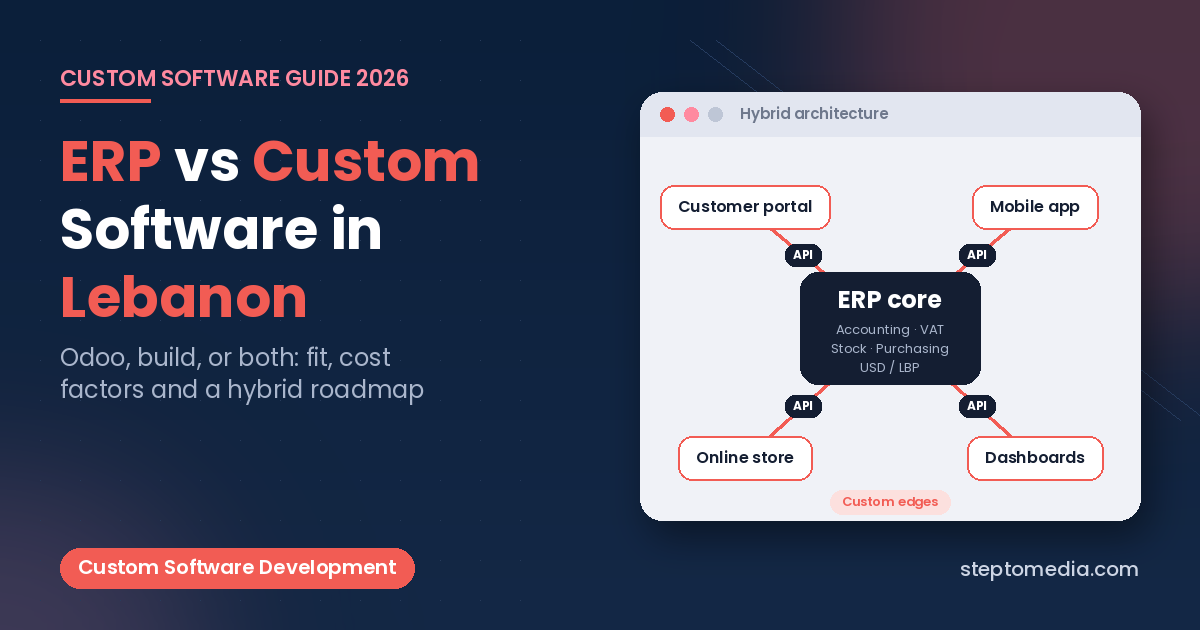
Often the strongest answer is not either/or. Keep accounting, inventory, and purchasing in a proven ERP, and build custom software only where it adds real value:
- Customer or dealer portals for orders, statements, and support.
- Mobile apps for sales reps, drivers, or technicians, built through mobile app development and synced with the ERP.
- Online stores that read stock and push orders automatically. See our guide to e-commerce website development in Lebanon and the GCC, and our website development service for the storefront side.
- Internal tools and dashboards for approvals and reporting the ERP does not handle well. Our post on custom internal tools for Lebanon SMEs shows what these usually look like.
Integration is the glue: clean APIs between the ERP, payments, WhatsApp, and your apps prevent double entry. Read our article on API integration for payments, ERP, and WhatsApp, or explore our API integration and process automation services.
Cost Factors to Compare
Scope drives cost on both paths, so compare the full cost structure over several years, not just the first invoice:
- ERP: licence or subscription fees (often per user), implementation and data migration, configuration and customisation, training, hosting, and upgrade work when a new major version is released.
- Custom software: discovery and design, development, testing, hosting, and ongoing maintenance and improvements. Our guide to custom software development cost in Lebanon explains what moves a quote up or down.
- Hidden costs on both sides: poor data migration, rushed architecture, and workarounds that nobody documents. Our article on the hidden costs of poor software architecture covers why these compound over time.
A Practical Way to Start
- Map your processes from order to cash and from purchase to stock, and mark where work is manual or duplicated.
- Separate standard from unique. Standard processes are ERP candidates; unique, revenue-critical ones are custom candidates.
- List users and channels: internal staff, customers, partners, mobile teams.
- Define phase one narrowly, with a clear go-live scope and data to migrate.
- Write a brief so different vendors quote the same thing. Our custom software brief guide gives you a template.
Working With a Lebanon Software Partner
A good partner will tell you when an ERP is enough and when custom software pays off. Step To Media builds custom software, web platforms, and mobile apps from Mkalles for businesses in Lebanon and the region.
Learn more about us as a software and web development company in Lebanon and how we work as a software development agency in Lebanon. When you are ready, contact us with your current systems, team size, and the processes that slow you down most.
Frequently Asked Questions
Is an ERP or custom software better for a small business in Lebanon?
If your accounting, stock, and sales processes are fairly standard, an ERP is usually the faster and safer start. Custom software makes more sense for unique workflows, customer-facing portals, or mobile teams the ERP does not serve well.
Can custom software replace Odoo or another ERP completely?
It can, but rebuilding accounting, tax, and payroll logic from scratch is rarely worth it. Most businesses get better value by keeping a proven ERP for finance and inventory and building custom tools around it.
What is a hybrid ERP and custom software setup?
The ERP stays the system of record for accounting, inventory, and purchasing, while custom portals, apps, or dashboards handle specific workflows and connect to it through APIs so data is entered only once.
Do ERPs handle USD and LBP for Lebanese businesses?
Many ERPs support multi-currency transactions, but setups differ. Confirm exchange-rate handling, dual-currency invoices, and the reports your accountant needs during evaluation, before you commit.
Can Odoo be customised for Arabic users?
Odoo supports Arabic and right-to-left interfaces, but printed documents, custom modules, and portals still need testing with real Arabic content. Plan that review into the implementation.
How should I prepare before talking to an ERP partner or software agency?
Map your main processes, list users and channels, note the systems you must connect, and define a narrow phase one. A written brief helps you compare ERP proposals and custom quotes fairly.