Warehouse Management App Development in Lebanon and the GCC: Barcodes, Picking, and ERP Sync
 30 Oct
Warehouse Management App Development in Lebanon and the GCC: Barcodes, Picking, and ERP Sync
Many distributors and importers in Lebanon and the Gulf still run warehouses on paper pick lists, spreadsheets, and one storekeeper’s memory. Stock counts drift and the wrong items get shipped. Warehouse management app development means building mobile and web software that tells your team what to receive, where to put it, what to pick, and how to pack it, with every scan recorded and synced to your ERP or accounting system.
This guide covers when a custom warehouse app makes sense, core features, scanning, offline mode, ERP integration, and a build plan for 2026.
ERP Module, Off-the-Shelf WMS, or a Custom App?
Many ERPs, including Odoo, ship with an inventory or warehouse module, and dedicated warehouse management systems (WMS) exist for larger operations. Our guide to ERP vs custom software recommends keeping stock and accounting in a proven ERP, and that still holds here. A custom warehouse app usually sits on top of the ERP and makes sense when:
- The ERP screens are too slow on the floor: staff need large buttons, scan-first flows, and Arabic labels on handheld devices, not desktop forms.
- Your process is specific: batch and expiry tracking, serial numbers, mixed pallets, cross-docking, or several warehouses and branches.
- You need connections the module lacks: e-commerce orders, a B2B ordering portal, courier labels, or WhatsApp alerts.
If the standard module fits your process, configure it first and build only the gaps.
Core Features of a Warehouse Management App
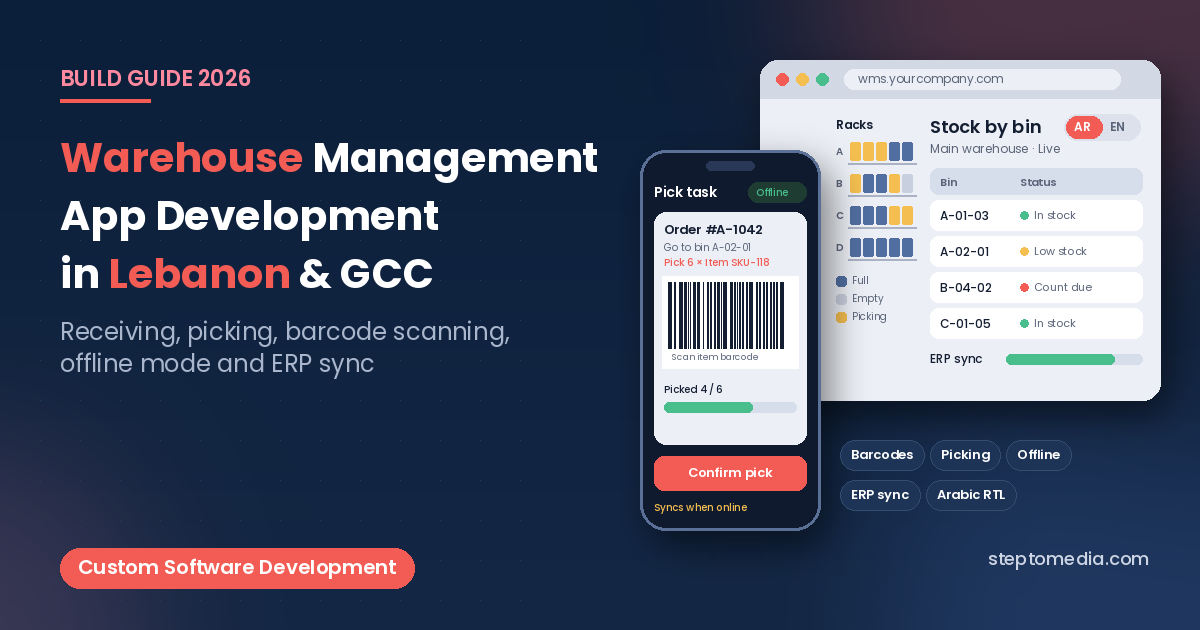
- Receiving: scan items against the purchase order or supplier delivery note, flag shortages and damaged goods, and print labels.
- Putaway and locations: zones, aisles, racks, and bins, with suggested locations so stock is stored where it can be found.
- Picking: pick lists grouped by route or zone, scan-to-confirm each item, and support for single-order, batch, or wave picking.
- Packing and dispatch: verify the order at the packing station, record boxes and weights, and hand over to drivers or couriers.
- Transfers and returns: moves between branches, and returns checked back into stock or quarantine.
- Cycle counts: count a few locations every day instead of closing the warehouse for a yearly stocktake.
- Batch, expiry, and serial tracking: first-expired-first-out picking for food, cosmetics, and pharmaceuticals, and serial numbers for electronics.
- Manager dashboard: open orders, pick progress, and discrepancies.
Version one usually needs receiving, locations, picking, and counts; wave picking, labour reports, and automation can follow.
Barcode Scanning and Devices
Scanning is what makes a warehouse app accurate. Most products already carry retail barcodes, and GS1 standards define identifiers such as the GTIN for trade items and the SSCC for logistic units like cases and pallets, so your app can read supplier labels and print its own for locations and pallets.
For devices you have two main options. Phone cameras work well for lower volumes: Google’s ML Kit barcode scanning reads common formats such as EAN-13, Code 128, QR, and Data Matrix on the device without a network connection, and Apple’s VisionKit offers a data scanner on iOS 16 and later. For many scans per hour, rugged Android handhelds with built-in scanners are faster and survive drops. Decide on devices early, as they shape the app design. Test with real labels and lighting, as our guide to mobile app testing recommends.
Offline Mode and Power Cuts
Wi-Fi often drops at the back of a warehouse or inside cold rooms, and power cuts still happen in Lebanon. Design the app to keep working: store the day’s tasks on the device, record scans locally, and sync them when the connection returns. The app should reserve stock when a task is assigned and flag anything that cannot be confirmed. The same offline-first approach is covered in our guide to field sales app development.
Warehouse Management App Development and ERP Integration
Integration decides whether the app helps or creates a second version of the truth. Agree on which system owns what: usually the ERP owns products, prices, purchase and sales orders, and stock valuation, while the warehouse app owns locations, tasks, and scan history. The app pulls orders to pick and pushes back receipts, shipments, transfers, and count adjustments.
Use the ERP’s API where it has one, and plan for retries, duplicate protection, and an error queue someone actually checks. Our API integration guide explains how to scope this, and if orders come from an online store, the warehouse becomes the link between sales and delivery.
Web, Mobile App, or Both?
Floor staff work on handhelds or phones, so the picking and receiving screens are a mobile app, often Android only when the company supplies the devices. Managers use a web dashboard for setup and reports. Our comparison of web application vs mobile app explains the trade-offs, and our guide to Flutter vs React Native covers cross-platform options if you also need iOS.
Arabic, Roles, and Data Protection
Warehouse teams in Lebanon and the Gulf may prefer Arabic, English, or both, so plan right-to-left layouts and bilingual product names and labels; our guide to bilingual Arabic and English websites covers the basics. Give each role only the screens it needs, log every scan and adjustment, and require approval for large adjustments. The app will also hold staff and customer data, so collect only what you need and secure it. Lebanon’s Law No. 81 of 2018 on electronic transactions and personal data, Saudi Arabia’s Personal Data Protection Law, and the UAE’s Federal Decree-Law No. 45 of 2021 set rules for personal data. This is general information, not legal advice.
A Practical Build Plan
- Walk the warehouse: map receiving, storage, picking, packing, and returns as they really happen today.
- Label locations and choose devices.
- Agree the ERP data contract: which system owns each record and how orders and stock movements sync.
- Build the core: receiving, putaway, picking, and cycle counts, with offline mode.
- Pilot in one warehouse or zone with real staff, then roll out and add batch tracking, waves, and reports.
Many companies start with a smaller custom internal tool for one painful step, such as receiving or counts, and grow it from there.
What Affects the Cost and Timeline
We don’t quote fixed prices without a scope. The main factors are the number of warehouses and processes, batch and serial tracking, device and printer integration, offline sync, the ERP and its API, languages, and reporting. For general budgeting, see our guide to custom software development cost in Lebanon, and plan for updates after launch with our guide to website and app maintenance.
How Step To Media Can Help
Step To Media builds websites, mobile apps, and custom software from Mkalles for businesses in Lebanon and the Gulf. Explore our custom software development, mobile app development, and website development services. You can also learn more about us as a software and web development company in Lebanon, or see how we work as a software development agency in Lebanon. Planning a warehouse app? Contact us with how many warehouses you run, the ERP you use, and where stock errors happen today.
Frequently Asked Questions
What is a warehouse management app?
A warehouse management app is mobile and web software that guides staff through receiving, putaway, picking, packing, transfers, and stock counts, records every barcode scan, and syncs stock movements with the ERP or accounting system.
Do I need a custom warehouse app if my ERP has an inventory module?
Not always. If the ERP’s inventory or warehouse module fits your process, configure it first. A custom app makes sense when floor screens are too slow, your process needs batch, expiry, or location rules the module lacks, or you need extra integrations.
Can a warehouse app use phone cameras instead of barcode scanners?
Yes. Phone cameras can read common barcodes on the device, which suits lower volumes. For many scans per hour, rugged handhelds with built-in scanners are usually faster and more durable.
Can the app work without Wi-Fi?
Yes, if it is built offline-first. Tasks are stored on the device, scans are recorded locally, and everything syncs with the server and ERP when the connection returns.
How is a warehouse app different from a field sales or delivery app?
A warehouse app runs inside the warehouse: receiving, storage, picking, and counts. A field sales app is for reps taking orders at customer sites, and a delivery app handles drivers and customers after goods leave the warehouse.
No next post available