Web Hosting in Lebanon: How to Choose Hosting, Domains and Servers for Your Website or App (2026)
Web Hosting in Lebanon: How to Choose Hosting, Domains and Servers for Your Website or App (2026)
 22 Nov
Web Hosting in Lebanon: How to Choose Hosting, Domains and Servers for Your Website or App (2026)
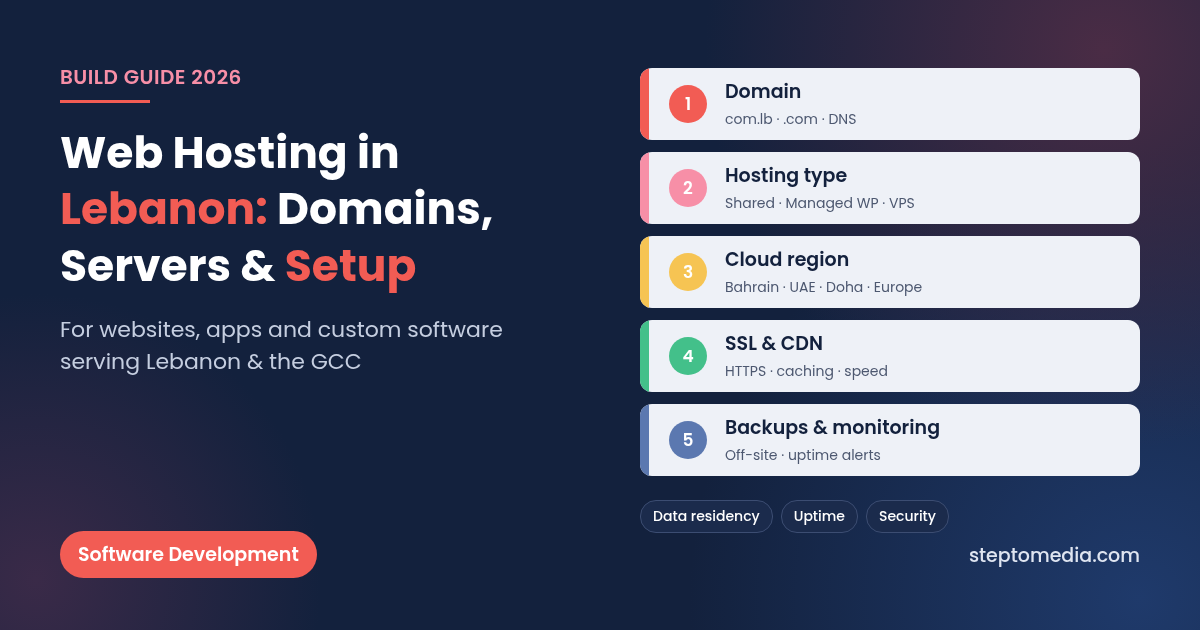
Choosing web hosting in Lebanon is easy to rush and expensive to get wrong. Your hosting decides how fast your website or app loads, how often it goes down, how safe your data is, and how easily you can grow into the GCC. This 2026 guide explains the main hosting options, local versus international servers, .lb and .com domains, and the technical setup a good developer should hand over with every website or app.
Step To Media is a software development agency in Lebanon, based in Mkalles. We build and launch websites, web applications, mobile app back ends and custom software, so we set up hosting for real projects all the time. This is the checklist we use.
Why Hosting Matters More Than Most Businesses Think
Hosting is not just “a place to put the files”. It affects:
- Speed: server response time is the first step of every page load, and slow pages lose visitors and sales. We cover the business impact in why slow websites are killing your online sales.
- Uptime: a store, booking system or customer portal that goes offline stops earning and stops serving clients.
- Security: server updates, firewalls, SSL certificates and isolated accounts protect your site and your customers’ data.
The Main Types of Web Hosting
1. Shared hosting
Many websites share one server and its resources. It is the cheapest option and works for small brochure sites with modest traffic. The trade-off is limited performance and less control, and a busy neighbor on the same server can slow you down.
2. Managed WordPress hosting
Hosting tuned for WordPress, usually with server-level caching, automatic backups, staging sites and malware scanning. It is a strong fit for corporate websites, blogs and WooCommerce stores. If WordPress is your platform, see our guide to working with a WordPress developer in Lebanon.
3. VPS (virtual private server)
You get a dedicated slice of a server with guaranteed resources and full control. It suits growing stores, custom web applications and APIs, but someone has to manage updates, security and monitoring. That is usually your developer or a managed VPS provider.
4. Cloud platforms
AWS, Microsoft Azure and Google Cloud let you scale servers, databases and storage up or down as traffic changes, and add managed services such as load balancers, object storage and backups. Cloud is the usual choice for mobile app back ends, SaaS products, portals and anything that needs to grow. It needs proper architecture and cost monitoring to avoid surprise bills.
5. Platform hosting (Shopify, website builders)
Hosted platforms such as Shopify or Wix include hosting in the subscription. You do not manage servers, but you also cannot move the site to another host. We compare that trade-off in website builder vs custom website in Lebanon.
Local Hosting in Lebanon or Abroad?
“Local” hosting means your server sits in a data center in Lebanon. “International” hosting means it sits abroad, often in Europe or the Gulf. Some providers that sell hosting in Lebanon actually resell servers located abroad, so always ask where the hardware physically is.
How to decide:
- Mostly Lebanese visitors: a local server can reduce latency, but check its power backup, network redundancy and support hours before you commit. A well-connected European server with a CDN is often a reliable alternative.
- Customers in the UAE, Saudi Arabia or Qatar: host closer to them. AWS has Middle East regions in Bahrain and the UAE, Microsoft Azure has UAE regions, and Google Cloud has regions in Doha and Dammam.
- A mixed Lebanon, GCC and Europe audience: pick one solid origin server and put a CDN in front of it, so images, scripts and styles are served from locations near each visitor.
Do not guess. Test server response time from Lebanese fixed and mobile networks, and from your main GCC market, before you choose.
Data Residency for GCC Projects
Some GCC clients, especially in government, finance and healthcare, must keep certain data inside the country. Saudi Arabia and the UAE both have personal data protection laws, and sector regulators can add their own rules. If you are building a portal or app for a Gulf client, confirm the data residency requirements with their legal or compliance team at the start of the project, then choose a cloud region that meets them. Our guide to secure app development in Lebanon and the GCC covers the wider security side.
Domains: .lb, .com.lb or .com?
- .com is the most familiar choice for businesses that sell across Lebanon, the GCC and beyond, and it is quick to register through any accredited registrar.
- .com.lb signals a Lebanese company. According to the Lebanese Domain Registry (LBDR), .lb domains are registered through LBDR-accredited registrars, not directly with the registry. A com.lb domain requires a legally registered business with supporting documents, a signed LBDR-A form, a Lebanese postal address and at least two name servers.
Whatever you choose, register the domain in your company’s name, with an email address you control. Many businesses lose access to their own domain because a former freelancer or agency registered it under their personal account.
What Your Developer Should Set Up
When a website or app goes live, the hosting setup should include:
- SSL (HTTPS) on every page, with automatic certificate renewal.
- Automatic backups stored off the server, plus a tested way to restore them.
- A staging environment to test updates before they reach the live site.
- Caching and a CDN for fast loading in Lebanon and the GCC.
- A firewall and login protection, with admin access limited to the people who need it.
- Uptime monitoring that alerts someone when the site goes down.
- Business email and DNS records (SPF, DKIM and DMARC) so your emails reach inboxes instead of spam.
- Handover documentation: where everything is hosted, who owns each account, and how to renew domains and plans.
Hosting also needs ongoing care: server and software updates, security patches and renewals. See what a good website and app maintenance plan in Lebanon should cover.
Hosting for Mobile Apps and Custom Software
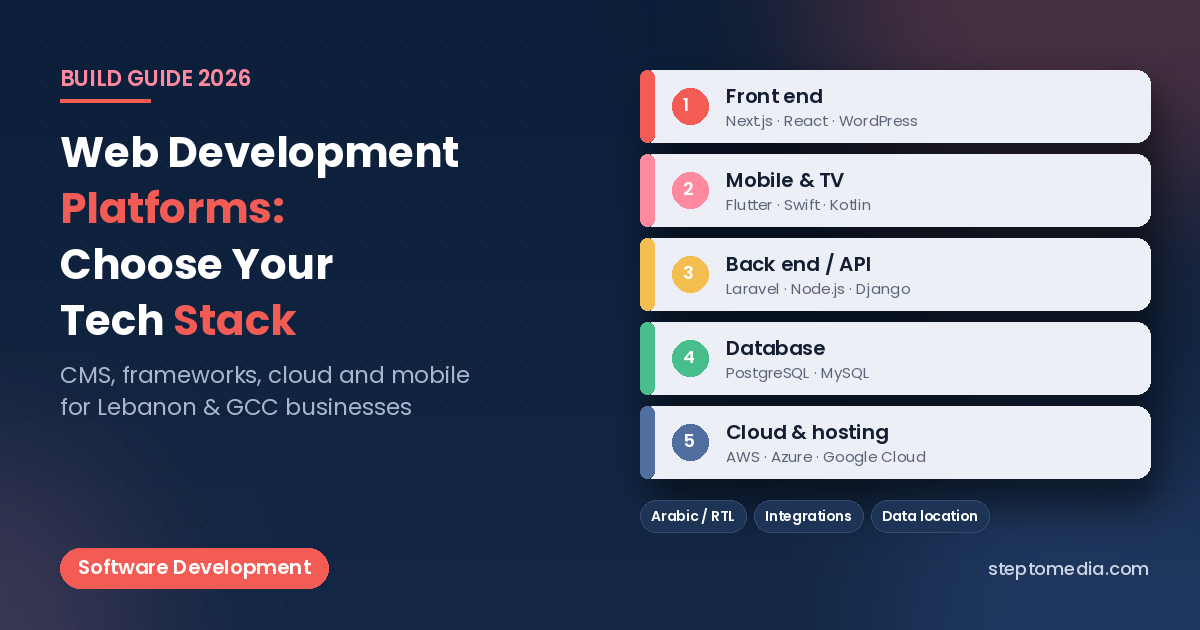
A mobile app is only as reliable as the API and database behind it. Apps with logins, payments, bookings or real-time updates usually run their back end on a cloud platform or a managed back end, with separate environments for development and production. Custom software such as ERPs and CRMs also needs access control and a backup policy that matches how critical the data is. Choosing the full stack, not just the server, is covered in our guide to web development platforms and tech stacks.
How Step To Media Can Help
We plan hosting as part of every build, sized for your traffic, your markets and your budget, and we hand over every account in your name. Our website development, mobile app development and custom software development teams set up servers, domains, SSL, backups and monitoring as part of the launch. Learn more about our software and web development company in Lebanon, or contact us to discuss your project.
Frequently Asked Questions
What is the best web hosting in Lebanon for a business website?
It depends on the site. Shared hosting can work for a small brochure website, managed WordPress hosting suits most corporate sites and WooCommerce stores, and a VPS or cloud platform is better for web applications, apps and high-traffic stores. Choose for speed from your visitors’ locations, uptime, backups and support, not price alone.
Should I host my website in Lebanon or abroad?
If most visitors are in Lebanon, a reliable local server can be slightly faster, but check its power and network redundancy. Many Lebanese businesses use a well-connected server in Europe or the Gulf with a CDN, especially when they also serve GCC customers. Test response times before deciding.
How do I register a .com.lb domain?
Through an LBDR-accredited registrar. LBDR requires a legally registered business with supporting documents, a signed LBDR-A form, a Lebanese postal address and at least two name servers. Check the current requirements on the LBDR website before you apply.
Which hosting is best for a mobile app back end?
Most business apps run their API and database on a cloud platform such as AWS, Azure or Google Cloud, or on a managed back end like Firebase. Pick a region close to your users and keep separate development and production environments.
Who should own my hosting and domain accounts?
Your company should. Register the domain and hosting in the business name with an email you control, and give your developer access rather than ownership. That way you never lose your website if you change agencies.
No next post available