Website Builder vs Custom Website in Lebanon: Wix, Squarespace, or a Developer?
Website Builder vs Custom Website in Lebanon: Wix, Squarespace, or a Developer?
 20 Nov
Website Builder vs Custom Website in Lebanon: Wix, Squarespace, or a Developer?
Searching for a website builder in Lebanon usually means one thing: you want a professional site online quickly without overspending. Builders such as Wix, Squarespace and Shopify make that possible for some businesses. For others they become a ceiling a year later, when Arabic pages, local payments or integrations stop fitting the template. This 2026 guide compares website builders with a developer-built website for Lebanese and GCC businesses, so you can choose based on what your site actually needs to do.
Step To Media is a software development agency in Lebanon based in Mkalles. We build websites, web applications, mobile apps and custom software for businesses in Lebanon and the GCC, so we see both sides: sites that should have stayed on a builder, and sites that outgrew one.
What a Website Builder Is (and What You Are Renting)
A website builder is a hosted platform where you pick a template, edit pages with a drag-and-drop editor and pay a recurring subscription. Hosting, security updates and the editor itself are handled by the platform. Common examples are Wix, Squarespace, Shopify for online stores, and the builders bundled with many hosting plans.
The trade-off is ownership. You own your content and your domain, but the design, code and features live inside the platform. Wix, for example, does not let you move a site’s design and code to another host, and Squarespace offers only a partial content export. If you leave, you usually rebuild. That is not a problem for a small site, but it matters when the website is a core business asset.
When a Website Builder Is the Right Choice
A builder is a sensible, honest choice when most of these are true:
- You need a simple brochure site: home, about, services, gallery and contact.
- The site is in one language, or Arabic is limited to a few pages.
- You do not need integrations with an ERP, CRM, booking system or local payment gateway.
- Someone on your team has time to build and update the site themselves.
- You are testing an idea and expect to rebuild once it proves itself.
For a new café, a freelancer portfolio or a small consultancy, a well-chosen template can be enough for the first year. Spending heavily on custom development before the business model is clear is rarely the best use of budget.
Where Builders Hit Limits for Lebanese and GCC Businesses
Arabic and right-to-left layouts
Arabic support varies between builders and between templates on the same builder. Some handle right-to-left text well; others flip the text but not the layout, icons or menus, or make it awkward to keep English and Arabic versions in sync. If Arabic matters to your customers, test real Arabic pages during a free trial before committing. Our guide to bilingual Arabic and English websites explains what a proper RTL build includes.
Payments and checkout
Online payments are often the deciding factor in Lebanon. A builder only supports the payment providers it has integrated, and not every provider is available to businesses registered in Lebanon or settles to a Lebanese account. Many merchants also rely on cash on delivery, WhatsApp orders or more than one currency. Before choosing a platform, confirm which gateways it supports for your country. Our article on payment gateways for websites and apps in Lebanon covers the options.
Integrations and custom workflows
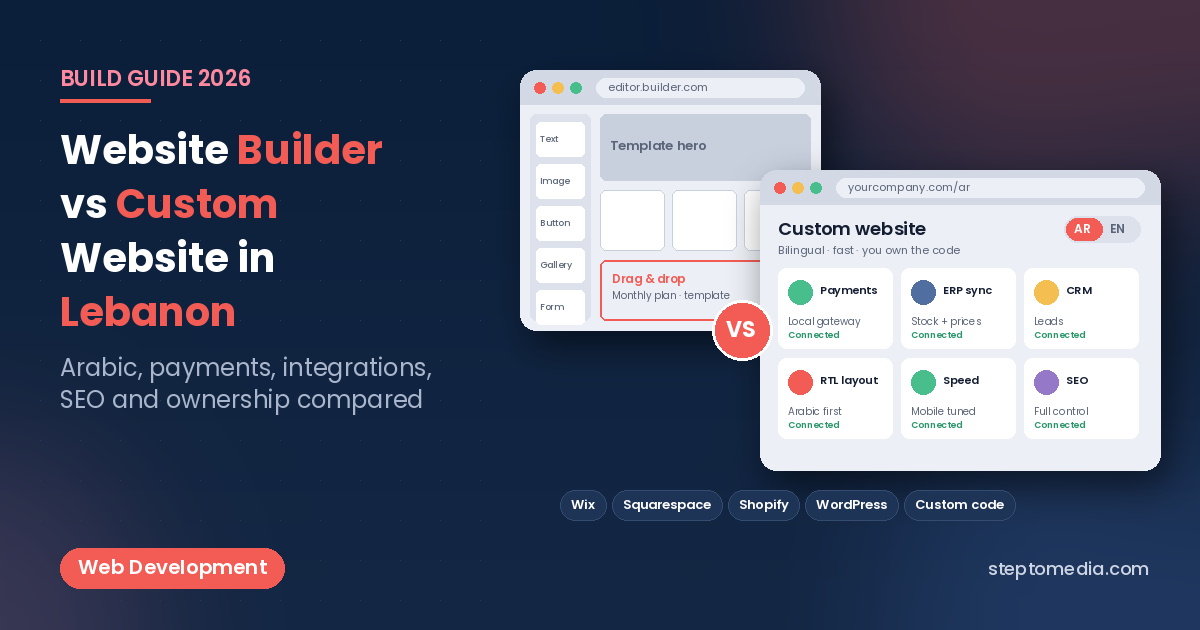
Builders work well inside their own app stores. They struggle when you need the website to talk to your stock system, send leads into a CRM, sync prices from an ERP or show customers a private dashboard. At that point you are no longer building a website; you are building a web application, and a builder is the wrong tool.
Speed, SEO and control
Builders handle the SEO basics: titles, descriptions, sitemaps and clean URLs. What they limit is control. You often cannot remove unused scripts, fine-tune how pages load, or change the HTML structure of a template. On mobile connections that can mean slower pages, and slow pages lose visitors and sales.
What a Developer-Built Website Gives You
Professional website development means the site is designed and coded around your business rather than a template. That can be a custom-coded site, a WordPress site with a custom theme, or a headless setup. The practical differences are:
- Ownership: you own the code and can move hosting or change developers.
- Proper Arabic and English: layouts designed for both directions from the start.
- Integrations: local payment gateways, ERPs, CRMs, WhatsApp and booking tools connected through APIs.
- Performance: only the code the site needs, tuned for mobile users.
- Room to grow: new features, portals or a mobile app can be added on the same foundation.
The cost is a larger upfront investment, a longer timeline and a need for ongoing maintenance. If you are weighing WordPress against fully custom code, read our WordPress vs custom website comparison.
Website Builder vs Custom Website: Side-by-Side
| Factor | Website builder | Developer-built website |
|---|---|---|
| Time to launch | Days to a few weeks | Usually several weeks to a few months |
| Upfront cost | Low: a subscription plus your time | Higher: design and development fees |
| Ongoing cost | Monthly or yearly subscription and paid apps | Hosting, maintenance and updates |
| Arabic / RTL | Varies by builder and template | Designed for both directions |
| Local payments | Limited to supported providers | Any gateway with an API |
| Integrations | App store add-ons | Custom APIs to ERP, CRM and other systems |
| Ownership | Tied to the platform | You own the code |
What About Cost?
Builder subscriptions are published on each platform’s pricing page and change often, so check current prices directly, and add the cost of premium templates and paid apps. A developer-built site depends on scope: number of pages, languages, integrations and whether there is e-commerce. We break down typical market ranges in our guide to website cost in Lebanon. Compare costs over two or three years, not just the first month, and include what a rebuild would cost if you outgrow the builder.
A Simple Way to Decide
- List what the site must do in the next two years, not just at launch.
- Mark the must-haves: Arabic, payments, integrations, customer accounts.
- Test a builder trial against those must-haves with real content.
- If two or more fail, talk to a developer before you invest more time in the builder.
- Plan for launch, whichever route you pick, using a website launch checklist.
If your website needs to connect to the rest of your business, look at custom software development too, since the site is often the front end of a bigger system.
Working With Step To Media
As a software and web development company in Lebanon, we will tell you honestly if a builder is enough for your stage. When it is not, we design and build bilingual websites, e-commerce stores and web apps that connect to the payment, ERP and CRM tools you already use. Contact us to talk through your project.
Frequently Asked Questions
Is a website builder good enough for a business in Lebanon?
It can be for a simple brochure site in one language with no integrations. Businesses that need proper Arabic pages, local payment gateways or connections to ERP and CRM systems usually outgrow a builder and do better with a developer-built website.
Can I move my Wix or Squarespace site to another host later?
Not fully. Wix does not let you move a site’s design and code to another host, and Squarespace offers only a partial content export. You keep your domain and content, but moving platforms usually means rebuilding the site.
Do website builders support Arabic and right-to-left layouts?
Support varies by builder and by template. Some handle RTL well, while others flip text without adjusting menus, icons or layouts. Test real Arabic pages in a free trial before committing.
Can I accept online payments in Lebanon with a website builder?
Only through the payment providers that builder supports, and not all of them are available to Lebanese businesses. Check the supported gateways for your country first. A developer-built site can integrate any gateway that offers an API.
When should I switch from a builder to a custom website?
Switch when the builder blocks growth: you need Arabic and English done properly, local payments, integrations, customer accounts, or faster pages than the template allows. Planning the move early costs less than patching a builder site for years.
No next post available