Web Development Platforms in 2026: How to Choose the Right Tech Stack (Lebanon & GCC)
Web Development Platforms in 2026: How to Choose the Right Tech Stack (Lebanon & GCC)
 21 Nov
Web Development Platforms in 2026: How to Choose the Right Tech Stack (Lebanon & GCC)
Every website or app sits on a set of web development platforms: a CMS or framework, a database, a hosting or cloud provider, and often a mobile toolkit. Picking that stack is one of the first decisions in a project, and one of the hardest to undo later. This 2026 guide explains the main platform options, what each is good at, and how businesses in Lebanon and the GCC can choose a tech stack that fits their goals, budget and team.
Step To Media is a software development agency in Lebanon, based in Mkalles. We build websites, web applications, mobile apps, TV apps and custom software, so we choose stacks for real projects every week. This guide is the same reasoning we walk clients through.
What “Web Development Platform” Actually Means
The phrase covers several layers that work together:
- Content and site platforms: website builders, WordPress and other CMSs, and e-commerce platforms such as Shopify or WooCommerce.
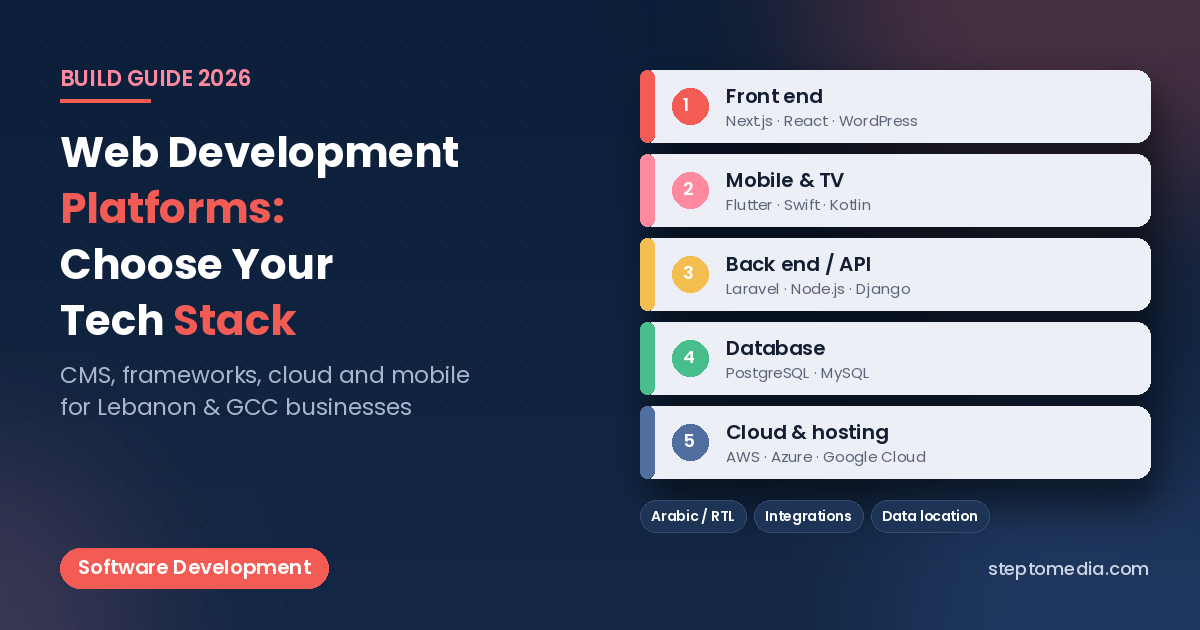
- Frameworks: code foundations developers build on, such as Laravel (PHP), Django (Python), Node.js with Next.js or NestJS (JavaScript/TypeScript) and ASP.NET Core (C#).
- Databases and back-end services: PostgreSQL, MySQL, MongoDB, or managed back ends such as Firebase and Supabase.
- Hosting and cloud: shared or managed WordPress hosting, VPS servers, and cloud providers such as AWS, Microsoft Azure and Google Cloud.
- Mobile toolkits: native Swift and Kotlin, or cross-platform Flutter and React Native.
Your “tech stack” is the combination you pick from these layers. There is no single best platform. There is only the best fit for what you are building.
The Main Platform Options in 2026
1. Website builders
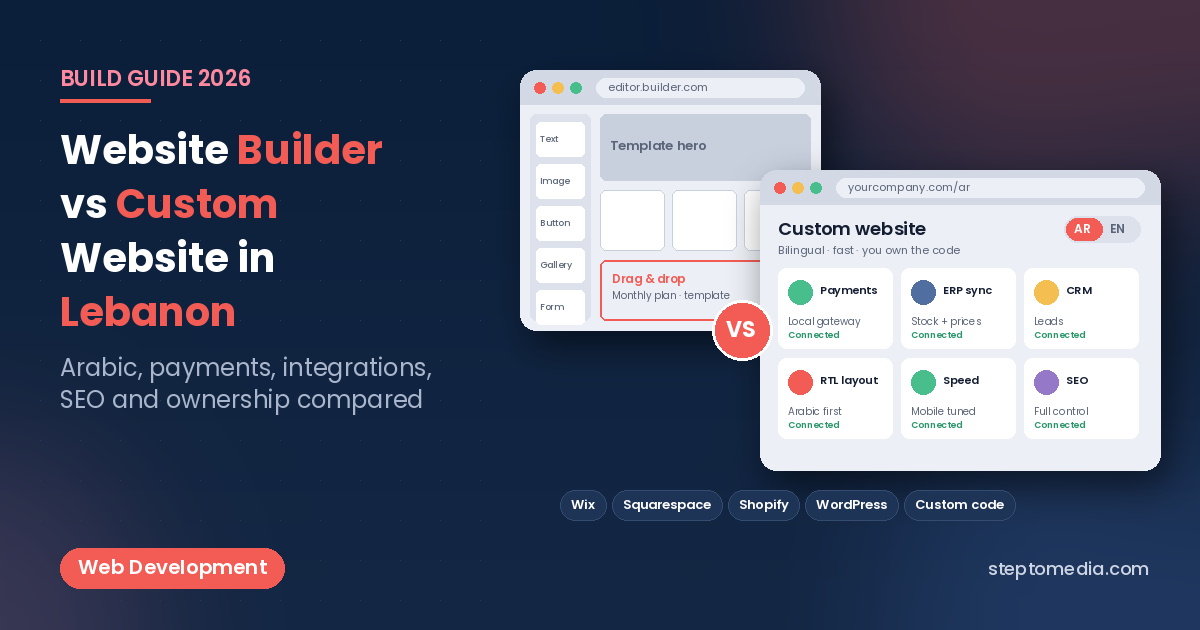
Hosted builders like Wix and Squarespace are the fastest way to launch a simple site. They suit brochure websites and early-stage ideas, but you rent the platform and its limits. We compare them in detail in website builder vs custom website in Lebanon.
2. WordPress and other CMSs
WordPress powers a large share of the web and is a strong choice for content-led websites, blogs, corporate sites and WooCommerce stores. It is open source, so you can move hosts freely, and there is a big pool of developers in Lebanon who know it. Its weak points are plugin sprawl and security updates if nobody maintains it. Our WordPress vs custom website guide covers where it fits.
A headless CMS (for example Strapi, Sanity, Contentful, or WordPress used headless) separates content editing from the front end. It is useful when the same content feeds a website, a mobile app and a TV app.
3. E-commerce platforms
Shopify, WooCommerce and Magento (Adobe Commerce) are the common choices. The deciding factors in our region are usually local payment gateways, cash on delivery, Arabic product data and integration with stock or ERP systems. See our e-commerce platform comparison for Lebanon and the GCC.
4. Application frameworks
When you need a portal, dashboard, booking system, marketplace or SaaS product, you move from site platforms to frameworks:
- Laravel: mature, productive and widely used in Lebanon; good for business systems and APIs.
- Node.js with Next.js or NestJS: one language (TypeScript) across front end and back end; strong for real-time features and modern web apps. We explain the rise of meta-frameworks like Next.js separately.
- Django: a solid fit when the product involves data processing or AI features built in Python.
- ASP.NET Core: common in enterprises and organisations already on Microsoft infrastructure.
For more on this category, read our guide to web application development in Lebanon.
5. Back-end-as-a-service and low-code
Firebase and Supabase provide authentication, databases, storage and APIs out of the box, which speeds up MVPs and mobile apps. Low-code tools can be useful for internal workflows. Both trade speed now for less control later, so check pricing at scale, data location and how hard it would be to migrate away.
6. Mobile and TV platforms
For apps, the choice is native (Swift for iOS, Kotlin for Android) or cross-platform (Flutter or React Native), with separate toolkits for smart TVs such as Android TV, tvOS, Samsung Tizen and LG webOS. Our Flutter vs React Native comparison goes deeper.
How to Choose the Right Tech Stack
Start from the product, not the tool
Write down what the system must do in its first year: pages and content, user accounts, payments, roles and permissions, integrations, and which devices it runs on. A content site, a store and a multi-role portal lead to very different stacks.
Arabic and right-to-left support
For Lebanese and GCC audiences, check that the platform, theme or component library handles right-to-left layouts properly, not just Arabic text. Modern CSS, most major frameworks and Flutter support RTL well, but individual plugins and templates often do not. Our bilingual Arabic-English website guide lists what to test.
Integrations and local payments
List every system the platform must talk to: payment gateways, ERP or accounting software, WhatsApp, delivery companies, SMS providers. Confirm that each one has an API or plugin for your chosen stack before you commit. Our article on payment gateways for Lebanese websites and apps helps with the payments side.
Hosting and data location
GCC clients increasingly ask where data is stored. AWS, Microsoft Azure and Google Cloud all operate data-centre regions in the Gulf, including the UAE, Bahrain, Qatar and Saudi Arabia depending on the provider, which helps with data residency rules such as Saudi Arabia’s Personal Data Protection Law. For Lebanese businesses serving local users, a reliable provider with a nearby region and a CDN usually matters more than the exact brand.
Talent and long-term maintenance
Choose platforms that many developers know. Laravel, WordPress, React, Node.js and Flutter all have healthy talent pools in Lebanon and the region, which protects you if you change teams. An exotic stack can be impressive and still be a risk if only one person can maintain it.
Total cost of ownership
Compare more than build cost: subscriptions, plugin licences, hosting, transaction fees and maintenance over three years. A platform that is cheap to launch can be expensive to run, and the reverse is also true. For budgeting, see our guides on website cost in Lebanon and custom software development cost.
Common Stack Choices by Project Type
- Corporate or content website: WordPress, or a headless CMS with Next.js if performance and multi-channel content matter.
- Online store: Shopify for speed of launch, WooCommerce for flexibility on WordPress, or a custom build for complex B2B or multi-vendor logic.
- Customer portal or dashboard: Laravel or Node.js with a PostgreSQL or MySQL database, hosted on a cloud provider.
- Mobile app with a back end: Flutter or React Native with a custom API, or Firebase/Supabase for an MVP.
- SaaS product: a framework you can scale and hire for, multi-tenant architecture, and cloud hosting with automated backups.
These are starting points, not rules. A good development partner should explain why they recommend a stack for your case, and what the trade-offs are.
How Step To Media Helps You Choose
We start every project with requirements, then recommend a stack and explain the reasons. Our website development, mobile app development and custom software development teams work across WordPress, Laravel, Node.js, Next.js, Flutter and native mobile, so the recommendation follows your project, not our habits. Learn more about our software and web development company in Lebanon, or contact us to discuss your project.
Frequently Asked Questions
What is the best web development platform in 2026?
There is no single best platform. WordPress is strong for content websites, Shopify and WooCommerce for online stores, and frameworks such as Laravel, Next.js or Django for custom web applications. The right choice depends on your features, integrations, budget and who will maintain it.
Is WordPress still a good choice for business websites in Lebanon?
Yes, for content-led and corporate websites it remains a practical choice, with many local developers and full freedom to change hosts. It needs regular updates, careful plugin choice and backups, and it is not the best base for complex portals or SaaS products.
Which tech stack is best for a mobile app?
Many business apps use Flutter or React Native to ship iOS and Android from one codebase, connected to a custom API built with Laravel or Node.js. Native Swift and Kotlin are better for apps that rely heavily on device features or demanding performance.
Can I change my platform later?
Yes, but migrations take time and budget, especially from closed builders or low-code tools. Choosing an open platform, keeping your data exportable and separating the back end through an API makes a future move much easier.
Do GCC clients need their data hosted in the Gulf?
It depends on the sector and the country’s data protection rules. Government, finance and health projects often have residency requirements. Major cloud providers have Gulf regions, so a compliant setup is usually possible; confirm the requirements with the client’s legal or compliance team early.
No next post available