E-Learning Platform Development in Lebanon and the GCC: LMS Options, Features, and Build Plan
 25 Oct
E-Learning Platform Development in Lebanon and the GCC: LMS Options, Features, and Build Plan
Schools, universities, training centers, and companies across Lebanon and the Gulf now teach part of their programs online. Many start with a video folder and a WhatsApp group, then hit limits: no progress tracking, no certificates, and no payments. E-learning platform development means building a proper system for courses, learners, assessments, and reporting that fits the way your institution already works.
This guide covers build options, core features, Arabic and regulatory details for Lebanon and the GCC, and a practical 2026 launch plan.
Who Needs an E-Learning Platform
The same core software serves very different organizations:
- Schools: homework, resources, quizzes, and parent visibility.
- Universities: blended courses, recordings, and student information system links. For the public site, see our guide to university website development and admission portals.
- Training centers: paid courses, certificates, and enrollment pages.
- Companies: onboarding and compliance training across branches.
- Teacher and professional communities: shared resources, discussions, and downloadable materials. Our Savoir et Pouvoir project is an example of an online platform built for Lebanese teachers to find resources and exchange ideas.
Build Options: Hosted LMS, Moodle, or a Custom Platform
There are three common routes:
- Hosted LMS or course platform: a subscription service where you upload content and invite learners. It is the fastest start, but you work within its features, payment options, and Arabic support.
- Moodle or another open-source LMS: Moodle is free, open-source software released under the GNU General Public License, which you can host yourself and extend with plugins and themes. It suits schools and universities that need mature course, quiz, and gradebook features. The trade-off is hosting, updates, and plugin compatibility, which need ongoing technical care.
- Custom e-learning platform: a web platform, and often mobile apps, built around your own learning model, brand, and business rules. It makes sense when learning is your product or you need workflows an LMS handles poorly, such as multi-instructor marketplaces or live tutoring.
A hybrid is common too: Moodle or a hosted LMS for course delivery, with a custom website, payment flow, or mobile app around it.
Core Features of an E-Learning Platform
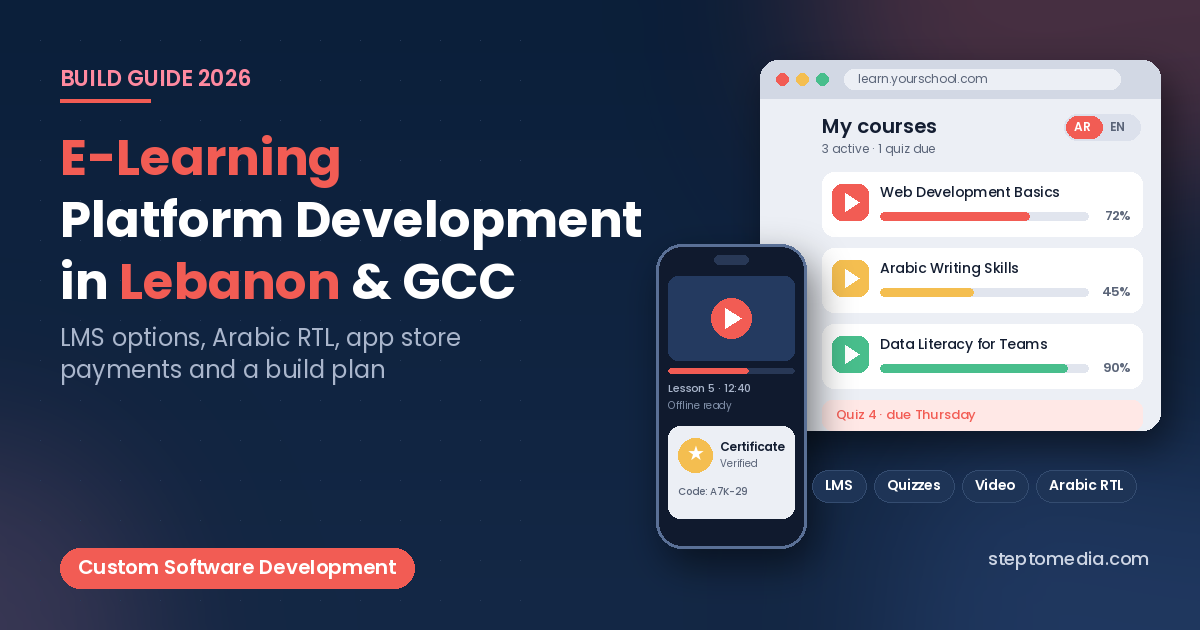
- Course builder: modules, lessons, video, documents, and drip release by date or progress.
- User roles: learners, instructors, administrators, and, for schools, parents, each with clear permissions.
- Assessments: quizzes, assignments with file upload, grading, and feedback.
- Progress tracking and certificates: completion rules and downloadable certificates with a verification code.
- Live classes: scheduling, video conferencing links, and recordings.
- Communication: announcements, discussions, and notifications.
- Payments and enrollment: one-off course fees, subscriptions, coupons, and invoices for corporate clients.
- Reporting: who enrolled, who finished, where learners drop off, and how assessments perform.
For a first release, focus on what learners and instructors use daily; gamification and advanced analytics can follow.
Content Standards: SCORM, xAPI, and LTI
If you buy ready-made courses or plan to move between platforms later, standards matter:
- SCORM is the long-established packaging format that most LMS products can import and track.
- xAPI (Experience API), stewarded by the Advanced Distributed Learning (ADL) Initiative, records learning activity as statements stored in a Learning Record Store. ADL describes it as an evolved version of SCORM that can track learning outside a traditional LMS, including in mobile apps.
- LTI (Learning Tools Interoperability), from 1EdTech, connects external learning tools to an LMS so users do not log in to each tool separately.
Decide upfront which content you will import and which tools you will connect; a custom platform does not need every standard.
Arabic, Bilingual, and Low-Bandwidth Requirements
Learners in Lebanon and the GCC often switch between Arabic, English, and French. Plan for a full right-to-left (RTL) interface, not only translated text: mirrored layouts, correct mixing of Arabic and Latin text in course titles, Arabic-friendly fonts, and certificates that render names correctly in both scripts. Our guide to bilingual Arabic and English websites covers the details.
Connectivity varies, so offer adaptive video quality, light lesson pages, resume-where-you-stopped, and offline viewing in the app.
Payments, App Stores, and In-App Purchase Rules
Selling courses online needs a payment setup that works for your market. Card gateways, wallets, and bank transfers differ between Lebanon and the Gulf, as explained in our guide to payment gateways in Lebanon.
Mobile apps add a further rule. Apple’s App Review Guidelines require In-App Purchase to unlock digital content such as premium courses or subscriptions, with listed exceptions, including real-time one-to-one services such as live tutoring between two people. Google Play’s payments policy likewise requires its billing system for digital content and education subscriptions sold inside an app, apart from defined exceptions and regional programs. Settle this before design, because it affects pricing. Our post on publishing on the App Store and Google Play covers accounts and review.
Regulation and Data Protection
In Saudi Arabia, the National eLearning Center (NELC) regulates online education and training. Its eLearning Regulations say institutions offering online courses and programs in the Kingdom must obtain the required licenses and integrate technically with the national platform, FutureX. If you target Saudi learners, check NELC’s current requirements before you build.
Learner data is personal data. Lebanon’s Law No. 81 of 2018 on electronic transactions and personal data, Saudi Arabia’s Personal Data Protection Law, and the UAE’s Federal Decree-Law No. 45 of 2021 all set rules on consent, purpose, security, and access. Collect only what you need, protect grades and identity documents, and take extra care with data about children. This is general information, not legal advice.
A Practical Build Plan
- Define the learning model: who teaches, who learns, and how courses are sold or assigned.
- Choose the route: hosted LMS, Moodle, custom, or a hybrid, based on features, budget, and data ownership.
- Map integrations: student information system, payments, single sign-on, video hosting, and messaging.
- Build a focused first version: courses, enrollment, progress, assessments, and the admin panel.
- Pilot with one cohort: fix friction before a wider launch.
- Launch and iterate: use completion and drop-off data to guide new features.
What Affects the Cost and Timeline
We don’t quote fixed prices without a scope, because e-learning projects vary widely. The main factors are the route you choose, the number of user roles, web only or web plus iOS and Android, live classes and video hosting, payment and subscription logic, bilingual content, integrations, and reporting depth. Filming and editing lessons is usually a separate budget.
How Step To Media Can Help
Step To Media builds websites, mobile apps, and custom software from Mkalles for institutions and businesses in Lebanon and the Gulf. Explore our website development, mobile app development, and custom software development services. You can also learn more about us as a software and web development company in Lebanon, or see how we work as a software development agency in Lebanon. Planning an online learning platform? Contact us with your learners, courses, and target markets.
Frequently Asked Questions
Should I use Moodle or build a custom e-learning platform?
Moodle suits schools, universities, and training teams that need mature course, quiz, and gradebook features and can maintain hosting and plugins. A custom platform makes sense when learning is your product, you sell courses, or you need workflows and branding that an LMS cannot support well.
Can an e-learning platform support Arabic and English?
Yes, if it is planned from the start: a full right-to-left interface, mixed Arabic and Latin text, Arabic-friendly fonts, and certificates that render names correctly in both languages.
Do I need Apple and Google in-app purchases to sell courses in my app?
Usually, yes, for digital courses and subscriptions sold inside a mobile app, under both stores’ payment rules. There are exceptions, such as real-time one-to-one tutoring on the App Store, so review the current rules before you set prices.
Do I need a license to offer online courses in Saudi Arabia?
Institutions offering online courses and programs in Saudi Arabia fall under the National eLearning Center’s eLearning Regulations, which require licensing and technical integration with the FutureX platform. Check the current requirements with NELC before launch.
Can the platform connect to our student information system?
In most cases, yes. If the system has an API, enrollments, grades, and user accounts can sync automatically. If it does not, scheduled file imports or a small middleware service can bridge the gap.
No next post available