Loyalty App Development in Lebanon and the GCC: Features, Build Options, and Rollout
 24 Oct
Loyalty App Development in Lebanon and the GCC: Features, Build Options, and Rollout
Paper stamp cards get lost, and a generic points plugin rarely fits how a Lebanese café chain, pharmacy, or Gulf retailer actually sells. Loyalty app development means building a rewards program around your own customers, branches, and point-of-sale (POS) system, so every purchase is recorded and every reward is easy to redeem.
This guide covers the build options, the features that matter, how a loyalty app connects to your existing systems, and a practical rollout plan for businesses in Lebanon and the GCC in 2026.
What a Loyalty App Actually Does
At its core, a loyalty app does four things: it identifies the customer, records each qualifying purchase, applies your reward rules, and lets the customer see and redeem what they have earned. Everything else, such as offers, referrals, or tiers, is built on top of those four steps.
The hard part is rarely the screens. It is the rules engine and the connection to the place where sales actually happen: the cashier, the online store, or the delivery flow.
Build Options: Wallet Pass, Ready-Made Platform, or Custom App
There are three common routes, and the right one depends on how central loyalty is to your business.
- Digital wallet pass: Apple Wallet supports a store card pass type and Google Wallet offers a Loyalty Cards API. A pass shows the customer’s balance and a barcode for the cashier, with no app download. It suits simple stamp or points programs, but offers limited room for personalization or in-app ordering.
- Ready-made loyalty platform: a subscription tool that plugs into supported POS or e-commerce systems. It is quick to launch, but you are limited to its rules, its branding options, and its integrations, and many do not support local POS systems or Arabic properly.
- Custom loyalty app: your own iOS and Android app (and often a web portal) with rules, data, and integrations you control. It costs more upfront, but it can combine loyalty with ordering, booking, or delivery, and the customer data belongs to you.
Many businesses start with a wallet pass or a web-based loyalty page and move to a full app once the program proves itself. A custom backend can serve all three channels from the same rules.
Core Features of a Loyalty App
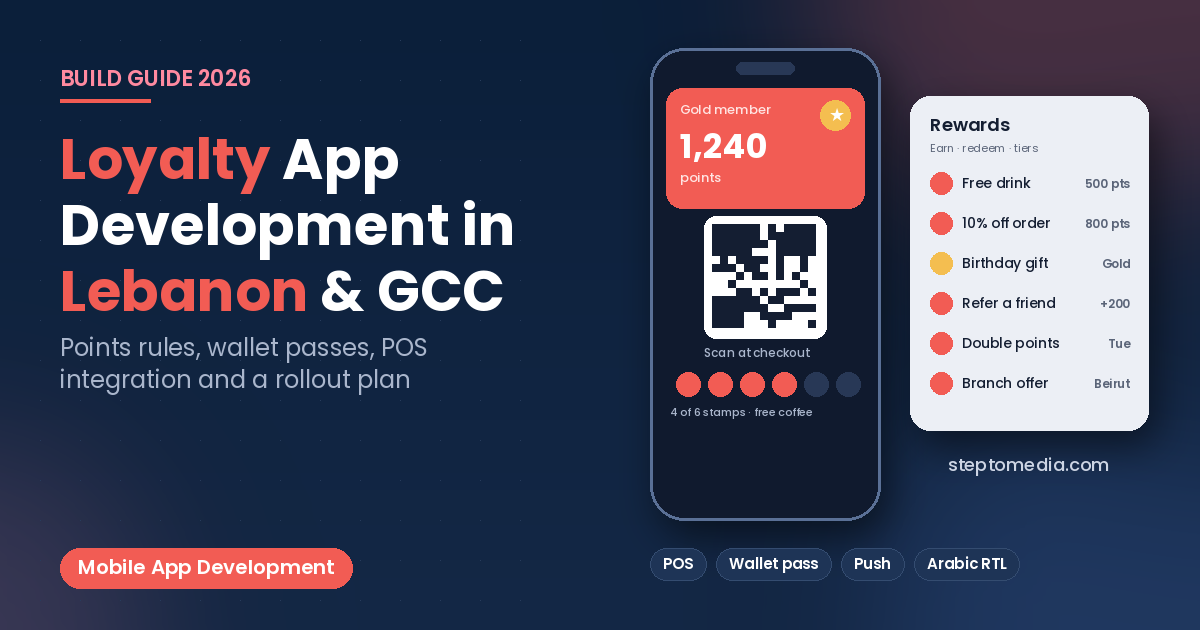
- Sign-up and identification: phone number with a one-time password is the most common choice in Lebanon and the Gulf, plus a QR code the cashier scans.
- Earning rules: points per amount spent, stamps per visit, bonus points for specific products, or double points on chosen days.
- Rewards and redemption: free items, discounts, or vouchers, with clear rules on minimum balances and expiry.
- Tiers: levels such as silver and gold that unlock better benefits as customers spend more.
- Offers and push notifications: targeted promotions based on purchase history, sent only to customers who gave permission.
- Referrals: rewards for both the existing customer and the friend they invite.
- Transaction history: a clear record of points earned, spent, and expiring.
- Admin dashboard: where your team manages rules, rewards, branches, and customer support cases without a developer.
Designing Points Rules That Work
A loyalty program fails when customers cannot understand it or when it quietly costs more than it returns. Before development, agree on a few decisions in writing:
- Earn rate and reward value: how much a customer spends to earn one point, and what a point is worth when redeemed.
- Currency handling: for Lebanon, decide whether points are calculated on USD or LBP totals and how mixed-currency payments are treated. For Gulf branches, define the rule per local currency.
- Expiry: whether points expire, after how long, and how customers are warned beforehand.
- Returns and cancellations: points from refunded or cancelled orders must be reversed automatically.
- Fraud limits: caps on daily earning, checks for repeated scans, and staff permissions for manual adjustments.
A short written specification of these rules saves weeks of rework. Our guide to writing a custom software brief shows how to structure it.
Integrations: POS, E-commerce, Delivery, and WhatsApp
A loyalty app is only as good as its connection to sales data. Typical integrations include:
- POS systems: so the cashier scans the customer’s code and points post automatically. If your POS has no API, a middleware service or a cashier-side web app can bridge the gap.
- Online store: so web and in-app orders earn and redeem the same points. See our guide to choosing an e-commerce platform in Lebanon and the GCC.
- Delivery and booking flows: loyalty works well inside an on-demand delivery app or a booking system for clinics and salons.
- ERP or accounting: so outstanding points are visible as a liability and reports match the books.
- WhatsApp notifications: balance updates and reward reminders through the WhatsApp Business Platform, covered in our WhatsApp ERP integration guide.
For a broader view of connecting systems, read our post on API integration for payments, ERP, and WhatsApp.
Arabic, Bilingual, and Multi-Branch Requirements
For Lebanon and the GCC, a loyalty app usually needs full Arabic and English support with right-to-left (RTL) layouts, reward names and terms in both languages, and push notifications in the customer’s chosen language. Multi-branch businesses also need per-branch reporting, branch-specific offers, and staff accounts limited to their own location. If you operate in more than one country, plan for separate currencies, prices, and possibly separate reward catalogs from day one.
Privacy, Consent, and Data Rules
Loyalty programs collect personal data and purchase history, so consent and security matter. Customers should opt in to marketing messages separately from joining the program, and iOS and recent Android versions both ask users for permission before an app can show notifications.
In Lebanon, Law No. 81 of 2018 on Electronic Transactions and Personal Data includes a section on personal data protection. In Saudi Arabia, the Personal Data Protection Law is overseen by SDAIA, and in the UAE, Federal Decree-Law No. 45 of 2021 governs personal data. This is general information, not legal advice; check the rules for each market you operate in.
A Practical Rollout Plan
- Define the program: goals, earn and burn rules, rewards, and the reports you need.
- Map integrations: confirm what your POS, store, and ERP can share, and how.
- Design and build an MVP: sign-up, earning, redemption, history, and the admin dashboard. Our post on MVP software development explains how to keep the first version focused.
- Pilot in one branch: train staff, watch for scanning and posting errors, and adjust rules.
- Publish and launch: release on both stores (see how to publish your app on the App Store and Google Play), then roll out branch by branch.
- Measure and improve: track sign-ups, active members, redemption rate, and repeat visits, then refine offers and tiers.
What Affects the Cost and Timeline
We don’t quote fixed prices without a scope, because loyalty projects vary widely. The main factors are the build route (wallet pass, platform, or custom app), the number and complexity of integrations, especially POS, the number of platforms (iOS, Android, web), bilingual content, tiers and referral logic, and the admin dashboard’s reporting needs. For general market ranges, see our guides to custom software development cost in Lebanon and the mobile app development timeline.
How Step To Media Can Help
Step To Media builds mobile apps, websites, and custom software from Mkalles for businesses in Lebanon and the Gulf, including the integrations that connect them to your POS, store, and messaging channels. Explore our mobile app development, custom software development, and website development services. You can also learn more about us as a software and web development company in Lebanon, or see how we work as a software development agency in Lebanon. Planning a rewards program? Contact us with your branches, POS system, and target markets.
Frequently Asked Questions
Do I need a full app for a loyalty program?
Not always. A digital wallet pass in Apple Wallet or Google Wallet can run a simple points or stamp program without an app download. A custom app makes sense when you want ordering, booking, personalized offers, or full control of your customer data.
Can a loyalty app connect to my existing POS?
Usually, yes. If the POS has an API, points can post automatically at checkout. If it doesn’t, a middleware service or a simple cashier-side web app can record purchases instead.
How do customers sign up?
The most common method is a phone number verified with a one-time password, followed by a personal QR code that the cashier scans at each purchase.
Should loyalty points expire?
That is a business decision. Many programs use expiry to limit outstanding liability, but customers should be warned clearly before points expire.
Can one app serve branches in Lebanon and the Gulf?
Yes, if it is planned that way: separate currencies, per-country reward catalogs, Arabic and English content, and branch-level reporting.
No next post available