Choosing an E-commerce Platform in Lebanon and the GCC: Shopify, WooCommerce, Salla, Zid, or Custom
 17 Oct
Choosing an E-commerce Platform in Lebanon and the GCC: Shopify, WooCommerce, Salla, Zid, or Custom
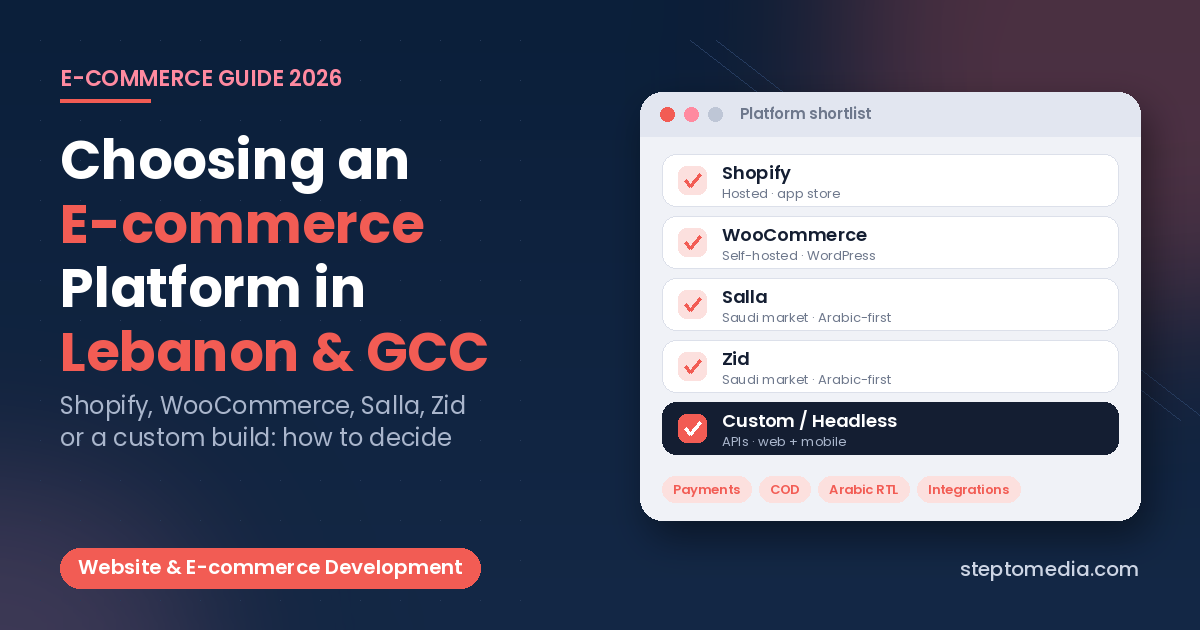
Before you design a single product page, you need to decide where your store will live. Choosing the right ecommerce platform Lebanon businesses can grow on is less about which brand is “best” and more about where you sell, how you get paid, and how much control you need over checkout, data, and integrations.
This guide compares the options Lebanese and GCC brands usually shortlist—Shopify, WooCommerce, Salla, Zid, and a custom or headless build—so you can pick one that fits today and still works when you expand.
Start With Four Questions, Not a Platform Name
Most platform regrets come from skipping these questions:
- Where are your customers and your company registered? A store selling inside Lebanon, a Lebanese brand selling to the Gulf, and a Saudi-registered business have different payment and compliance options.
- How will customers pay? Cash on delivery, local card gateways, wallets, and bank transfers are not supported equally everywhere.
- What must the store connect to? Accounting, stock, POS, delivery companies, WhatsApp, or a mobile app.
- Who will run it day to day? A small team needs a simple admin; larger operations may need custom roles.
Your answers will usually rule out one or two options before you compare features.
Shopify: Fast Hosted Launch With an App Ecosystem
Shopify is a hosted, subscription-based platform. Hosting, security, and checkout are managed for you, and a large app store covers reviews, shipping, and more.
- Good fit: brands that want to launch quickly, sell mostly standard products, and prefer not to manage servers.
- Watch out for: payments. Shopify Payments is not offered in every country, so many stores connect a third-party gateway instead, and Shopify charges its own extra transaction fee on those orders. Check the current rate for your plan on Shopify’s pricing page.
- Also consider: app subscriptions add up, and deep checkout customisation is limited on lower plans.
WooCommerce: Flexible and Self-Hosted on WordPress
WooCommerce is a free, open-source plugin that turns a WordPress site into a store. You own the code and data and choose your own hosting, theme, and extensions.
- Good fit: content-heavy brands, unusual pricing rules, and teams that already run WordPress.
- Watch out for: hosting quality, security, and plugin hygiene are your responsibility. Too many plugins slow the store down, and slow websites cost online sales.
Still undecided on WordPress itself? Read our comparison of WordPress vs a custom website in Lebanon.
Salla and Zid: Built for the Saudi Market
Salla and Zid are Saudi e-commerce platforms with Arabic-first store builders, local payment methods such as mada, and integrations with shipping companies operating in the Kingdom.
- Good fit: businesses registered in Saudi Arabia that sell mainly to Saudi customers and want an Arabic storefront and dashboard out of the box.
- Watch out for: merchant verification. Both platforms ask for Saudi documents—such as a commercial registration or a freelance work certificate and a matching bank account—to activate selling or online payment gateways. A company registered only in Lebanon should confirm eligibility before planning around them.
- Also consider: Saudi sellers also have local obligations such as ZATCA e-invoicing, so check how your platform and accounting tools handle it.
Custom or Headless E-commerce: When Templates Hold You Back
A custom store is built around your business logic. A headless setup separates the storefront (website or app) from the commerce engine, which can be a platform like Shopify or a custom backend, and connects them through APIs.
- Good fit: B2B pricing, multi-brand catalogues, marketplaces, subscriptions, or a store sharing one backend with a mobile app.
- Watch out for: higher upfront scope and the need for a clear product owner and specific requirements.
- Also consider: custom makes sense when the store is core to how you operate. Our custom software development and mobile app development services cover this kind of build.
Choosing an Ecommerce Platform in Lebanon: Side-by-Side
- Speed to launch: Shopify, Salla, and Zid are usually fastest; custom takes longest.
- Control: WooCommerce and custom builds give the most control over code, data, and hosting.
- Payments in Lebanon: plan around the gateways and COD flows you can actually use. Our guide to payment gateways for Lebanon websites and apps walks through the options.
- Arabic and RTL: Salla and Zid are Arabic-first; Shopify and WooCommerce support Arabic with the right theme and translation setup; custom builds can be designed bilingual from day one. See our guide to bilingual Arabic-English websites.
- Integrations: custom and WooCommerce builds give you more freedom when no app exists for your local provider.
Integrations Often Decide the Platform
In Lebanon and the Gulf, the store rarely works alone. Orders may need to reach accounting software, stock may sync with a POS, and customers may expect WhatsApp updates. If a platform has no reliable connector for your accounting software or delivery partner, you will need custom API work either way. Our article on API integration for payments, ERP, and WhatsApp explains what that involves, and our API integration service handles it. If you run your own riders or drivers, our guide to on-demand delivery app development covers the operational side.
Cost Factors to Compare
Pricing pages show only part of the picture. Compare total cost over two to three years:
- Hosted platforms (Shopify, Salla, Zid): monthly plan, paid apps or add-ons, theme purchase or customisation, payment and transaction fees.
- WooCommerce: hosting, premium plugins and themes, security, updates, and developer time for maintenance.
- Custom or headless: discovery, design, development, testing, hosting, and ongoing improvements.
- On every option: product data, migrations, and staff training.
For broader budgeting context, see our guide to website cost in Lebanon, which explains what moves a quote up or down.
A Practical Way to Decide
- Confirm where you are registered and which payment methods you can legally accept.
- List must-have features and integrations, and mark what is phase one versus later.
- Shortlist two options, not five.
- Test the admin with the people who will process orders every day.
- Plan how you would migrate data if you outgrow the platform.
Once the platform is chosen, our guide to e-commerce website development in Lebanon and the GCC covers checkout, performance, and catalogue structure, and how to scale your online store in Lebanon covers growth after launch. Before going live, run through our website launch checklist.
Working With a Lebanon Development Partner
Step To Media builds websites, online stores, mobile apps, and custom software from Mkalles for businesses in Lebanon and the region. Explore our website development service, learn more about us as a software and web development company in Lebanon, or see how we work as a software development agency in Lebanon. When you are ready, contact us with your markets, payment needs, and the systems your store must connect to.
Frequently Asked Questions
What is the best e-commerce platform for a business in Lebanon?
There is no single best option. Shopify suits fast hosted launches, WooCommerce suits teams that want control, and custom suits unique workflows or integrations. Start from your payment methods and integrations.
Can a Lebanese company sell on Salla or Zid?
Salla and Zid are built for the Saudi market and ask for Saudi documents, such as a commercial registration or freelance work certificate and a matching bank account, to activate selling or payment gateways. A company registered only in Lebanon should confirm eligibility with the platform first.
Does Shopify work for stores in Lebanon?
Yes, Shopify can run a store for Lebanese customers, but Shopify Payments is not offered in every country. Many stores use a third-party gateway or cash on delivery, and Shopify adds its own transaction fee on third-party gateway payments, so check the current rate for your plan.
Is WooCommerce cheaper than Shopify?
The WooCommerce plugin is free, but you pay for hosting, extensions, and maintenance. Shopify has a monthly plan plus app and transaction fees. Compare total cost over two to three years.
When does a custom or headless e-commerce build make sense?
When your store needs B2B pricing, marketplace features, complex integrations, or one backend shared with a mobile app. With standard products and checkout, a hosted platform is usually the better start.
Can I switch e-commerce platforms later?
Yes, but products, customers, orders, URLs, and SEO redirects all need to move carefully. Good export options and planned redirects reduce the risk.
No next post available