Real Estate Website Development in Lebanon and the GCC: Features, Listings, and Ad Rules
 26 Oct
Real Estate Website Development in Lebanon and the GCC: Features, Listings, and Ad Rules
Property buyers and tenants in Lebanon and the Gulf usually start online, comparing areas, prices, and photos on their phones before they call a broker. Real estate website development means building a site that turns that browsing into qualified enquiries: fast listing search, clear property pages, and a lead flow that reaches your sales team in minutes, not days.
This guide for brokerages, developers, and property managers covers website types, features, Arabic and mobile needs, Dubai and Saudi advertising rules, and a 2026 build plan.
Which Type of Real Estate Website Do You Need?
The right build depends on how you sell:
- Brokerage website: many listings for sale and rent, filters, agent profiles, and enquiry forms. Listings change daily, so the admin panel matters as much as the design.
- Developer or project website: one or a few projects with floor plans, unit types, payment plans, construction updates, and brochure downloads. The goal is registrations of interest and showroom visits.
- International investment website: properties in several countries, often for overseas buyers. Our McGardens Estate project is an example: a platform for exploring premium properties in Dubai, Muscat, and the United Kingdom.
- Property management portal: tenant and owner logins, maintenance requests, and statements, closer to custom software than a marketing site.
Core Features of a Real Estate Website
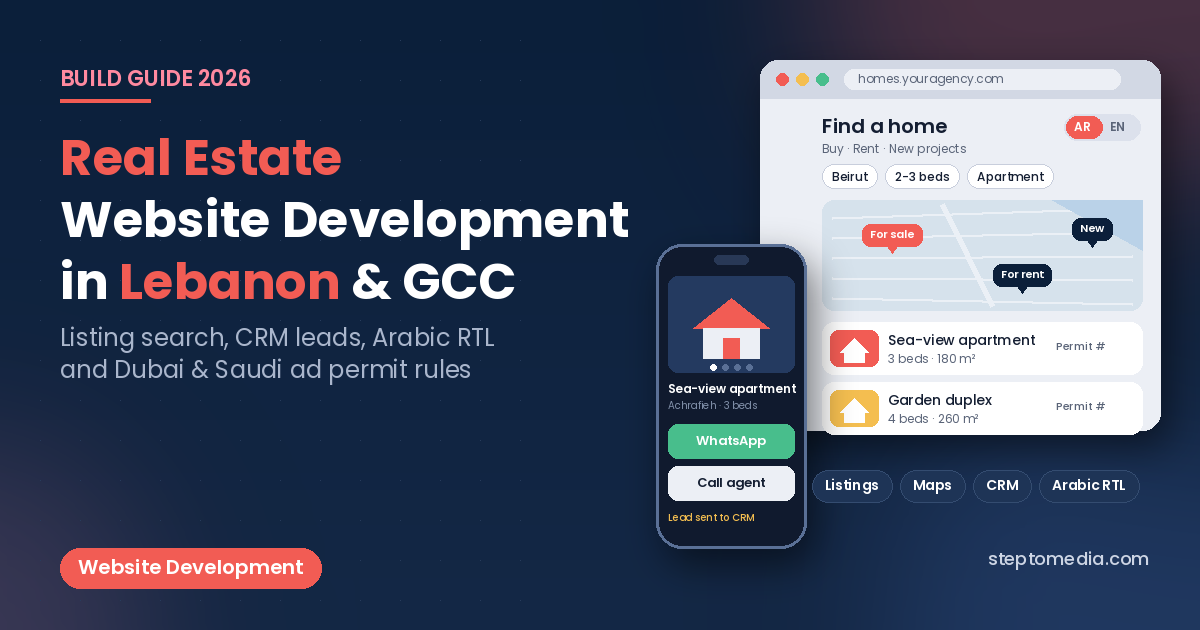
- Listing search and filters: buy or rent, area, price, bedrooms, type, and size, with fast results that keep filters when users go back.
- Property pages: a photo gallery, floor plans, video or virtual tour, key facts, amenities, location map, and a clear call to action.
- Map search: browse listings by neighborhood.
- Lead capture: enquiry forms, click-to-call, and WhatsApp buttons, each tagged with the listing and source so you know what generated the lead.
- Saved searches and alerts: registered users get notified when matching properties are added.
- Project pages for developers: unit availability, payment plans, and downloadable brochures behind a short form.
- Admin panel: add, edit, publish, and archive listings; mark units sold or rented; manage agents and leads.
Keep the first release focused on search, listing pages, and leads; mortgage calculators and comparison tools can follow.
Listings, CRM, and Lead Management
A common problem on property websites is stale data: sold units still appear, prices are out of date, and enquiries sit in an inbox. Plan the data flow before design:
- One source of truth: decide whether listings live in the website’s database, your CRM, or a property management system, and sync from there instead of editing in several places.
- Lead routing: send each enquiry to the right agent or team by area, project, or language, with an instant notification.
- Follow-up: automatic confirmations and agent reminders. Our guide to WhatsApp ERP integration explains how business systems can send WhatsApp messages through the official platform.
- Portal exports: if you also advertise on property portals, check whether they accept a feed or import from your system, so you are not retyping every listing.
Arabic, Bilingual, and Mobile-First Design
Property audiences in the region are multilingual: Lebanon may need Arabic, English, and French; Gulf sites usually need Arabic and English. Plan a full right-to-left (RTL) layout for Arabic, translated listing fields rather than only translated menus, and correct number, currency, and area formats. Our guide to bilingual Arabic and English websites covers the technical details.
Most property browsing happens on phones, so design the listing page for one-handed use: swipeable galleries, sticky call and WhatsApp buttons, and short forms. Photo galleries are the main performance risk, so compress and lazy-load images. Our post on why slow websites lose sales explains why speed matters.
Advertising Rules in Dubai and Saudi Arabia
If your website advertises property in the Gulf, local advertising rules affect how listings are built:
- Dubai: the Dubai Land Department’s Real Estate Regulatory Agency requires brokerages to obtain a permit through the Trakheesi system for real estate advertisements, including electronic and online ads, and the permit number must be displayed on the ad. Brokers also need a marketing contract with the property owner.
- Saudi Arabia: the Real Estate General Authority (REGA) issues a real estate advertisement license for each property ad, linked to a brokerage contract that includes marketing rights. Its Real Estate Marketing and Advertising Regulations, approved in 2026, require ads to show the license number and key property details, prohibit misleading content, and apply across channels including online platforms.
In practice, add permit or license number fields, show them on each listing, and make it easy to unpublish expired or sold listings. Check current rules with each authority before launch.
Maps, SEO, and Data Protection
Maps: map search usually relies on a provider such as Google Maps Platform, which offers pay-as-you-go and subscription pricing, or on open map data. Estimate usage early.
SEO: give each listing and each area its own crawlable page with a unique title and description, rather than loading everything inside a single search page. Schema.org has a RealEstateListing type that can describe listings in structured data, though it does not guarantee special search results.
Data protection: enquiry forms collect names, phone numbers, budgets, and sometimes identity documents. Lebanon’s Law No. 81 of 2018 on electronic transactions and personal data, Saudi Arabia’s Personal Data Protection Law, and the UAE’s Federal Decree-Law No. 45 of 2021 set rules on consent, purpose, and security. Collect only what you need, restrict access to leads, and say clearly how contact details are used. This is general information, not legal advice.
WordPress or a Custom Build?
WordPress with a well-maintained real estate plugin can suit a smaller agency with simple filters. A custom build makes more sense for complex search, a large or fast-changing inventory, CRM integration, owner and tenant portals, or several markets. Our comparison of WordPress vs. custom websites goes deeper into the trade-offs.
A Practical Build Plan
- Define audience and markets: buyers, tenants, or overseas investors, and where you advertise.
- Map the data: listing fields, where listings come from, and how leads reach agents.
- Build the admin panel and integrations: CRM, WhatsApp, email, and maps.
- Add compliance fields: permit or license numbers where required.
- Test on real phones and connections, then launch with analytics tracking each enquiry source. Our website launch checklist helps with go-live.
What Affects the Cost and Timeline
We don’t quote fixed prices without a scope. The main factors are the number of listings and filters, map search, languages, integrations with a CRM or property system, portals for owners or tenants, and whether you need a mobile app as well as the website. For general budgeting, see our guide to website cost in Lebanon.
How Step To Media Can Help
Step To Media builds websites, mobile apps, and custom software from Mkalles for businesses in Lebanon and the Gulf. Explore our website development, mobile app development, and custom software development services. You can also learn more about us as a software and web development company in Lebanon, or see how we work as a software development agency in Lebanon. Planning a property website or portal? Contact us with your listings, markets, and the systems you already use.
Frequently Asked Questions
What features does a real estate website need?
At minimum: listing search with filters, property pages with photos and a map, enquiry forms with click-to-call and WhatsApp, and an admin panel to publish, update, and archive listings.
Can a real estate website connect to our CRM?
Usually, yes. If your CRM has an API, listings and leads can sync automatically and enquiries can be routed to the right agent. Otherwise, scheduled imports or small middleware can bridge the gap.
Do property listings in Dubai need a permit number?
Yes. Brokerages advertising property in Dubai, including online, must obtain an advertising permit through the Dubai Land Department’s Trakheesi system and display the permit number on the ad. Check the current requirements with the Dubai Land Department.
Do real estate ads in Saudi Arabia need a license?
Yes. The Real Estate General Authority issues a real estate advertisement license for each property ad, and ads must display the license number. Its marketing and advertising regulations apply to online platforms as well as other channels.
Should a real estate website support Arabic and English?
For most Lebanese and Gulf markets, yes. Plan a right-to-left Arabic layout, translated listing details, and correct currency and area formats from the start.