B2B Portal Development in Lebanon and the GCC: Ordering, Pricing, and ERP Sync
 27 Oct
B2B Portal Development in Lebanon and the GCC: Ordering, Pricing, and ERP Sync
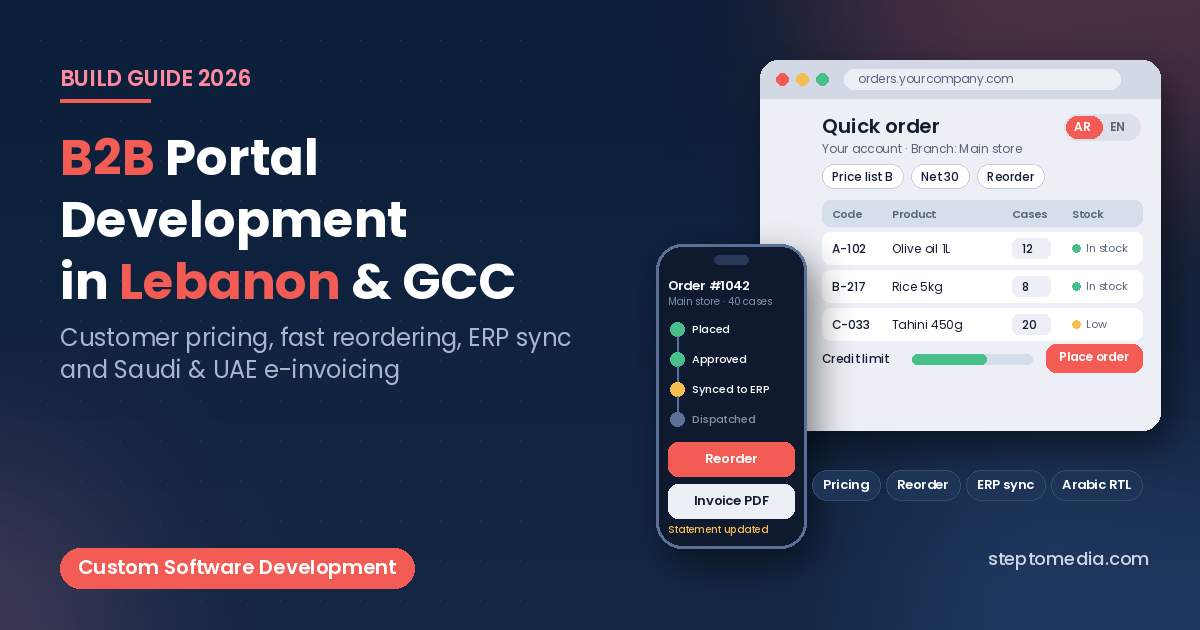
Many distributors, wholesalers, and manufacturers in Lebanon and the Gulf still take trade orders by phone, WhatsApp messages, and spreadsheets. B2B portal development means building a secure, logged-in website or app where your business customers can see their own prices, place and repeat orders, check stock and statements, and download invoices without waiting for someone in your office to answer.
This guide covers what a B2B ordering portal should include, how it connects to your ERP, when an off-the-shelf option is enough, the e-invoicing rules that matter in Saudi Arabia and the UAE, and a practical build plan for 2026.
What Is a B2B Portal?
A B2B portal is a private storefront and self-service area for trade customers: shops, pharmacies, restaurants, contractors, or resellers that buy from you regularly. Unlike a public online store, every customer logs in and sees a catalog, price list, and payment terms agreed with them. It is different from an internal tool for your own staff (our post on custom internal tools covers those) and from a consumer store, which our e-commerce platform guide compares.
Typical users are distributors and wholesalers serving many retail outlets, manufacturers selling to dealers across Lebanon and the GCC, and multi-branch groups whose branches order from a central warehouse.
Core Features of a B2B Ordering Portal
- Company accounts with several users: one customer company, many branches or buyers, each with roles such as “can order” or “needs approval”.
- Customer-specific catalogs and prices: price lists per customer or group, volume breaks, minimum order quantities, and case or pallet units.
- Fast ordering: search by product code, quick-order lists, reorder from past orders, and CSV upload for large orders.
- Stock and delivery visibility: available quantities, expected restock dates, and order and delivery status.
- Credit limits and payment terms: show outstanding balance, block or flag orders above the limit, and support terms such as 30 days alongside online payment.
- Statements and documents: invoices, credit notes, delivery notes, and account statements available for download.
- Sales rep tools: reps place orders on behalf of customers and see their accounts, often in a mobile app.
Start with ordering, pricing, and order status; returns, quotes, and loyalty-style rebates can follow in a later phase.
ERP Integration: The Heart of the Portal
A B2B portal is only as reliable as its data. Products, prices, stock, customer balances, and invoices usually live in an ERP or accounting system, so the portal should read from it and write orders back instead of keeping a second copy that drifts out of date. Decide which system owns each piece of data and how often it syncs.
If you run Odoo, its built-in portal already lets invited customers view their quotations, sales orders, and invoices, and a custom ordering front end can sit on top of it. Our comparison of ERP vs custom software explains this “ERP core, custom edges” approach, and our guide to API integration in Lebanon covers connecting payments, ERP, and messaging. For order updates by WhatsApp, see WhatsApp ERP integration.
B2B Portal Development: Off-the-Shelf or Custom?
You do not always need a full custom build:
- ERP portal modules: good when customers mainly need to view orders and invoices and your ERP already holds everything.
- E-commerce platforms with B2B features: Shopify B2B, for example, supports company accounts, catalogs, quantity rules, volume pricing, and net payment terms, with more advanced options such as customer-level catalogs and deposits on the Shopify Plus plan. This suits simpler catalogs sold on standard terms.
- Custom development: makes sense when pricing rules are complex, you sell in several currencies or markets, orders must follow approval steps, sales reps need offline-capable apps, or the portal must integrate tightly with a local ERP or accounting system.
A common middle path is a custom portal connected to your existing ERP, so you keep proven accounting while customers get an ordering flow built around how they buy.
E-Invoicing Rules in Saudi Arabia and the UAE
If your portal issues invoices to business customers in the Gulf, plan for e-invoicing from the start:
- Saudi Arabia: the Zakat, Tax and Customs Authority (ZATCA) requires e-invoices from compliant electronic solutions. Its Phase Two “Integration Phase” adds connecting those solutions to the Fatoora platform, using a specified invoice format and additional fields, and is rolled out in waves. ZATCA notifies each wave at least six months ahead; the 25th wave, announced in July 2026, must integrate by 1 February 2027.
- UAE: the Ministry of Finance’s e-invoicing system covers business-to-business and business-to-government transactions. A pilot started on 1 July 2026; businesses with annual revenue of AED 50 million or more must implement it by 1 January 2027, and smaller businesses by 1 July 2027, through an Accredited Service Provider.
In practice, your ERP or e-invoicing provider usually generates the invoice and the portal only displays it. Check current rules with each authority before launch.
Arabic, Mobile, and Payments
Trade buyers in the region often order in Arabic, so plan a right-to-left layout and translated product names, not only translated menus; our guide to bilingual Arabic and English websites covers the details. Many shop owners reorder from a phone, so keep the reorder flow short.
Payment methods vary: bank transfer, cash on delivery, cheques collected by reps, and card payments. If you want online payment, our guide to payment gateways in Lebanon explains the options.
Security and Data Protection
Customers must never see each other’s prices or balances. Enforce access per company and user, and log who placed or approved each order. Lebanon’s Law No. 81 of 2018 on electronic transactions and personal data, Saudi Arabia’s Personal Data Protection Law, and the UAE’s Federal Decree-Law No. 45 of 2021 set rules on consent, purpose, and security for personal data. This is general information, not legal advice.
A Practical Build Plan
- Map how customers order today: channels, pricing rules, and approvals.
- Decide the source of truth: which data comes from the ERP and how orders flow back.
- Pick the approach: ERP portal, platform with B2B features, or custom build.
- Launch a pilot with a small group of loyal customers and one or two sales reps.
- Roll out in phases, adding rep apps, returns, and quotes later.
What Affects the Cost and Timeline
We don’t quote fixed prices without a scope. The main factors are the number of products and pricing rules, ERP integration depth, languages, approval workflows, a sales rep mobile app, and e-invoicing requirements. For general budgeting, see our guide to custom software development cost in Lebanon.
How Step To Media Can Help
Step To Media builds websites, mobile apps, and custom software from Mkalles for businesses in Lebanon and the Gulf. Explore our custom software development, website development, and mobile app development services. You can also learn more about us as a software and web development company in Lebanon, or see how we work as a software development agency in Lebanon. Planning a trade ordering portal? Contact us with how your customers order today and the ERP or accounting system you use.
Frequently Asked Questions
What is a B2B portal?
A B2B portal is a private, logged-in website or app where business customers see their own catalog, prices, and payment terms, place and repeat orders, and download invoices and statements.
Can a B2B portal connect to our ERP?
Usually, yes. If your ERP has an API, products, prices, stock, and balances can sync to the portal and orders can flow back automatically. Odoo, for example, also includes a customer portal for viewing quotations, orders, and invoices.
Do we need a custom build or can we use Shopify B2B?
Shopify B2B suits simpler catalogs with standard terms. A custom build makes more sense for complex pricing, approval workflows, several markets, offline sales rep apps, or tight integration with a local ERP.
Does a B2B portal need to support e-invoicing in Saudi Arabia or the UAE?
If it issues invoices to Gulf business customers, yes. Saudi Arabia’s ZATCA rolls out Fatoora integration in waves, and UAE e-invoicing for B2B transactions starts on 1 January 2027 for businesses with revenue of AED 50 million or more.
Should a B2B portal have a mobile app?
A responsive web portal is often enough. A mobile app is worth it when sales reps take orders in the field or customers reorder often from phones.
No next post available