WhatsApp ERP Integration in Lebanon and the GCC: A 2026 Guide for Businesses
 22 Oct
WhatsApp ERP Integration in Lebanon and the GCC: A 2026 Guide for Businesses
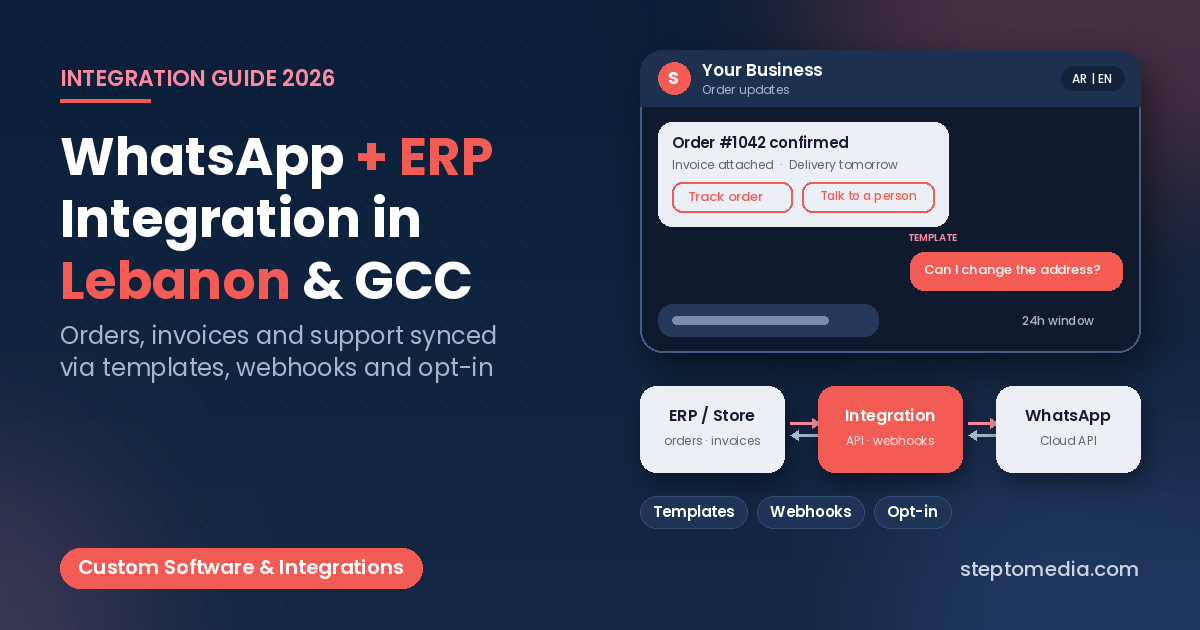
In Lebanon and across the Gulf, customers expect order updates, invoices, and answers on WhatsApp, yet many teams still copy those messages by hand from their ERP or store into a shared phone. A proper WhatsApp ERP integration connects WhatsApp to the systems that hold your orders, customers, and invoices, so the right message goes out automatically and every reply lands where your team can act on it.
This guide covers what it connects, how it is built on the official WhatsApp Business Platform, and the rules and costs for 2026. For the wider picture of connecting payments, CRMs, and ERPs, see our guide to API integration for payments, ERP, and WhatsApp.
WhatsApp ERP Integration: What It Connects
Events in your business system trigger WhatsApp messages, and customer replies flow back into it. Common patterns:
- Order and delivery updates: confirmation when an order is created in your ERP or e-commerce platform, then dispatch and delivery notices.
- Invoices, quotations, and receipts: a document sent to the customer’s WhatsApp as soon as it is issued, with a reminder before the due date.
- Appointment reminders: confirmations and reminders from a booking system, as in our guide to booking system development for clinics and salons.
- One-time passwords: login or account verification codes for your website or app.
- Support inbox: incoming chats matched to the customer record and turned into tickets your team can assign, instead of living on one employee’s phone.
- Self-service lookups: a customer asks for an order status or balance and your system answers from live data.
WhatsApp Business App vs. the WhatsApp Business Platform
The free WhatsApp Business app is designed for people replying by hand on a phone. System integrations use the WhatsApp Business Platform, whose Cloud API, hosted by Meta, lets your software send and receive messages programmatically. You can connect directly or through a Meta Solution Provider, which may add tools such as shared inboxes.
Some ERPs include a ready-made connector. Odoo, for example, has a WhatsApp app, but its documentation states that it is Enterprise-only and works only with WhatsApp Business Platform accounts, not the Business app. Otherwise, a small integration service in the middle is the usual answer. Our comparison of ERP vs custom software in Lebanon covers when to extend an ERP and when to build around it.
How the Integration Is Built
On Meta’s side you need a business portfolio, a WhatsApp account with a business phone number, and a messaging account that holds your templates and billing. On your side, a typical build has:
- Triggers: your ERP, store, or booking system emits an event, such as “order shipped” or “invoice posted”.
- An integration service: it maps the event to the right template, finds the customer’s opted-in WhatsApp number, and calls the Cloud API over HTTPS.
- Webhooks: Meta sends incoming customer messages and delivery status updates to an endpoint you host. Meta signs these requests (the X-Hub-Signature-256 header), so verify the signature before trusting the data.
- Write-back: replies, read receipts, and failures are saved against the order or customer record, so staff see the full history in one place.
- Queues and retries: messages are queued and retried, because the platform applies rate limits. By default a business number can send up to 80 messages per second, and only about one message every 6 seconds to the same user.
Keep access tokens on the server, never in a website or app, and log every send.
Templates, the 24-Hour Window, and Opt-In
The integration has to enforce WhatsApp’s rules in code:
- Templates: to start a conversation, a business must use a pre-approved message template. Templates fall into three categories: marketing, utility (transactional updates), and authentication (codes). Meta’s documentation says review can take up to 24 hours.
- Customer service window: when a customer messages you, a 24-hour window opens and resets with each new customer message. Inside it you can reply freely; outside it, only templates can be sent.
- Opt-in: you may only message people who gave you their number and agreed to receive messages from you. You must honor opt-out requests.
- Human escalation: automation is allowed, but the policy requires a clear path to a person, such as a human agent transfer, phone, or email.
- Sensitive data: the policy forbids asking people to share full payment card numbers, financial account numbers, or personal ID numbers in chat.
What WhatsApp Messaging Costs in Lebanon and the GCC
Since 1 July 2025, Meta charges per delivered message, based on the message category and the recipient’s country code. Messages customers send to you are not charged. According to Meta’s pricing page (updated September 2026):
- Lebanon is billed under the “Rest of Middle East” rate, together with Bahrain, Jordan, and Yemen.
- Saudi Arabia, the UAE, Kuwait, Qatar, and Oman each have their own rates on the rate card.
- From 1 October 2026, service replies (non-template messages inside the 24-hour window) are free for the first 1,000 per business phone number each month, then charged.
- Meta may change rates only on the first day of a quarter, with advance notice.
Check Meta’s current rate card for your markets before budgeting. Solution Providers may add their own fees.
Messaging Limits and Business Verification
Meta caps how many unique customers you can reach with templates in a moving 24-hour period. New business portfolios start at 250. Business verification, or another scaling path, raises this to 2,000; it can then rise automatically to 10,000, 100,000, and unlimited if message quality stays high.
Data Protection: Lebanon and GCC Rules
WhatsApp’s policy requires a published privacy policy and the consents your local law demands. In Lebanon, Law No. 81 of 2018 on Electronic Transactions and Personal Data includes a personal data protection section. In Saudi Arabia, the Personal Data Protection Law is overseen by SDAIA, and the UAE’s Federal Decree-Law No. 45 of 2021 governs personal data. Send only the fields each message needs, and take legal advice for regulated sectors such as health or finance. This article is not legal advice.
A Practical Rollout Plan
- Pick two or three high-value messages, such as order confirmation, delivery update, and invoice.
- Clean up phone numbers in your ERP in international format and add an opt-in field.
- Set up the business portfolio, start verification, and submit templates in Arabic and English.
- Build the service and webhooks, test with Meta’s test number, then go live with a small group.
- Add inbound support once outbound messages are stable.
How Step To Media Can Help
Step To Media builds websites, mobile apps, and custom software from Mkalles for businesses in Lebanon and the Gulf, including the integrations that connect them to your ERP, store, and messaging channels. Explore our custom software development, website development, and mobile app development services. You can also learn more about us as a software and web development company in Lebanon, or see how we work as a software development agency in Lebanon. If you want WhatsApp connected to your systems, contact us with the ERP or platform you use and the messages you want to automate.
Frequently Asked Questions
Can I connect the regular WhatsApp Business app to my ERP?
Not for a proper integration. Integrations use the WhatsApp Business Platform (Cloud API); Odoo, for example, states its WhatsApp app does not support Business app accounts.
Can I send any message to a customer at any time?
No. Outside the 24-hour customer service window you can only send pre-approved templates, and only to customers who opted in to messages from you.
How is WhatsApp messaging charged in Lebanon?
Meta charges per delivered message by category and country. Lebanon falls under the “Rest of Middle East” rate; Saudi Arabia, the UAE, Kuwait, Qatar, and Oman have their own rates.
Are customer replies free?
Messages customers send you are not charged. Since 1 October 2026, your service replies are free for the first 1,000 per business number each month, then charged.
How many customers can I message per day?
New business portfolios can reach 250 unique customers with templates in 24 hours. Business verification can raise this to 2,000, then automatic scaling can increase it further.
Do I need a developer to integrate WhatsApp with my systems?
A built-in ERP connector may need mostly configuration. Custom flows, webhooks, and links between several systems usually need development.
No next post available