Fleet Management Software Development in Lebanon and the GCC: GPS Tracking, Drivers and Maintenance (2026)
Fleet Management Software Development in Lebanon and the GCC: GPS Tracking, Drivers and Maintenance (2026)
 24 Nov
Fleet Management Software Development in Lebanon and the GCC: GPS Tracking, Drivers and Maintenance (2026)
Delivery vans, service trucks, rental cars, school buses, sales cars: once a business runs more than a handful of vehicles, phone calls and WhatsApp groups stop being enough to know where everything is. Fleet management software development brings vehicles, drivers, trips, fuel and maintenance into one system that dispatchers, drivers and managers share. This 2026 guide explains which features matter, how GPS and telematics fit in, and what to plan for when you build fleet software for Lebanon, Saudi Arabia, the UAE and the wider GCC.
Step To Media is a software development agency in Lebanon, based in Mkalles. We build web platforms, mobile apps and custom software for companies in Lebanon and the Gulf. Below is the planning checklist we would walk through with a logistics company, a distributor or any business that runs its own vehicles.
Who Needs Fleet Management Software?
Fleet software is not only for large transport companies. The same core system can be scaled for:
- Logistics and courier companies that dispatch many daily trips and need proof of delivery.
- Distributors and FMCG companies whose trucks and van sales teams cover fixed routes.
- Field service businesses such as maintenance, HVAC, telecom and security firms that send technicians in company cars.
- Car rental and leasing companies that need vehicle status, mileage and service history per car.
- Schools, construction companies and contractors that run buses, pickups and heavy equipment.
If your vehicles mainly carry sales reps visiting stores, also read our guide to field sales app development. If you deliver customer orders from an app, see on-demand delivery app development.
Core Features of a Fleet Management System
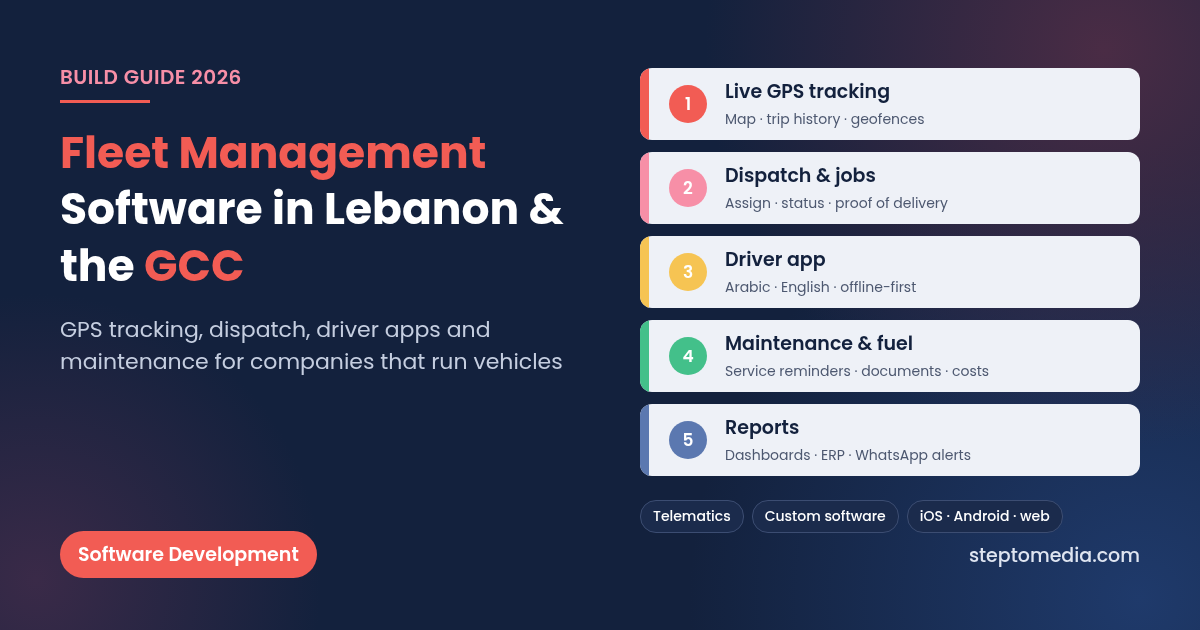
Live tracking and trip history
A live map shows every vehicle, its status (moving, idle, stopped, offline) and its current job. Trip history lets managers replay a route, check arrival times and answer client questions without calling the driver.
Dispatch and job assignment
Dispatchers create jobs, assign them to the nearest suitable vehicle or driver, and push them to the driver app. Status updates such as accepted, on the way, arrived and completed flow back automatically.
Driver app
The driver app is where most of the data comes from, so it must be simple. Typical screens include today’s jobs, navigation hand-off to Google Maps or Waze, pre-trip vehicle checklists, fuel entries with receipt photos, proof of delivery (signature, photo or code) and a button to report a breakdown or accident.
Maintenance and documents
Service reminders by date or mileage, repair logs, tyre and battery records, plus expiry alerts for registration, insurance and driver licences. This module alone often pays back the project, because missed services and expired papers are expensive surprises.
Fuel and cost tracking
Record fuel fills, fuel cards and other running costs per vehicle, then compare cost per kilometre or per trip across the fleet. Clear reports help you spot unusual consumption early.
Alerts and geofences
Draw zones around warehouses, client sites or restricted areas and get alerts when vehicles enter or leave them, idle too long, speed, or go offline.
Reports and dashboards
Managers need daily and monthly views: trips completed, on-time rate, idle time, distance, fuel and maintenance costs per vehicle, driver or branch. Exports to Excel and scheduled email reports are usually expected.
GPS Devices, Telematics or a Phone App?
There are three common ways to get vehicle data into the system:
- Driver smartphone app: shares location while the driver is on shift. It is the fastest and cheapest way to start, but tracking stops if the phone is off, out of battery or left behind.
- Dedicated GPS trackers: installed in the vehicle and powered by it, so they keep reporting regardless of the driver’s phone. Many models send data over the mobile network to the provider’s server.
- Telematics and OBD-II devices: plug into the vehicle’s diagnostic port or wiring and can report engine-related data such as ignition, mileage and, depending on the device and vehicle, fault codes and harsh driving events.
A custom platform can combine these sources. If you already pay a tracking provider, ask whether it offers an API or data feed; a custom system can often read that data instead of replacing the hardware. That kind of API integration is usually cheaper than reinstalling devices across the fleet.
Off-the-Shelf Tracking vs Custom Fleet Software
Ready-made fleet tracking tools are a good fit when you mainly need a live map and standard reports. Custom fleet management software becomes worth it when:
- Your dispatch rules are specific, for example cold-chain loads, multi-drop routes, or jobs tied to contracts and SLAs.
- Drivers and staff need a fully bilingual Arabic and English experience with right-to-left layouts.
- Fleet data must connect to your ERP, accounting, HR or warehouse systems instead of living in a separate tool.
- Your own clients need a branded portal to track their shipments or service visits.
- Per-vehicle subscription fees across a growing fleet start to outweigh the cost of owning the platform.
For a deeper comparison of the trade-offs, see custom software vs SaaS and our notes on ERP vs custom software.
What to Plan for in Lebanon and the GCC
Arabic and English from day one
Drivers, dispatchers and managers often prefer different languages. Plan both languages, RTL layouts and Arabic place names in the design rather than translating later.
Weak coverage and offline-first apps
Mountain roads in Lebanon and long highway and desert routes in the GCC can drop mobile data. The driver app should save checklists, photos and job updates on the device and sync automatically when the signal returns.
Maps and addresses
Many customers share a location pin or describe a landmark instead of a formal street address. Let dispatchers save exact pins per client site and reuse them, so drivers do not have to call for directions on every trip.
Integration with your existing systems
Fleet data becomes far more useful when it reaches the rest of the business: completed deliveries can update orders, fuel costs can post to accounting, and job statuses can notify customers on WhatsApp. Our guides on WhatsApp and ERP integration and warehouse management apps cover those links in detail.
Privacy and driver consent
Location tracking is personal data. Track during working hours, tell drivers clearly what is collected and why, restrict who can view location history, and check the data protection rules that apply in each country you operate in, such as Saudi Arabia’s Personal Data Protection Law or the UAE’s federal data protection law.
A Practical Build Plan
- Discovery: map how jobs, vehicles and drivers are handled today, which reports managers need, and which systems must connect.
- First version: live tracking, dispatch, driver app, vehicle and document records, maintenance reminders and core reports.
- Pilot: roll out to a small group of vehicles and drivers, collect feedback and fix friction in the driver app before scaling.
- Phase two: route planning, telematics integrations, client tracking portal, fuel card imports and advanced analytics.
A typical stack is a web dashboard for dispatch and management, iOS and Android driver apps (often cross-platform), a secure cloud back end with an API, and integrations with maps, tracking devices and your business systems. Our custom software development team designs the platform and back end, our mobile app development team builds the driver app, and our website development team handles client-facing portals.
What Drives the Cost?
Every fleet is different, so a fixed price without a scope is not meaningful. The main cost drivers are:
- The number of user roles and apps (dispatcher dashboard, driver app, client portal).
- Whether you use phone tracking, existing GPS devices, or new telematics integrations.
- Offline support, route planning and the depth of reports.
- Integrations with ERP, accounting, HR or WhatsApp.
- Bilingual Arabic and English design, hosting and ongoing maintenance.
For public market ranges and how agencies price projects, see our guide to custom software development cost in Lebanon.
Work With a Lebanese Software Partner
If you are comparing vendors, start with our page on choosing a software and web development company in Lebanon. When you are ready to scope your fleet platform, contact Step To Media with your fleet size, the vehicles and jobs you manage, and the systems you already use, and we will help you plan a first version that fits.
FAQ: Fleet Management Software Development
What does fleet management software do?
It gives one place to track vehicles and drivers: live location, trips, fuel, maintenance, documents and costs. A driver app captures checklists, proof of delivery and issues, and managers see dashboards and alerts instead of chasing updates by phone.
Should we buy an off-the-shelf fleet tracking tool or build custom software?
Off-the-shelf tracking tools are fast to start and fit standard needs. Custom fleet management software makes sense when your dispatch rules, Arabic and English workflows, ERP or accounting integration, or client reporting do not fit a ready-made product. Some companies start with a tracking provider and build a custom layer on top of its API.
Do we need GPS hardware, or can a phone app track vehicles?
A driver phone app can share location during shifts and is the cheapest way to start. Dedicated GPS or telematics devices keep tracking even when the phone is off and can report engine data such as ignition, mileage and harsh driving. Many fleets mix both.
Can the driver app work with weak mobile coverage?
Yes, if it is built offline-first. The app stores checklists, photos and status changes on the device and syncs them when the connection returns, which matters on mountain roads in Lebanon and long desert routes in the GCC.
How long does it take to build fleet management software?
It depends on scope. A focused first version with live tracking, a driver app, maintenance reminders and basic reports is usually planned in weeks to a few months; route optimization, telematics integrations and client portals add time. A written scope gives a reliable estimate.
No next post available