Recruitment Portal Development in Lebanon and the GCC: Jobs, Applicants, and ATS Workflows
Recruitment Portal Development in Lebanon and the GCC: Jobs, Applicants, and ATS Workflows
 8 Nov
Recruitment Portal Development in Lebanon and the GCC: Jobs, Applicants, and ATS Workflows
Employers in Lebanon and the Gulf still collect many CVs through shared inboxes and spreadsheets. Candidates want a clear way to apply and hear back; recruiters want one list of applicants. Recruitment portal development means building that product: bilingual job postings, structured applications with CV upload, a candidate pipeline with applicant tracking (ATS) workflows, and roles for recruiters, hiring managers, and candidates—connected carefully to the HR systems you already run.
This 2026 guide covers features, roles, Arabic RTL, integrations, security, mobile apply flows, custom vs packaged options, a build plan, and budgeting.
Why Employers and HR Teams Need Recruitment Portals
A careers page says “we are hiring.” A recruitment portal answers “what happened to my application” and “who should we interview next.” When that lives in email, good candidates wait and nobody sees where each role stands. Portals help when you need:
- Structured applications: the same required fields for every applicant to a role, instead of free-form emails with missing details.
- One applicant record: CV, answers, notes, and interview feedback in one place, not across several inboxes.
- Visible pipelines: recruiters and hiring managers see how many candidates sit in each stage for each role.
- Consistent communication: acknowledgements, invitations, and outcomes sent from templates.
This is different from custom internal tools for Lebanon SMEs, which cover staff portals, leave, expenses, and general approvals for people already employed. It is also different from B2B portal development for ordering and ERP sync. A recruitment portal focuses on jobs, applicants, and hiring decisions.
Core Features of Recruitment Portal Development
Scope version one around the hiring journey you will run every week:
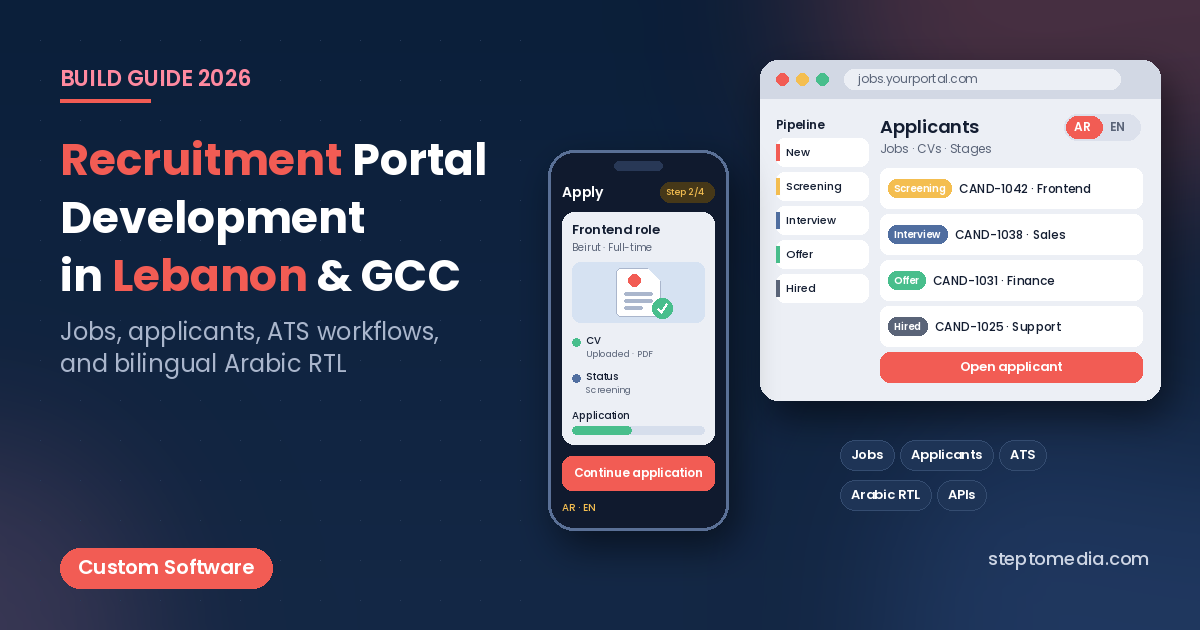
- Job posting: bilingual job pages with title, location, department, and type, editable without a developer.
- Application intake: short forms with required fields that change by role, CV/resume upload, optional cover letter, and supporting documents where a role needs them.
- Candidate pipeline: a kanban or list view with clear stages—new, screening, interview, offer, hired, rejected—and bulk actions recruiters actually use.
- Interview scheduling: propose slots, record the agreed time, and send reminders; calendar sync can come later.
- Scorecards: simple structured feedback per interview so hiring managers compare candidates on the same criteria.
Also plan email notifications, filters, duplicate detection, and basic reports such as applicants per role and time in each stage.
Candidate, Recruiter, and Hiring Manager Roles
Design roles explicitly rather than one shared login wall:
- Candidate: browse jobs, apply, upload a CV, and track status—never see other applicants.
- Recruiter: publish roles, screen applicants, move candidates between stages, schedule interviews, and send templated messages.
- Hiring manager: review shortlisted candidates for their own roles, leave scorecards, and approve or decline offers.
- Admin: configure stages, application forms, locations, email templates, and access rights.
Permissions and audit logs matter as much as screens: a hiring manager may see only their roles, while a group recruiter sees every location.
Arabic RTL and Bilingual Lebanon–GCC Hiring
Many Lebanon and GCC employers hire in Arabic and English across several countries. Treat language and location as product features:
- True RTL layouts: job pages, application forms, and status screens that flip correctly for Arabic.
- Linked language versions: each job available in AR and EN with a clear switch, not mixed scripts in one field.
- Bilingual templates: acknowledgement, interview, and outcome messages your team maintains in both languages.
- Multi-location hiring: filter roles by country and city, and route applicants to the right recruiter for Lebanon, Saudi Arabia, or the UAE.
See our guide to bilingual Arabic-English websites for RTL patterns you can reuse.
Integrations: Career Sites, HRIS, Email, and WhatsApp
A recruitment portal rarely owns the full employee record. Plan clean connections early:
- Career site: publish open roles on your main website automatically so listings never disagree.
- HRIS or ERP handoff: when a candidate is hired, pass approved details to your HR or ERP system through an API or controlled export.
- Email and WhatsApp: confirmations and interview reminders with opt-in, frequency limits, and templates your team can edit.
- Optional CV parsing: can help later; start with clean forms and human review.
See API integration for payments, ERP, and WhatsApp and WhatsApp ERP integration. Compare extending an ERP vs a focused hiring layer in ERP vs custom software.
Security, Audit Trails, and Applicant Data
CVs, ID copies, contact details, and interview notes are personal data. Design for least privilege, encrypted transport, careful file storage, clear retention periods for unsuccessful applicants, and logs for who viewed or changed each record. Collect only what each role needs. Lebanon’s Law No. 81 of 2018, Saudi Arabia’s Personal Data Protection Law, and the UAE’s Federal Decree-Law No. 45 of 2021 set personal-data rules in those markets. This is general information, not legal advice—confirm requirements with counsel where you operate.
Mobile Applications and Companion Apps
Many candidates find and apply for jobs on a phone. Make the mobile-web apply flow excellent before a native app: short steps, CV upload from the phone, saved progress, and large tap targets. When an app makes sense (job alerts via push, saved searches, recruiter approvals on the go), treat it as a companion on the same APIs. See web app vs mobile app and publishing on the App Store and Google Play. Also see why responsive web design matters and why slow websites hurt conversions.
Custom Build vs Packaged or SaaS ATS
Packaged or SaaS applicant tracking systems can be faster when your stages and integrations fit. A custom portal fits unusual hiring models, multi-entity groups, bilingual UX packaged screens cannot match, or deep HR integrations vendors lack. Many teams ship jobs, applications, and a pipeline first, then add scheduling and HRIS links. Compare custom software vs SaaS and our custom web application development guide. We do not name vendors; evaluate demos against your stages, languages, and integration checklist.
A Practical Build Plan
- Map the hiring journey: roles, locations, application fields, pipeline stages, and who may see each candidate.
- Choose build shape: configure a packaged ATS if it fits, or build custom when roles, RTL, or integrations demand it.
- Design jobs, forms, and pipeline: bilingual job pages, the mobile apply flow, recruiter and hiring-manager views, and message templates.
- Integrate carefully: career site, email, optional WhatsApp, and HR handoff—prefer stable APIs over manual re-typing.
- Pilot and harden: one department or country, audit logging, security review, then expand. Use our website launch checklist for public go-live hygiene.
Recruitment Portal Development: Cost and Timeline
We don’t quote fixed prices without a scope. Drivers include languages, locations, roles, pipeline complexity, scheduling, integrations, and security review. For budgeting see custom software development cost in Lebanon and website cost in Lebanon, plus our website development timeline. After launch, plan updates with website and app maintenance. Job pages and apply forms still benefit from website conversion UX for Lebanon SMEs.
How Step To Media Can Help
Step To Media builds websites, mobile apps, and custom software from Mkalles for clients in Lebanon and the Gulf. Explore website development, custom software development, and mobile app development. Learn more as a software and web development company in Lebanon or software development agency in Lebanon. Planning a recruitment portal? Contact us with your locations, languages, pipeline stages, and version-one integrations.
Frequently Asked Questions
What is recruitment portal development?
It means building job postings, applications with CV upload, a candidate pipeline, and recruiter and hiring-manager workflows in one tracked process instead of email and spreadsheets.
Is a recruitment portal the same as an internal HR tool?
No. Internal tools handle leave, expenses, and approvals for current staff. A recruitment portal handles jobs, applicants, interviews, and offers before someone joins.
Should we buy a packaged ATS or build a custom recruitment portal?
Configure a packaged ATS when your stages and integrations fit. Build custom when multi-location hiring, bilingual UX, or HR integrations need a focused portal packaged screens cannot deliver.
Do recruitment portals in Lebanon and the GCC need Arabic RTL?
Many do. Plan RTL job pages and forms, linked AR/EN versions of each role, and bilingual message templates your team can maintain.
When should an employer add a mobile app for hiring?
After the mobile-web apply flow works well. Add an app for job alerts, saved searches, or recruiter approvals—and feed it from the same APIs as the portal.
No next post available