Property Management Software in Lebanon and the GCC: Tenant Portals, Rent, and Maintenance Requests
Property Management Software in Lebanon and the GCC: Tenant Portals, Rent, and Maintenance Requests
 10 Nov
Property Management Software in Lebanon and the GCC: Tenant Portals, Rent, and Maintenance Requests
Property management software helps landlords, property managers, and building committees in Lebanon and the GCC run rentals without chasing tenants on the phone. Instead of rent tracked in a notebook, maintenance requests lost in WhatsApp chats, and building notices taped to the lift, tenants get a portal or app, and your team gets one place to see units, leases, payments, and open issues. This guide covers what to build and how to plan it.
Property Management Software vs a Real Estate Website
A real estate website is about marketing: listings, search filters, and enquiries from people who do not live in your buildings yet. Property management software starts after the lease is signed. Its users are existing tenants, owners, and your own staff, and its job is operations:
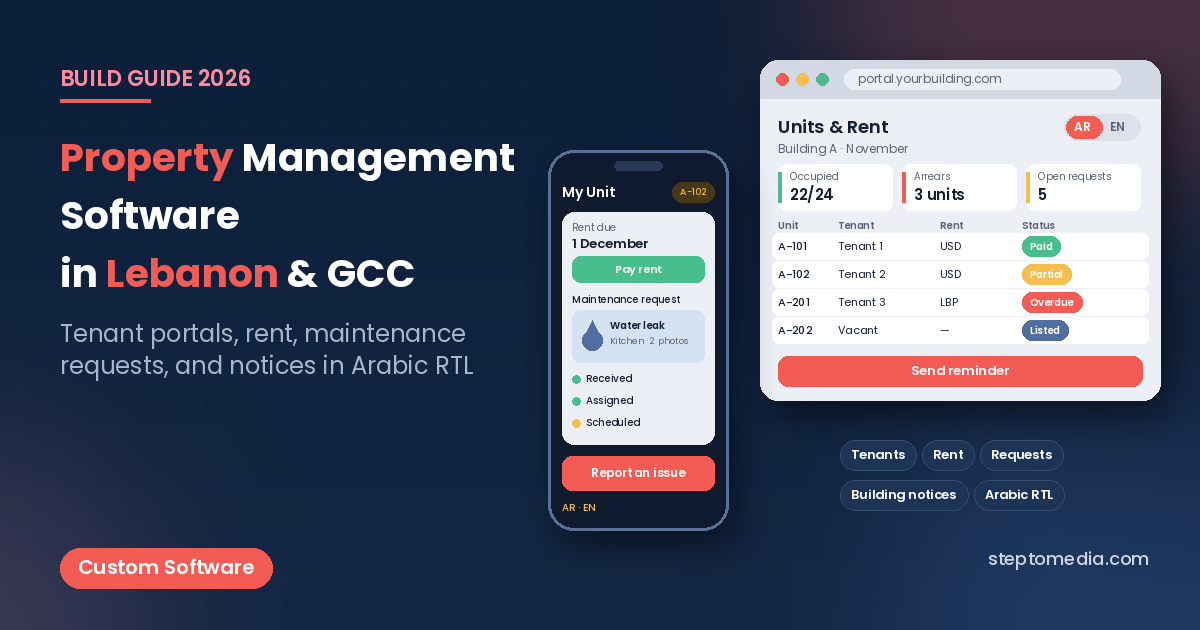
- Tenant portal or app: lease details, rent due, payment history, maintenance requests, and notices.
- Staff back office: buildings, units, leases, charges, requests, technicians, and reports.
- Owner view: for managers who run units for several owners, statements per unit and per owner.
The two can share data: a unit that becomes vacant can be published as a listing.
Who Uses It in Lebanon and the GCC
- Landlords and family offices with a few buildings and dozens of tenants.
- Property management companies running units on behalf of local and expatriate owners.
- Building committees that collect service charges and shared costs, such as generator, cleaning, and maintenance fees in Lebanese residential buildings.
- Commercial landlords with offices and shops in Beirut, Dubai, Riyadh, or Doha.
Core Features of Property Management Software
- Portfolio structure: owners, buildings, floors, units, and unit types, with occupancy status.
- Leases: start and end dates, rent amount and currency, payment frequency, deposit, renewal reminders, and signed documents.
- Charges and payments: rent, service charges, utilities, and one-off fees, with partial payments and receipts.
- Maintenance requests: tenants report issues with photos; staff assign, schedule, and close them.
- Notices: water cuts, lift maintenance, meetings, or rule changes sent to a building, a floor, or selected units.
- Reports: arrears, occupancy, expiring leases, open requests, and income per building or owner.
Tenant Portal: What Tenants Should See
The tenant side should be usable on a phone in a minute:
- A home screen with the next amount due, the due date, and a clear payment status.
- Payment history and downloadable receipts.
- A “Report an issue” button with category, description, photos, and preferred visit time.
- Request tracking: received, assigned, scheduled, done.
- Building notices and documents.
Login can be by phone number with a one-time code, which suits tenants who rarely remember passwords. Whether you start with a responsive web portal or a mobile app depends on how often tenants will use it; our guide on web application vs mobile app explains the trade-off, and good mobile app UX matters more than feature count.
Rent, Service Charges, and Payments
Money is where projects get complicated, so define the rules before design:
- Currencies: in Lebanon, leases and charges may be in US dollars, Lebanese pounds, or a mix; in the GCC, usually local currency. Store the currency on each charge, not only on the lease.
- Payment methods: cards online, bank transfers with uploaded proof, cash, and cheques, all recorded in one ledger.
- Partial payments and arrears: allocate payments to the oldest charges and send reminders around the due date.
- Deposits: track security deposits separately from rent, including deductions at move-out.
For online payments, use a payment gateway’s hosted or tokenised checkout so card data never touches your servers. Our payment gateway guide covers the options for Lebanon and the Gulf.
Maintenance Requests and Technicians
Maintenance is usually the feature tenants care about most. A good workflow has clear stages: new, assigned, scheduled, in progress, waiting for parts, and closed. Staff set priority (a water leak is not a loose handle), assign a technician or contractor, and record whether the cost goes to the tenant, the owner, or the building.
Technicians need a small mobile view: today’s jobs, access notes, before and after photos, and a “mark done” button. If your team lives in WhatsApp, notifications can go there through the WhatsApp Business API; see our notes on API integration for payments, ERP, and WhatsApp. Preventive schedules can create recurring jobs, such as lift or generator checks.
Building Notices and Communication
Notices replace the paper noticeboard and long group chats. Target them by building, floor, or unit, send them as push notifications or messages, and keep an archive. For committees, a simple “I have read this” acknowledgement helps with meetings and rule changes.
Leases, Renewals, and GCC Tenancy Registration
Store each lease as structured data, not only a PDF: dates, rent, escalation terms, and notice periods, so the system can remind you before expiry and prepare renewals. In the Gulf, tenancy contracts are registered with government systems, such as Ejari in Dubai and the Ejar platform in Saudi Arabia. At minimum, your software should store registration numbers and documents per lease; whether any direct integration is possible depends on what each authority offers to third parties, and should be confirmed during scoping.
Arabic, Bilingual, and Mobile-First Design
Tenants and owners in Lebanon and the GCC may prefer Arabic or English, and staff often switch between both. Plan a bilingual Arabic and English interface with proper RTL from the start, including notices and receipts in both languages.
Custom Build or Ready-Made Software?
Ready-made tools can work for a standard rental portfolio. A custom build makes more sense when you need mixed currencies, service charges split by building rules, statements for many owners, proper Arabic RTL, or accounting and ERP integration. Our comparisons of custom software vs SaaS and ERP vs custom software help you decide. We do not name vendors; we help you compare against your own requirements.
A Practical Build Plan
- Map your portfolio and processes: buildings, units, charge types, payment methods, and who approves what. A clear custom software brief saves weeks later.
- Start with an MVP: units, leases, charges, payments, and maintenance requests. Add owner statements, preventive maintenance, and advanced reports next.
- Pilot one building: test with real tenants and technicians, then roll out.
- Plan support: backups, security updates, and app store releases; see our website and app maintenance guide.
If you also run renovations, our guide to construction management software covers the project side.
Property Management Software: Cost and Timeline
We don’t quote fixed prices without a scope. Cost depends on the number of user roles (tenants, owners, staff, technicians), whether you need a web portal only or mobile apps too, payment and accounting integrations, data migration, and Arabic and English content. Our custom software development cost guide and MVP development guide explain how scope drives budget and timeline.
How Step To Media Can Help
Step To Media is a software and web development company in Lebanon working with clients in Lebanon and the GCC. As a software development agency in Lebanon, we build custom software, tenant-facing web portals, and mobile apps for iOS and Android, in Arabic and English. If you are planning property management software, contact us with your portfolio size and current process, and we will help you define a realistic first version.
Frequently Asked Questions
What is property management software?
Property management software is a system for running rental properties after the lease is signed. It tracks buildings, units, leases, rent and service charges, payments, maintenance requests, and notices, and usually includes a tenant portal or app plus a back office for staff.
Do tenants need a mobile app, or is a web portal enough?
Many projects start with a responsive web portal with phone number login. A mobile app makes sense when tenants use it often, for example for maintenance requests and push notifications.
Can property management software handle US dollars and Lebanese pounds?
Yes, if it is designed for it. Each charge and payment should store its own currency, and reports should show balances per currency, so mixed USD and LBP leases or service charges stay accurate.
Can tenants pay rent online?
Yes, through a payment gateway’s hosted or tokenised checkout. The system should also record bank transfers, cash, and cheques in the same ledger.
How much does property management software cost in Lebanon?
We don’t quote fixed prices without a scope. Cost depends on user roles, web portal vs mobile apps, integrations, data migration, and bilingual content.
No next post available