Gym Membership App Development in Lebanon and the GCC: Classes, Check-In, and Subscriptions
 1 Nov
Gym Membership App Development in Lebanon and the GCC: Classes, Check-In, and Subscriptions
Many gyms, fitness studios, and sports clubs in Lebanon and the Gulf still sell memberships at the front desk, take class bookings over WhatsApp, and check members in against a paper list or a spreadsheet. That breaks once classes fill up and renewals slip. Gym membership app development means building a member app and an admin dashboard that handle plans, renewals, class booking, check-in, and payments in one place.
This guide covers build options, core features, check-in, app store payment rules, integrations, and a build plan for 2026.
Ready-Made Gym Software or a Custom App?
Subscription gym platforms are quick to set up and suit a single gym with standard plans. A custom app, or a custom layer on top of existing tools, makes more sense when:
- Your plans are specific: family and corporate memberships, class packs, off-peak access, student rates, or memberships that work across several branches.
- You want your own brand in the stores: a member app under your gym’s name, not a shared marketplace app.
- You need local payments and languages: Arabic and English, cash at the desk alongside card payments, and the gateways that actually work in your country.
- You need connections the platform lacks: access gates, your accounting system, WhatsApp reminders, or a loyalty program shared with a café or shop.
If a platform fits, start there and build only the gaps; our guide to custom software vs SaaS explains the trade-off.
Core Features of a Gym Membership App
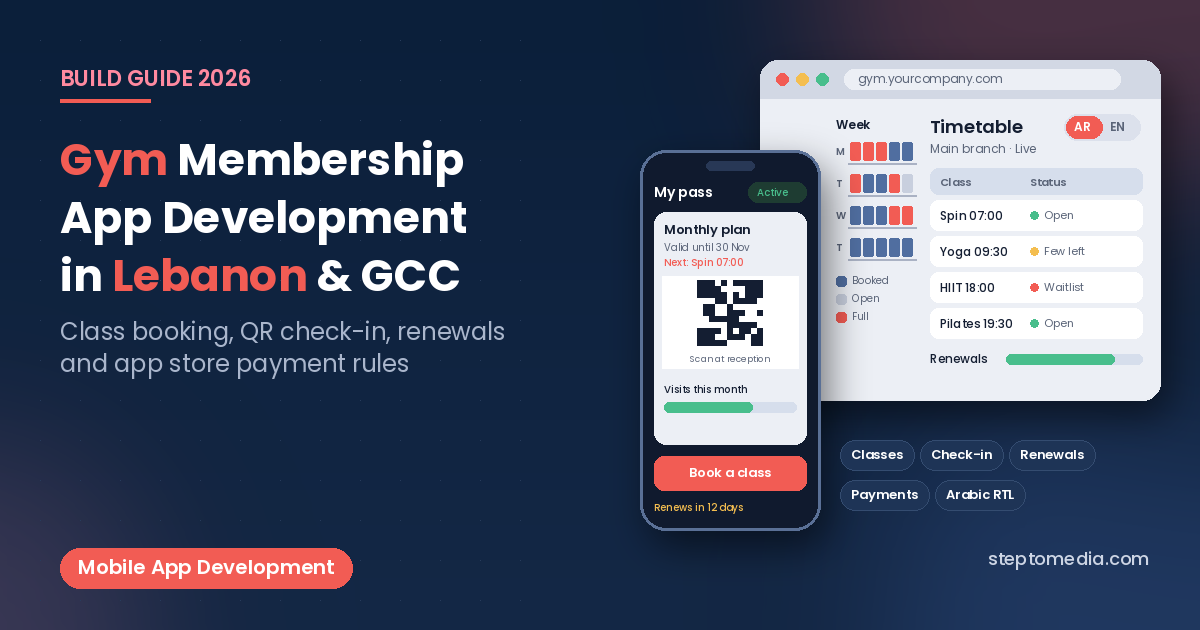
A gym app has two sides: the member app on iOS and Android, and a web dashboard for staff and managers.
- Membership plans: monthly, quarterly, and yearly plans, class packs, trial passes, freezes for travel or injury, and upgrades or downgrades.
- Renewals and reminders: expiry dates, renewal reminders by push notification or WhatsApp, and a clear list of overdue members for the front desk.
- Class schedule and booking: weekly timetables per branch, capacity limits, waitlists that promote the next member automatically, and cancellation cut-offs.
- Check-in: a QR code in the app or a wallet pass, scanned at reception or at an access gate.
- Trainers and personal training: trainer profiles, session packs, and booking one-to-one sessions.
- Manager dashboard: active members, renewals due, class occupancy, no-shows, and revenue by plan and branch.
Classes and memberships are different from one-to-one appointments. If your business mainly books individual time slots, as clinics and salons do, see our guide to booking system development instead.
Check-In: QR Codes, Wallet Passes, and Access Gates
The simplest check-in is a QR code in the member app that reception scans with a tablet. The code should change regularly or be tied to the member’s account so it can’t be shared by screenshot, and the scan should show at once whether the membership is active, frozen, or expired.
Wallet passes are another option. Apple lists a gym membership card as an example of a generic pass in Apple Wallet, and Google Wallet’s generic pass supports membership cards, so members can check in without opening the app. If you use turnstiles or door controllers, the app’s backend can approve or deny entry through the hardware vendor’s API. The same scanning ideas appear in our guide to event ticketing app development.
Payments and App Store Rules
Google Play’s payments policy says its billing system must not be used for physical services and lists gym memberships as an example. Apple’s App Store Review Guidelines say that physical goods or services consumed outside the app must use payment methods other than in-app purchase, such as Apple Pay or card entry. In practice, in-person memberships and classes are paid through your own payment gateway.
Digital content is different. If you sell on-demand workout videos or a content subscription inside the app, both stores generally require their own in-app purchase systems. Plan your product mix before you design checkout, and read our guide to publishing on the App Store and Google Play for the review process.
For the gateway itself, check which providers support recurring or saved-card payments in your market. Our guide to payment gateways for websites and apps in Lebanon covers the options. Many gyms in Lebanon still take cash, so the desk should record cash and card payments against the same membership.
Integrations
- Accounting or ERP: push payments and invoices.
- WhatsApp and push notifications: booking confirmations, waitlist alerts, and renewal reminders, sent only to members who agreed to receive them.
- Access control: gates or door controllers at each branch.
- Health data: optionally, workouts from Apple HealthKit or Android’s Health Connect, with clear permission.
Our API integration guide explains how to scope these connections. If you also offer workout videos, they can later extend to a TV app for members training at home.
Arabic, Multi-Branch, and Data Protection
Members in Lebanon and the Gulf may prefer Arabic, English, or both, so plan right-to-left layouts, bilingual class names, and Arabic notifications from the start; our guide to bilingual Arabic and English websites covers the basics. Chains need branch-level schedules, staff roles that only see their branch, and reports across all branches.
Gym apps hold personal and sometimes health-related data, so collect only what you need and secure it. Apple’s guidelines treat health and fitness data as especially sensitive and restrict using it for advertising. Lebanon’s Law No. 81 of 2018 on electronic transactions and personal data, Saudi Arabia’s Personal Data Protection Law, and the UAE’s Federal Decree-Law No. 45 of 2021 set rules for personal data. This is general information, not legal advice.
A Practical Build Plan
- Map your plans and rules: every membership type, freeze and cancellation rules, class capacity, and how cash payments are handled today.
- Choose check-in and payments: QR at reception, wallet passes, or gates, and a gateway that works in your market.
- Design the member journey: sign-up, buying a plan, booking, and check-in, tested with real members. Our guide to mobile app UX covers the essentials.
- Build version one: plans, renewals, class booking, check-in, and the staff dashboard. A cross-platform framework, compared in our Flutter vs React Native guide, keeps one codebase for iOS and Android.
- Pilot in one branch, migrate existing members, then add trainers, integrations, and reports.
Gym Membership App Development: Cost and Timeline
We don’t quote fixed prices without a scope. The main factors are the number of plans and rules, branches, check-in hardware, payment gateway and recurring billing, integrations, languages, and whether you sell digital content. For general budgeting, see our guide to custom software development cost in Lebanon, and plan for updates after launch with our guide to website and app maintenance.
How Step To Media Can Help
Step To Media builds websites, mobile apps, and custom software from Mkalles for businesses in Lebanon and the Gulf. Explore our mobile app development, custom software development, and website development services. You can also learn more about us as a software and web development company in Lebanon, or see how we work as a software development agency in Lebanon. Planning a gym or studio app? Contact us with your branches, membership types, and how members book and pay today.
Frequently Asked Questions
What is a gym membership app?
A gym membership app is a member-facing mobile app plus a staff dashboard that manages membership plans, renewals, class booking, check-in, payments, and reports for a gym, studio, or sports club.
Can gym memberships be paid through Apple or Google in-app purchase?
Generally no. Google Play lists gym memberships as physical services that must not use its billing system, and Apple requires services consumed outside the app to use other payment methods. Digital content such as workout videos usually does use in-app purchase.
How do members check in with a gym app?
Usually with a QR code in the app or a wallet pass that reception scans with a tablet. The app can also connect to turnstiles or door controllers through the hardware vendor’s API.
Can one app handle several branches?
Yes. A multi-branch app can have separate schedules, staff, and capacity per branch, memberships valid at one or all branches, and reports for each branch and the whole chain.
How is a gym app different from a booking system or loyalty app?
A booking system manages one-to-one appointments such as clinic or salon visits. A loyalty app rewards repeat purchases with points. A gym app manages recurring memberships, group classes with capacity and waitlists, and check-in.
No next post available