Insurance Claims Portal Development in Lebanon and the GCC: FNOL, Tracking, and Adjusters
Insurance Claims Portal Development in Lebanon and the GCC: FNOL, Tracking, and Adjusters
 7 Nov
Insurance Claims Portal Development in Lebanon and the GCC: FNOL, Tracking, and Adjusters
Insurers and brokers in Lebanon and the Gulf still take many claims by phone, email, and paper. Policyholders want one place to file, upload documents, and see status. Insurance claims portal development means building that product: first notice of loss (FNOL), roles for policyholders, brokers, and adjusters, bilingual Arabic/English flows, and careful links to policy and payment systems—without a full core-policy rewrite.
This 2026 guide covers core features, roles, Arabic RTL, integrations, security, mobile companions, custom vs packaged options, a build plan, and budgeting via public market guides.
Why Insurers and Brokers Need Claims Portals
A brochure site answers “who we are.” A claims portal answers “what happens to my claim.” When that path is slow or opaque, call centres fill with status questions and documents get lost between inboxes. Portals help when you need:
- Self-service FNOL: structured intake instead of free-form emails that miss required fields.
- Fewer status calls: policyholders and brokers see where a claim sits without ringing the desk.
- Cleaner handoffs: adjusters and internal teams work from one case record, not scattered attachments.
- Auditability: who uploaded what, who approved what, and when—useful for compliance conversations.
Related patterns appear in custom internal tools for Lebanon SMEs and B2B portal development—those cover workflows and ordering; claims portals add FNOL, evidence, and adjuster steps.
Core Features of Insurance Claims Portal Development
Scope version one around the claims journey you will run every day:
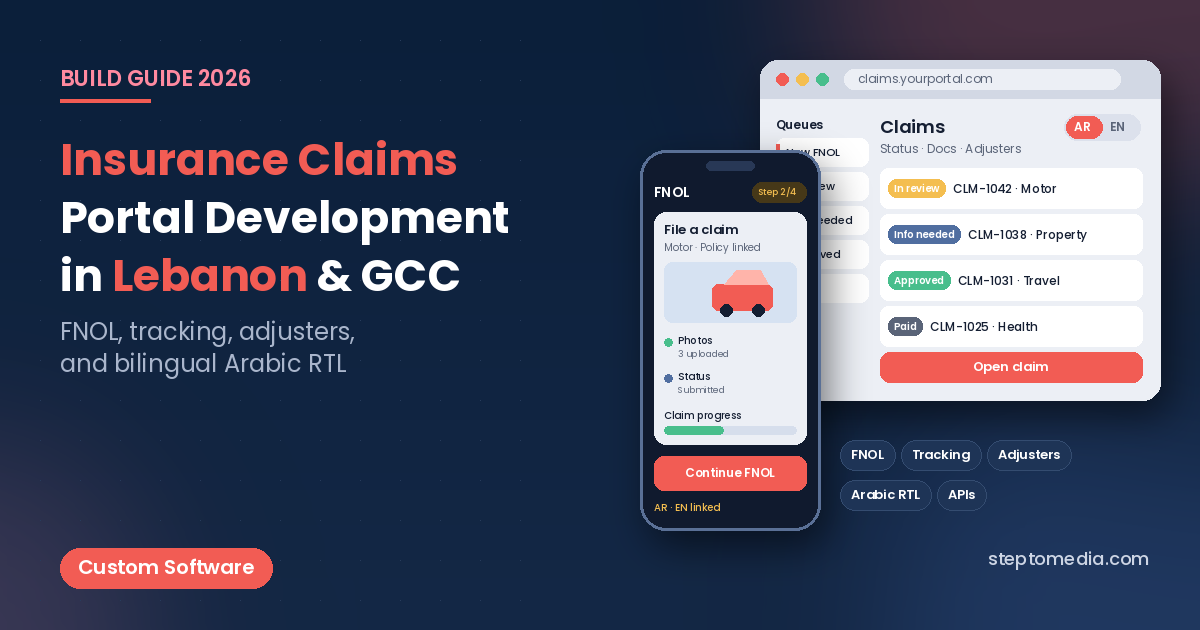
- FNOL intake: policy lookup or reference entry, loss type, date/location, narrative, and required fields that change by line of business.
- Document upload: photos, PDFs, police or medical reports, with size limits, virus scanning where you operate it, and clear labels for each file.
- Status tracking: a simple timeline (submitted, under review, information requested, approved, paid, closed) visible to the right roles.
- Adjuster workflows: assignment, notes, requests for more information, and decision capture without editing the public story.
- Payments and settlements: when you pay out digitally, keep checkout short and auditable—see our payment gateway guide. Wallet-style UX is a separate track from fintech app development, not a second product in version one.
Also plan notifications (email and optionally WhatsApp), a path to supply missing files, and basic volume/ageing reports.
Policyholder, Broker, and Adjuster Roles
Design roles explicitly rather than one shared login wall:
- Policyholder: file FNOL on their policies, upload evidence, answer information requests, and see status—not other people’s claims.
- Broker / intermediary: file or assist for clients they represent, see portfolio queues, and receive alerts when underwriters need more data.
- Adjuster / claims staff: work queues, assign cases, request documents, record assessments, and push status changes that the portal reflects.
- Admin: configure loss types, required documents, templates, and access.
Permissions and audit logs matter as much as screens. Specialise fields for claims—not for ERP ordering catalogues.
Arabic RTL and Bilingual Lebanon–GCC Portals
Many Lebanon and GCC audiences expect Arabic-first or AR/EN. Treat language as a product feature:
- True RTL layouts: FNOL forms, timelines, document lists, and dashboards that flip correctly for Arabic.
- Linked language versions: clear AR/EN switches for help text and status labels, without mixing scripts in one messy field where it hurts readability.
- Bilingual notifications: email and WhatsApp templates your ops team can maintain in both languages.
- Readable mobile typography: long Arabic instructions must stay usable on small screens after a loss event.
See our guide to bilingual Arabic-English websites for RTL patterns you can reuse.
Integrations: Policy Systems, Payments, and Messaging
A claims portal rarely owns the full policy database. Plan clean connections early:
- Core policy / PAS reads: validate coverage, policy numbers, and insured parties through authenticated APIs—or controlled file sync if APIs are not ready.
- Payments: settlement payouts or premium top-ups through a gateway that fits your entity and currencies.
- WhatsApp and email: status and “please upload” messages with frequency caps and templates ops can edit.
- Optional document assist: OCR can help later; start with labelled uploads and human review before promising automated extraction.
See API integration for payments, ERP, and WhatsApp and WhatsApp ERP integration. Compare extending an ERP vs a focused claims layer in ERP vs custom software.
Security, Audit Trails, and Personal Data
Claims files hold identity documents, medical details, addresses, and financial data. Design for least privilege, encrypted transport, careful storage, clear retention, and immutable logs for uploads and decisions. Collect only what each loss type needs. Lebanon’s Law No. 81 of 2018, Saudi Arabia’s Personal Data Protection Law, and the UAE’s Federal Decree-Law No. 45 of 2021 set personal-data rules in those markets. This is general information, not legal advice—confirm requirements with counsel where you operate.
Mobile and Companion Apps
Most FNOL starts on a phone browser. Make mobile web excellent before a native app: camera uploads, resilient progress where you can, and large tap targets. When an app makes sense (push, offline draft FNOL, store distribution), treat it as a companion on the same APIs. See web app vs mobile app and publishing on the App Store and Google Play. Also see why responsive web design matters and why slow websites hurt conversions.
Custom Build vs Packaged or SaaS Claims Suites
Packaged or SaaS suites can be faster when processes and connectors fit. A custom portal fits unusual broker models, bilingual UX packaged screens cannot match, or deep integrations vendors lack. Many teams ship focused FNOL and tracking first, then deepen policy links. Compare custom software vs SaaS and our custom web application development guide. We do not name vendors; evaluate demos against your FNOL and integration checklist.
A Practical Build Plan
- Map the claims journey: lines of business, FNOL fields, documents, statuses, and who may see each claim.
- Choose build shape: configure a packaged suite if it fits, or a custom portal when roles, RTL, or integrations demand it.
- Design FNOL and queues: bilingual forms, policyholder/broker/adjuster views, and notification templates.
- Integrate carefully: policy reads, payments if needed, and messaging—prefer stable APIs over brittle mailbox scraping.
- Pilot and harden: one line of business, audit logging, security review, then expand. Use our website launch checklist for public go-live hygiene.
Insurance Claims Portal Development: Cost and Timeline
We don’t quote fixed prices without a scope. Drivers include languages, roles, FNOL complexity by line of business, documents, payments, integrations, and security review. For budgeting see custom software development cost in Lebanon and website cost in Lebanon, plus our website development timeline. After launch, plan updates with website and app maintenance. FNOL forms still benefit from website conversion UX for Lebanon SMEs.
How Step To Media Can Help
Step To Media builds websites, mobile apps, and custom software from Mkalles for clients in Lebanon and the Gulf. Explore website development, custom software development, and mobile app development. Learn more as a software and web development company in Lebanon or software development agency in Lebanon. Planning a claims portal? Contact us with lines of business, languages, roles, and version-one integrations.
Frequently Asked Questions
What is insurance claims portal development?
It means building FNOL, document upload, status tracking, and adjuster workflows so policyholders, brokers, and claims staff share one structured journey instead of email and paper.
Do claims portals in Lebanon and the GCC need Arabic RTL?
Most do. Plan RTL forms and timelines, bilingual notifications, and AR/EN labels ops can maintain—not a last-minute translation layer.
Should we buy a packaged claims suite or build custom?
Configure a suite when process and connectors fit. Build custom when broker models, bilingual UX, or integrations need a focused portal packaged screens cannot deliver.
What integrations matter first for a claims portal?
Policy or coverage reads, notifications (email and optionally WhatsApp), and payments if you settle digitally. Add OCR only after labelled uploads and human review work reliably.
When should an insurer add a mobile app for claims?
After mobile-web FNOL works well. Add an app for richer push, offline drafts, or store distribution—and feed it from the same APIs as the portal.
No next post available